Sufi Mysticism in Art: Whirling Dervishes, Rumi, and the Persian Visionary Tradition
At the center of Islamic civilization, running through its heart like a hidden river, flows a current of mystical experience that the religion's more legalistic forms have often tried to contain and sometimes to suppress — and that has always found a way to express itself anyway, in poetry, in music, in the ecstatic turning of the body, and in some of the most exquisite visual art ever produced in the history of human civilization. This current is Sufism — tasawwuf in Arabic — the inner dimension of Islam, its esoteric heart, the path of direct experience of the divine that runs alongside and sometimes athwart the path of law and doctrine.
The name's origins are debated: some derive it from suf (wool), referring to the coarse woolen garments worn by early Muslim ascetics; others from safa (purity); others from the Greek sophia (wisdom). What is not debated is what Sufism seeks: fana — annihilation of the ego in the divine Beloved — and baqa — subsistence in that unity, the state of living in the world while knowing oneself to be, at the deepest level, nothing other than the divine reality that breathes through all things.
The greatest poet of this path — perhaps the greatest mystic poet in any language — was Jalal al-Din Muhammad Rumi (1207–1273), a Persian scholar and jurist who was utterly transformed by his encounter with the wandering dervish Shams-i Tabrizi in 1244. The two men spent months in spiritual conversation of such intensity that Rumi's family and students grew alarmed and eventually drove Shams away. When Shams disappeared — probably murdered by jealous disciples — Rumi poured his grief and longing into poetry that filled six volumes of the Divan-e Shams and the six-book Masnavi, still considered the greatest work of Persian literature and among the greatest mystical texts ever written in any language. The Masnavi's opening line — a lament of the reed flute cut from its reed bed, crying for its origin — is one of the most compressed spiritual teachings in existence: we are all cut from our source, and all our longing, all our suffering, is the sound of that separation.
After Rumi's death, his son Sultan Walad formalized the spiritual community around his father's legacy into the Mevlevi Order — the order of the whirling dervishes. The Sema ceremony — the ritual turning that is the order's central practice — was formalized as a cosmic meditation in movement: the dervish's white robe represents the shroud of ego death; the tall felt hat (sikke) represents the tombstone of the ego; the turning itself represents the revolution of the soul around the divine center, as the planets turn around the sun and electrons around the nucleus. One hand is raised to receive divine grace; the other is lowered to transmit it to the earth. The dervish becomes a channel.
The images in this gallery move between the living tradition of the Sema — photographed in Turkey and Egypt, where the Mevlevi and related orders still practice — and the Persian miniature tradition that surrounded and illustrated the Sufi literary legacy. These miniatures — jewel-like, precise, impossibly detailed — are among the supreme achievements of Islamic visual art, and they encode, in their luminous figures and paradisiacal garden settings, the same vision that Rumi encoded in his poetry: a world saturated with divine beauty, in which every face is a mirror of the Beloved.

Whirling dervishes in Sema ceremony — the Mevlevi Order's central ritual; the turning begins slowly and deepens as the dervish enters meditative absorption; experienced practitioners describe the state as a form of moving meditation in which the boundary between self and divine presence becomes thin; the ceremony lasts approximately one hour and passes through four selams (salutations) representing stages of spiritual knowledge

Dancing dervishes — Rijksmuseum collection, Amsterdam; European artists of the 17th and 18th centuries were fascinated by the Mevlevi Sema, which they documented with a mixture of admiration and incomprehension; the ritual seemed to them simultaneously athletic, theatrical, and genuinely otherworldly — which is precisely what it is designed to be

Mevlevi dervishes bowing in unison during the Sema ceremony — the bow (*devran*) between the turning sequences is an expression of submission and mutual recognition among the practitioners; each bows to the divine light within the other, seeing not the person but the soul; this is the Sufi teaching of *wahdat al-wujud* (unity of being) made visible in gesture

Dervishes in Avanos, Cappadocia — central Turkey; the Mevlevi Order traces its origin to Konya, where Rumi lived, taught, and is buried; the landscape of Cappadocia — its extraordinary geological formations, its ancient Christian cave churches, its deep sense of time — provides a fitting backdrop for a practice that is itself about moving through time into the timeless

Tanoura dancer, Egypt — the Egyptian Sufi whirling tradition uses the spinning of multi-layered colored skirts and cloth panels as a visual mandala of movement; the dancer spins cloth over his head, creating a dome of color that mirrors the cosmic dome; the Egyptian Tanoura is more theatrical than the Mevlevi Sema but draws from the same spiritual root: the body as axis, movement as prayer
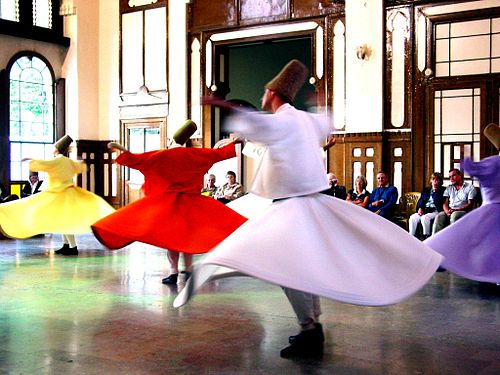
Whirling dervishes — white robes extended, eyes half-closed; the tall brown felt hat (*sikke*) worn during the Sema represents the tombstone of the ego; the white robe (*tennure*) represents the shroud; the black cloak (*hirka*) worn before the turning begins represents the tomb itself; when the dervish removes the black cloak and begins to turn in white, it enacts the resurrection of the soul from ego-death

Whirling dervish in motion — the turning of the Sema follows a precise cosmological metaphor articulated by Rumi: the dervish turns as the earth turns on its axis, as the planets turn around the sun, as electrons turn around the nucleus; the revolution is not chaos but the fundamental movement of all existence around its divine center; the practitioner does not create the turning — they submit to it
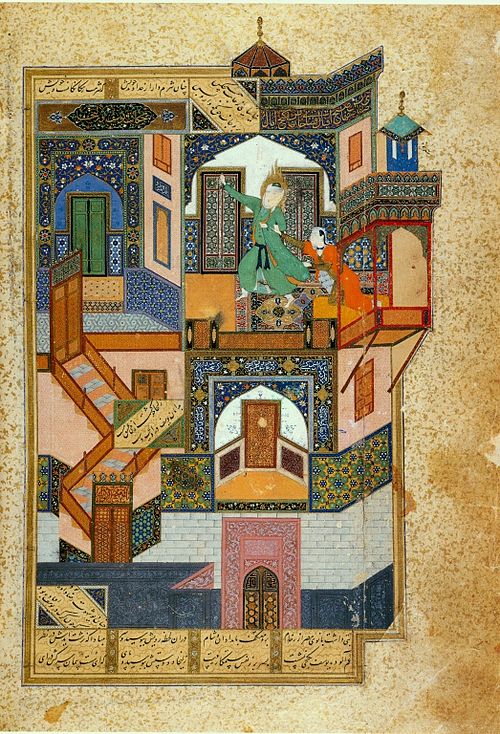
Yusuf and Zulaykha — Persian miniature; the story of Joseph and Potiphar's wife, transformed by Sufi poets (especially Jami) into an allegory of the soul's love for divine beauty: Zulaykha represents the soul consumed by longing for the beautiful; Yusuf represents the divine Beloved in human form; the story of obsessive human love becomes a map of the mystical path

Battle scene — Varka and Golshah manuscript, 13th century Seljuk Anatolia; one of the earliest surviving illustrated Persian manuscripts, combining the conventions of pre-Islamic Iranian art with the developing Islamic miniature tradition; the story is a tragic romance that Sufi readers interpreted allegorically — the separation of the lovers as the soul's separation from the divine, the battle as the struggle of the ego against surrender

Demotte Shahnameh illustration — 14th century, one of the great Persian illustrated manuscripts; the Shahnameh (Book of Kings) of Ferdowsi is the national epic of Iran, but Sufi readers have always found within its heroes and monsters a spiritual geography: the hero's journey through darkness and monsters toward a kingdom of light mirrors the soul's path through the ego's territories toward divine recognition

Miniature by Junaid — 14th century master of the Baghdad school of Persian painting; Junaid's work represents the height of the classical Jalayirid style, in which figures of impossible delicacy inhabit paradisiacal gardens; the garden (*bustan*) in Persian mystical poetry is the world seen through the eye of the divine: every flower the face of the Beloved, every stream the flow of grace


Comentarios