The Egyptian Book of the Dead: Spells, Judgment, and the Journey to the Afterlife

In the museums of Cairo, London, Paris, and New York, in climate-controlled cases with precisely calibrated lighting, lie some of the most extraordinary documents in human history: papyrus scrolls, painted in vivid pigments that have survived three and a half millennia, filled with hieroglyphic text and luminous illustrations depicting the most audacious project the human imagination has ever undertaken — a detailed, operational manual for surviving death. These are the papyri of what we call the Egyptian Book of the Dead, and they are the culmination of a tradition of funerary literature stretching back to the Old Kingdom Pyramid Texts of 2400 BCE: the ancient Egyptian belief that death is not an ending but a passage, and that the correct knowledge — the right spells, the right divine names, the right answers to the challenges of the underworld — could guide a soul safely through the treacherous terrain of the Duat (the Egyptian underworld) to a state of eternal existence in the presence of Osiris and the gods.
The title we use — "Book of the Dead" — is a German Egyptologist's coinage from the early nineteenth century. The ancient Egyptians called it Reu nu pert em hru: "The Spells of Coming Forth by Day." This name reveals the document's purpose far more accurately: it is not a meditation on death but a guide to the light, a collection of spells that empower the deceased to "come forth by day" — to move freely through the underworld, to transform into any form they desire, to speak the correct words before every gate and every guardian, and ultimately to emerge into the eternal day of the Field of Reeds (Aaru), the Egyptian paradise, where they would live as a perfect being (Akh) in the company of the gods.
The tradition of Egyptian funerary literature goes back much further than the papyrus scrolls most people associate with the "Book of the Dead." The Pyramid Texts — the world's oldest religious texts that survive in written form — were inscribed on the interior walls of royal pyramids beginning around 2400 BCE. These spells were initially the exclusive property of pharaohs, whose divine nature made them automatically worthy of ascension to the stars after death. By the Middle Kingdom (2000–1650 BCE), the tradition had been democratized — wealthy nobles began commissioning Coffin Texts, inscribed on the interior of wooden coffins, that adapted royal funerary spells for private use. By the New Kingdom (1550–1070 BCE), the tradition had been democratized further and committed to papyrus: anyone who could afford to commission the scroll could access its protective magic. The most famous surviving papyrus — the Papyrus of Ani, held in the British Museum — was produced around 1250 BCE for a royal scribe named Ani and his wife Tutu, and at 78 feet (24 meters) in length, it is one of the longest and most beautifully illustrated examples of the tradition.
The structure of the Book of the Dead is not linear in the way a modern narrative is. It is a repository — a collection of approximately 192 distinct chapters or "spells" (rw) — from which the scribe composing a particular papyrus would select the spells most appropriate to the client. No two papyri are identical: the selection, ordering, and illustration of spells was customized for each individual. Some spells address specific practical needs — Spell 6 animated the ushabti figurines placed in the tomb to do agricultural labor on the deceased's behalf in the afterlife; Spell 30B commanded the heart not to testify against its owner during the Judgment; Spell 125 provided the "Declaration of Innocence" (sometimes called the "Negative Confession") that the deceased was required to recite before the forty-two divine judges. Other spells grant more exotic powers: Spell 76 allows transformation into any divine form; Spell 77 transforms the deceased into a golden falcon; Spell 81 transforms them into a lotus flower; Spell 83 into a phoenix (benu bird).
The theological center of the Book of the Dead — and its most visually striking chapter — is Spell 125: The Weighing of the Heart. This is the great judgment scene that has become the most iconic image of ancient Egyptian spirituality: in the Hall of Two Truths (Maati), before the god Osiris seated on his throne and surrounded by forty-two divine assessors, the heart of the deceased is placed on one pan of a great scale. On the other pan sits a feather — the feather of Ma'at, the goddess of truth, justice, and cosmic order. Thoth, the ibis-headed god of writing and wisdom, records the result. The monstrous Ammit — part lion, part hippopotamus, part crocodile — crouches beneath the scale, waiting to devour the heart of anyone whose misdeeds outweigh the feather of truth. If the heart is lighter than the feather — if the life lived has been in alignment with Ma'at — the deceased passes the judgment and proceeds to eternal life. This scene encodes a complete moral theology: the idea that the quality of an earthly life is literally weighed in the balance, and that cosmic justice is an absolute principle from which no being, not even the dead, can escape.
The Egyptian concept of the person is far more complex than the simple body-soul dualism of later Western thought. The ancient Egyptians recognized multiple components of the self, each with its own role in the afterlife journey. The Ka was the vital life-force, the double of the person, which remained in the tomb and required regular offerings of food and drink. The Ba — often depicted as a human-headed bird — was the mobile soul that could travel between the tomb and the world of the living, and that undertook the journey through the underworld. The Akh — achieved only through successful completion of the funerary rites and passage of the judgment — was the fully transformed, glorified form of the person, a being of pure light existing in eternal communion with the gods. The Ren (name) and the Sheut (shadow) also played roles in identity and survival. The Book of the Dead addressed all of these components, providing spells to protect the Ka, guide the Ba, and achieve the transformation into the Akh.
The visual program of the illuminated papyri is inseparable from the verbal program of the spells. In the most elaborate manuscripts, virtually every chapter is accompanied by an illustration that depicts the action described in the text — the deceased standing before a gate and speaking the gate's name; the heart being weighed against the feather of Ma'at; the soul in the form of a bird perching on the mummy; the Field of Reeds showing the deceased farming the divine land in an eternal paradise of grain and water. These are not decorative additions to the text but parallel modes of the same protective magic: image and word working together to make the reality they depict. The ancient Egyptian word for "spell" (heka) was also the word for "magic" — because in the Egyptian understanding, correctly spoken and correctly visualized, words and images had the power to create the realities they described. A spell drawn perfectly and spoken correctly was not a petition to the gods but a direct intervention in the fabric of reality.
The deities of the underworld depicted in Book of the Dead papyri form a cast of extraordinary characters. Osiris, the murdered and resurrected god of the dead, is both judge and exemplar: because he himself died, was dismembered, reassembled by his sister-wife Isis, and reborn, every deceased Egyptian participates in his myth, becoming "the Osiris" before Osiris's own throne. Anubis, the jackal-headed god of embalming and mummification, accompanies the soul through the underworld and presides over the weighing of the heart. Thoth, divine scribe, records the judgment and guides the soul with his wisdom. The Field of Reeds itself — shown in several papyri as an idealized Nile landscape with lush vegetation, canals, and standing grain — is recognizably the Egyptian world made permanent and perfect: the afterlife as the best version of the life one already knows.
The knowledge encoded in the Book of the Dead did not stop circulating with the decline of ancient Egyptian civilization. Through the Hermetic and Gnostic traditions of late antiquity, through the Neoplatonist synthesis of Egyptian and Greek wisdom, and through the nineteenth-century translation and publication of the great papyri by scholars like Karl Richard Lepsius (whose 1842 publication introduced the text to the Western world), elements of Egyptian afterlife theology have flowed into the esoteric traditions of the modern West. The idea of a post-mortem judgment in which the ethical quality of a life is assessed, the practice of preparing the soul with knowledge and invocations, the vision of the afterlife as a perfected mirror of earthly life — these themes echo through Western occultism, Theosophy, and the New Age traditions that have drawn so deeply on ancient Egyptian sources.
The images in this gallery draw from the great surviving papyri — the Ani Papyrus, the Hunefer Papyrus, the Pinedjem Papyrus, and others held in the British Museum and museums across the world — as well as from inscribed pyramid and tomb walls. Together they form a map of the ancient Egyptian afterlife: from the gates and guardians of the Duat, through the terrifying moment of the Weighing of the Heart, to the serene eternity of the Field of Reeds, where the blessed dead walk forever under the eye of Osiris, perfectly preserved, perfectly known, perfectly alive.

Book of the Dead — hieroglyphic text and vignette on papyrus; the combination of text and illustration is central to the Book of the Dead tradition: spells and images worked together as parallel modes of protective magic, each reinforcing the other's power; the hieroglyphic script itself was considered sacred — the Egyptians called it 'the words of the gods' (mdw ntr), and each sign was believed to carry the power of the thing it depicted

Hieroglyphic text from the Pyramid of Teti I — one of the earliest examples of funerary literature, the Pyramid Texts date to c. 2400 BCE and represent the ancestor tradition from which the Book of the Dead descended; carved into the limestone walls of the burial chamber and painted in vivid pigments, these texts were the exclusive property of pharaohs — the democratic diffusion of this knowledge to ordinary Egyptians would come centuries later
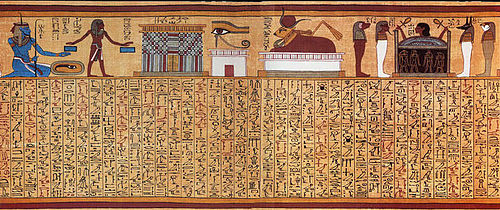
Book of the Dead, Spell 17 — one of the most theologically complex chapters, Spell 17 addresses the nature of the sun god and the transformation of the deceased into a divine form; its cryptic utterances prompted extensive commentary in ancient times, and the illustrated vignette above the text — showing the deceased playing the board game Senet, often interpreted as a metaphor for navigating the fortunes of the afterlife — is among the most visually enigmatic images in the entire tradition

Book of the Dead, Spells 79-80 — chapters addressing transformation and the use of divine names; knowledge of divine names was understood in ancient Egypt as a form of power — to know the true name of a god or a guardian was to have authority over them; many spells in the Book of the Dead take the form of declarations of identity: 'I am Osiris,' 'I am the great god,' establishing the deceased's divine nature through the performative power of speech

The Weighing of the Heart — the central judgment scene of the Book of the Dead, Spell 125; on the left pan of the scales sits the heart of the deceased; on the right, the feather of Ma'at (truth and cosmic order); Anubis oversees the weighing while Thoth records the result; the monstrous Ammit waits below to devour the heart if it is found too heavy with wrongdoing; this image encodes the Egyptian conviction that moral quality is a physical reality, literally measurable against the standard of divine truth
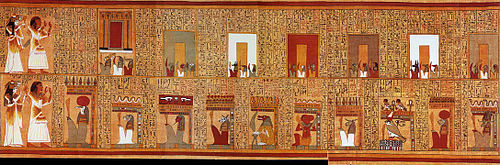
Book of the Dead, chapters 144-145 — spells for passing through the gates of the underworld; the Duat (Egyptian underworld) was imagined as a region of gates, each guarded by terrifying beings whose names and passwords had to be known by the traveler; the accumulation of these 'gatekeeping' spells reflects the Egyptian understanding of the afterlife journey as a series of thresholds requiring specific knowledge at each stage

Ani Papyrus, Chapter 125 — the Declaration of Innocence (Negative Confession) from the most famous surviving Book of the Dead; the scribe Ani declares his innocence before 42 divine assessors, each responsible for judging a specific category of wrongdoing; the negative formulation ('I have not done...') reflects Egyptian moral theology: righteousness was understood not as the performance of positive acts but as the consistent avoidance of specific violations of Ma'at
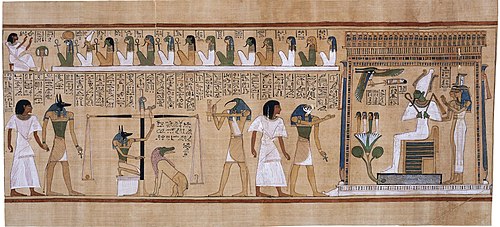
The Judgment of the Dead in the presence of Osiris — Osiris, the murdered and resurrected god, serves as both judge and model for the deceased; because Osiris himself died and was reborn, every deceased Egyptian participates in his myth; the Hall of Two Truths where the judgment takes place is the threshold between the world of the living and the eternal life of the Field of Reeds (Aaru), the Egyptian paradise

Book of the Dead of Pinedjem II — British Museum; produced for a High Priest of Amun at Thebes, c. 990 BCE; the elaborate quality of this papyrus reflects the resources available to the highest levels of Egyptian society; the illustration shows the complexity of the visual program in the finest manuscripts, where figures, hieroglyphs, and symbolic elements are coordinated with precision to create a complete map of the soul's afterlife journey

Papyrus of Ani — cursive hieratic script alongside hieroglyphic; the Book of the Dead was produced in both formal hieroglyphic script (used for display and sacred contexts) and the more rapid cursive hieratic used for everyday writing; the Ani Papyrus, at approximately 78 feet (24 meters) in length, is the longest surviving example of the tradition and one of the most richly illustrated; Ani was a royal scribe — his professional expertise in writing lends a particular poignancy to this document commissioned for his own death

Medjed — a mysterious deity from the Book of the Dead described in Chapter 17; Medjed ('the smiter') is one of the most enigmatic figures in the Egyptian afterlife tradition, often depicted as a shrouded being with visible feet and the power to strike down the wicked; the spare, abstract quality of this depiction contrasts with the elaborate multi-figure compositions of the great papyri, showing the full range of the visual tradition from minimalist symbol to detailed narrative


Comentarios