Neoplatonism: Emanation and the Soul's Return to the One
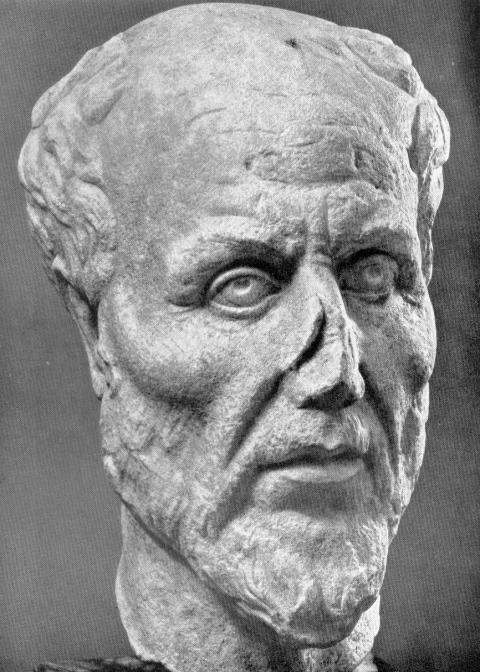
Plotinus (204–270 CE), the founder of **Neoplatonism**, whose *Enneads* — edited by his student Porphyry — became one of the most influential philosophical works in the history of Western **esoteric philosophy**.
Somewhere between the philosophy of Plato and the rise of Christianity, a philosopher from Egypt sat down to write — or rather, to dictate, for his eyesight was failing — the most systematic and spiritually ambitious account of the structure of reality that the ancient world produced. His name was Plotinus. His work is the Enneads. And the tradition that flows from him — Neoplatonism — shaped the metaphysical imagination of the Western world for more than a thousand years.
Neoplatonism is not a museum piece. It is a living philosophical tradition that underlies medieval Christian mysticism, Islamic Sufi thought, Jewish Kabbalah, the Renaissance revival of magic and Hermeticism, and much of what contemporary esoteric philosophy takes for granted: the idea that the universe flows from a single divine source; that the soul is a spark of that source temporarily exiled in matter; that consciousness has levels, the deepest of which is identical with the divine; and that the purpose of the philosophical or spiritual life is the soul's return to its origin.
To understand Neoplatonism is to find the hidden skeleton of much Western mysticism — the philosophical bones beneath the flesh of ritual, symbol, and devotional practice.
Plotinus and the Architecture of Reality
Plotinus (204–270 CE) was born in Egypt — possibly in Lycopolis — and studied in Alexandria before settling in Rome, where he taught philosophy for decades and attracted a remarkable circle of students including the politician Porphyry, who would later edit and publish his writings. He is said to have achieved union with the One (henosis) four times in his life — a mystic of the first order as well as a systematic philosopher.
The structure of reality as Plotinus describes it is one of emanation: a flowing forth from a single, ineffable source, generating successive levels of being, each less unified and less perfect than the one above it, while never diminishing the source itself. The metaphors he uses are careful: light radiating from a sun that is not diminished; water flowing from a spring that is not exhausted; a perfume spreading from its origin. What emanates is real and beautiful — but it is not the source.
The structure has three primary levels (the hypostases):
The One (to Hen): The ultimate principle — beyond being, beyond consciousness, beyond thought. The One does not think, because thinking implies a distinction between subject and object, and the One is absolutely simple, without division or multiplicity. It cannot be named or described directly; Plotinus says of it only what it is not (via negativa). It is the ground of all being, the condition for everything else, the source from which all existence flows — but it is not itself a being among beings. It simply is, in a way that defies comprehension.
The Intellect (Nous): The first emanation from the One is the Intellect — divine mind, eternal and self-thinking, contemplating the eternal Forms (the Platonic archetypes). The Intellect is the realm of the Ideas: the perfect, unchanging patterns of which all things in the world are imperfect copies. Truth, beauty, justice, the mathematical truths — these exist fully and permanently in the Intellect. The Intellect is also, in its very act of contemplating the One, the first experience of consciousness: the moment when reality first becomes aware of itself.
The Soul (Psyche): The second emanation, flowing from the Intellect, is the Soul — the principle of life, movement, and time. The Soul has two faces: an upper face eternally contemplating the Intellect, and a lower face turned toward the material world, generating and animating it. The cosmology of Neoplatonism is one in which the visible universe is itself a living, ensouled organism — the expression of Soul's creative contemplation.
Matter: At the furthest remove from the One — not emanated directly but the result of the exhaustion of the process of emanation — is matter: formless, dark, devoid of quality. Matter is not evil in itself; it is simply the limit of being, the maximum of distance from the source. But it is the level at which the soul, having descended into individual embodiment, finds itself most confused, most forgetful of its origin.
The Descent and Ascent of the Soul
The individual human soul, in Plotinus's account, is a fragment of the World Soul that has descended into a body — not as punishment (unlike the Gnostic view) but as a natural process of the Soul's creativity. The body is not the prison of the soul; it is the soul's expression in matter. But the descent involves a kind of forgetting: the embodied soul loses sight of its true nature and mistakes itself for its body, its desires, its social identity.
The philosophical life — and the spiritual life — is the reversal of this forgetting: the soul's gradual ascent back through the levels of being, purifying its identification with matter, then with body and sensation, then with discursive thought, until it reaches the Intellect — the level at which it sees the eternal Forms in their pure beauty. Beyond that, in moments of mystical experience, the soul transcends even the Intellect and touches the One directly: the experience Plotinus calls henosis — union, in which the distinction between the soul and the One temporarily dissolves.
This is not annihilation. It is recognition. The soul discovers that what it always was, at its deepest level, is not separate from the One — and never was. The exile was real, the journey was real, the forgetting was real; but the ground of being never changed.
Porphyry, Iamblichus, and the Question of Theurgy
After Plotinus, Neoplatonism developed in two significant directions, associated with two of his students.
Porphyry (c. 234–305 CE) edited and organized Plotinus's writings into the Enneads (nine groups of nine treatises), without which they would likely have been lost. He remained faithful to Plotinus's purely contemplative path: philosophy and intellectual ascent were sufficient; the soul could reach the One through philosophy alone, without the assistance of ritual.
Iamblichus (c. 245–325 CE) disagreed fundamentally. For Iamblichus, the soul was too deeply embedded in matter to lift itself by philosophical reasoning alone — it needed the assistance of the gods, and the gods were encountered not through abstract contemplation but through theurgy: sacred ritual, the manipulation of symbols, names, and material objects that had the power to invoke divine presence and draw the soul upward.
This debate — gnosis through intellectual contemplation vs. gnosis through sacred practice — is one of the oldest in the history of esoteric philosophy, and it remains alive today in the tension between purely philosophical approaches to spirituality and those that insist on the necessity of ritual, embodiment, and ceremony.
Iamblichus's position won. Theurgy became central to the later Neoplatonic tradition, especially in the work of Proclus (412–485 CE), whose vast philosophical system synthesized the entire tradition and gave it the systematic rigor that would make it transmissible to the medieval world.
The Extraordinary Reach of Neoplatonic Thought
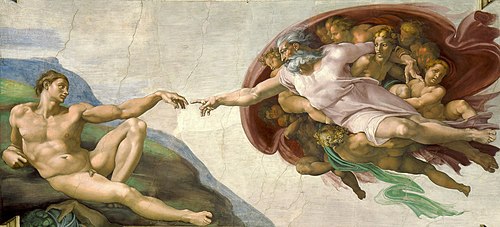
Michelangelo's *Creation of Adam* (c. 1511) — the spark of divine life passing through the extended finger of God into Adam reflects the Neoplatonic concept of emanation: divine being flowing into matter without losing itself.
The influence of Neoplatonism on subsequent thought is vast and largely invisible — like the grammar of a language that speakers use without thinking about.
Christian mysticism: The great theologians of late antiquity — above all, Pseudo-Dionysius the Areopagite (c. 5th-6th century CE), who wrote under the name of St. Paul's Athenian convert — translated Neoplatonic philosophy into Christian theology with extraordinary sophistication. His Divine Names, Mystical Theology, and Celestial Hierarchy gave medieval Christianity its conceptual framework for thinking about gnosis, the celestial hierarchy, and the via negativa — the approach to the divine through negation rather than positive assertion. Without Pseudo-Dionysius, Meister Eckhart, John of the Cross, and the Cloud of Unknowing are unthinkable.
Islamic Sufism: Al-Farabi and Avicenna (Ibn Sina) transmitted Neoplatonism to the Islamic philosophical tradition, where it influenced Sufi thought about the soul's relationship to the divine. The Sufi poet Rumi's description of the soul's longing for its origin — the reed separated from the reed bed — is pure Neoplatonism in Islamic dress.
Kabbalah: The ten Sefirot of the Kabbalistic Tree of Life — ten divine emanations flowing from the infinite Ein Sof through successive levels to the material world — are structurally identical to the Neoplatonic hypostases. Whether this is historical influence or independent parallel development remains debated; but the convergence is profound.
The Renaissance: The recovery of Neoplatonism in 15th-century Florence was one of the defining intellectual events of the Renaissance. When the Byzantine philosopher Gemistus Plethon arrived at the Council of Florence in 1438 with manuscripts of Plato and the Neoplatonists, Cosimo de' Medici was so inspired that he founded the Florentine Platonic Academy and commissioned the humanist scholar Marsilio Ficino to translate the entire Platonic and Neoplatonic corpus into Latin.

**Marsilio Ficino** (1433–1499), head of the Florentine Platonic Academy, who translated Plotinus's *Enneads* into Latin and synthesized **Neoplatonism** with **Hermeticism** and Christian theology — shaping the entire Renaissance conception of the soul.
Marsilio Ficino (1433–1499) translated not only Plato and Plotinus but the Hermetic Corpus Hermeticum (also brought to Florence from Byzantium), which he saw as part of the same ancient wisdom tradition — a prisca theologia (ancient theology) in which Hermes Trismegistus, Zoroaster, Plato, and Plotinus all taught, from different angles, the same fundamental truths about the divine, the soul, and its return to the source. This synthesis — Neoplatonism + Hermeticism + Christian theology — defined the intellectual and spiritual climate of the Renaissance and gave birth to Renaissance magic, alchemy, and the tradition of the Magi.
The Neoplatonic Legacy in Contemporary Esoteric Thought
Every tradition in the modern Western esoteric world bears the mark of Neoplatonism: the Golden Dawn's understanding of the Sephiroth, the Theosophical scheme of planes of existence (physical, astral, mental, causal — an echo of matter, soul, intellect), the New Age understanding of vibration and higher dimensions, the depth psychological framework of Jung (who explicitly acknowledged his debt to Plotinus).
The Neoplatonic vision is, at its core, a vision of abundance: reality is not a closed system of finite resources but an infinite overflow from an inexhaustible source. The One does not give by diminishing; it pours forth without loss. The soul does not earn its way back to the divine by accumulating spiritual credits; it returns by removing the obstacles to recognition of what it always was.
And in the deepest mysticism — whether Christian, Sufi, Kabbalistic, or secular — what the mystic discovers in the moment of union is invariably the same thing: not that they have become divine, but that they always were, and simply forgot.
This is the secret of Neoplatonism, and it is no secret at all.
— Lux Esoterica
Related Esoteric Inquiries:
- Pythagorean Mysticism: The Sacred Science of Numbers and the Music of the Cosmos
- Olympiodorus and the Commentary on the Alcibiades: The Esoteric Alchemy of the Self
- The Chaldean Oracles: Neoplatonic Theurgy and the Voice of the Divine Mind
Lux Esoterica.
2026.


Comments