Noh Masks: The Sacred Faces of Japanese Theater
Noh theater — developed in the 14th century CE under the genius of Zeami Motokiyo (1363-1443) and formally codified under the patronage of the Ashikaga shogunate — is the oldest continuously performed theatrical tradition in the world. It is also, by modern Western standards, the most radical: plays that last four to eight hours, performed at a pace of deliberate slowness designed to produce altered states in the audience, in which the principal actor (the shite) often wears a carved wooden mask that transforms them into a supernatural being — a demon, a ghost, a god, a vengeful woman, a mad spirit. The Noh mask is not a costume accessory. It is a sacred object, carved by specialist craftsmen who may spend months on a single mask, traditionally using the same techniques and the same aesthetic standards established in the 14th century. Each mask belongs to a specific category of character, each category carries a specific dramatic and spiritual function, and each individual mask, through the quality of its carving, possesses a specific personality — so that the actor must learn not only the mask's type but its individual character, the specific quality of divine or demonic presence this particular carved face carries.

Hannya mask (17th-18th century), Important Cultural Property — the mask of the female demon: a jealous woman transformed by her obsessive love into a supernatural being; the Hannya is the most psychologically complex Noh mask — the golden horns and terrifying grimace of demonic rage coexist with the eyes that still show the human anguish beneath; 'this mask should make the audience feel both fear and compassion,' Zeami wrote

Hannya mask variant — different carvers produce masks of the same type with distinct personalities; the Noh tradition distinguishes between the mask's category (Hannya, Okina, Ko-omote, etc.) and its individual character; a great mask is said to have kokoro (heart/mind) — an inner life that transcends the wood from which it is carved and changes expression with the movement of the actor's head

Hashihime mask (Edo period, 1600s), Tokyo National Museum — the Bridge Princess, a woman of extreme jealousy who performs rituals to curse her rival; the mask shows the first stage of the transformation into Hannya — the expression of concentrated malevolent intent that has not yet fully become demonic; the stages of spiritual deterioration and transformation are mapped in the Noh mask series

Hannya (Chūnari, middle stage), with inscription 'Omi utsu', Edo period, Tokyo National Museum — the inscription indicates both the mask's type and the specific quality of jealous passion it embodies; the chūnari ('middle-becoming') Hannya is not yet fully demonic — the horns are present but the human tragedy is still visible; the actor who wears this mask must find in their own emotional memory the specific quality of love transformed into rage

Namanari mask (Edo period), Tokyo National Museum — the earliest stage of the transformation, when the jealous woman's horns have just begun to emerge but her human face is still dominant; the Noh mask series tracks the soul's journey through passion into damnation with the precision of a psychological case study; the masks make visible what no dialogue can fully describe

Deigan mask — a female ghost with golden eyes, one of the most technically demanding masks to produce; the gilded eyes indicate supernatural vision — the dead see differently from the living; the Deigan appears in plays where a woman's spirit returns from death to complete unfinished emotional business; death in Noh theater is not an ending but an intensification

Young woman mask and Drunken Spirit mask (18th-19th century) — the contrast between the serene, idealized ko-omote (young woman) face and the comic distortion of the drunken spirit; Noh's emotional range extends from the most refined tragic beauty to the grotesque comedy of the kyōgen interludes; the masks contain the full spectrum of human and supernatural experience
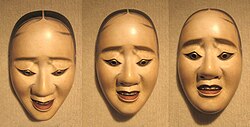
Hawk mask showing expression change with head tilting — the same mask photographed from three slightly different angles demonstrates the fundamental technique of Noh mask acting: the carved features are fixed, but the actor creates the illusion of changing expression by tilting the head (terasu, to illuminate — raising the face into light) or kumorasu (to cloud — lowering it into shadow); the mask is not a limitation but a technology

Noh stage, Itsukushima Shrine, Miyajima — one of the oldest surviving Noh stages, built over the water of the sacred island; the architectural form of the Noh stage (the hinoki cypress platform, the four pillars, the painted pine tree on the back wall, the bridgeway from which the actor enters) has remained unchanged since the 15th century; the pine tree represents the original sacred tree of Noh's Shinto roots

Noh performance, Sado Island — the masked actor in full costume; the combination of the mask, the formal kimono layers, and the deliberate movement creates a being that is neither fully human nor fully supernatural; Zeami's teaching was that the actor should become the character — not by imitating them from the outside but by finding their essential quality within and letting it manifest through the mask


Comentarios