The Four Elements: Earth, Water, Fire, and Air — The Esoteric Foundations of the Universe
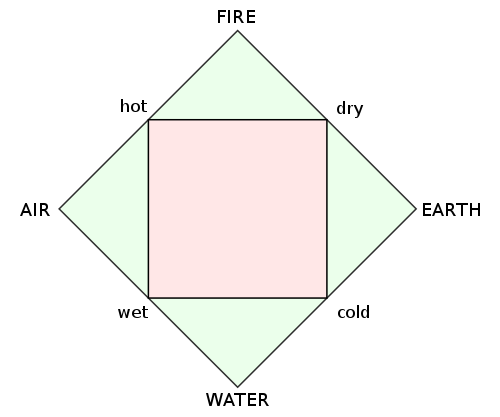
The four classical elements and their qualities: each element shares one quality with its two neighbors, creating a cycle of transformation through which all matter flows.
Before the periodic table. Before atoms. Before the quantum field. Long before any of the conceptual architectures of modern science, human beings looking at the world around them arrived at a framework so intuitive, so phenomenologically true, and so philosophically rich that it persisted for more than two thousand years as the basis of natural philosophy, medicine, alchemy, astrology, and esoteric philosophy across Europe, the Islamic world, and beyond.
The world, they said, is composed of four fundamental principles: Earth, Water, Fire, and Air.
Not earth as in soil, or water as in the liquid that fills a cup — though those too. The four elements were understood as modes of matter, qualities of being, patterns of force that pervade the cosmos at every scale. They were as much psychological and spiritual realities as physical ones. And together, in their constant interaction, transformation, and opposition, they were said to generate everything that exists.
This teaching did not die with the Scientific Revolution. It was transmuted — carried into alchemy, integrated into astrology, encoded in the Tarot's four suits, embedded in the four elementals of Paracelsus, woven into the architecture of Hermeticism, and preserved in the esoteric traditions of the West and East alike. To understand the four elements is to understand the hidden grammar of an enormous portion of the world's spiritual and philosophical heritage.
Empedocles and the Birth of a Framework
The systematic teaching of four elements in the Western tradition begins with Empedocles of Akragas (c. 494–434 BCE), a Greek philosopher, healer, and visionary who proposed that all matter is composed of four eternal, indestructible "roots" — rhizomata — that he identified with the gods: fire with Zeus, earth with Hera, water with Nestis (Persephone), and air with Aidoneus (Hades). Nothing is created or destroyed; the four roots simply combine and separate under the influence of two cosmic forces — Love (Philía) and Strife (Neikos) — to produce all the variety of the natural world.
This was a revolutionary idea: a finite number of eternal principles, governed by universal forces, generating infinite complexity. The model was simultaneously scientific, mythological, and psychological — the forces of Love and Strife were not merely physical but named what Empedocles saw as the deepest tendencies of reality: the impulse toward union and the impulse toward separation.
Aristotle (384–322 BCE) refined and systematized the doctrine. He added a fifth element — the aether — for the celestial realm (which, unlike the earthly world, was perfect and unchanging), and he organized the four earthly elements according to four qualities: hot, cold, wet, and dry.
- Fire: hot and dry
- Earth: cold and dry
- Water: cold and wet
- Air: hot and wet
Each element shares one quality with its neighbors in the cycle, which is what makes transformation possible: fire and earth share dryness; earth and water share coldness; water and air share wetness; air and fire share heat. By changing one quality, one element can become another — and this became the theoretical foundation of all medieval alchemy.
Plato and the Geometry of Creation
Plato (c. 428–348 BCE) approached the four elements differently: through mathematics and geometry. In his Timaeus — arguably the most influential cosmological text in the Western tradition — he associated each element with one of the Platonic solids (the five regular polyhedra):
- Fire → Tetrahedron (4 triangular faces — the sharpest, most penetrating)
- Earth → Cube (6 square faces — the most stable, immovable)
- Water → Icosahedron (20 triangular faces — the most fluid, spherical)
- Air → Octahedron (8 triangular faces — intermediate)
- Aether → Dodecahedron (12 pentagonal faces — the cosmos itself)
Plato's vision was one of sacred geometry: the universe is mathematically ordered, and the elements are not vague qualities but precise geometric forms embedded in the fabric of creation. This vision deeply influenced Hermeticism, Neoplatonism, Renaissance natural philosophy, and — most famously — Johannes Kepler, who attempted to model the distances of the planetary orbits using the five Platonic solids (his Mysterium Cosmographicum, 1596).
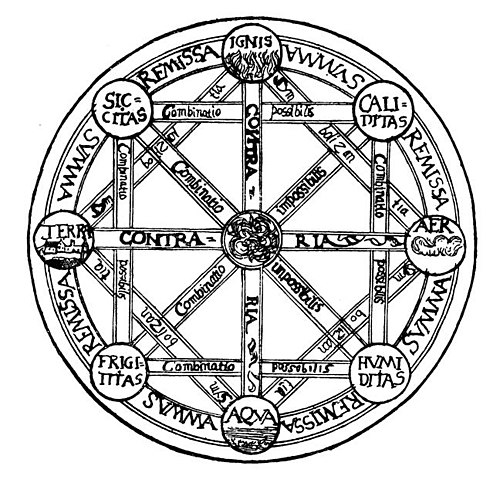
A diagram from Leibniz illustrating the Aristotelian four elements and their shared qualities — the theoretical basis of elemental transformation in classical natural philosophy and alchemy.
The Elements in Alchemy
Medieval and Renaissance alchemy inherited the Aristotelian framework wholesale and built upon it an elaborate science of transformation. For the alchemist, the four elements were not merely theoretical categories but operational realities: to work with matter was to work with their combinations and transmutations.
The alchemical Great Work (Magnum Opus) was understood as a process of elemental purification: the initial prima materia — the raw, undifferentiated substance — was subjected to a series of operations that separated its elements, purified each, and recombined them at a higher level of integration. The four stages of the Work — Nigredo (blackening), Albedo (whitening), Citrinitas (yellowing), and Rubedo (reddening) — were associated with the four elements in various systems, as well as with the four seasons and the four compass directions.
Paracelsus (1493–1541), the Swiss physician and alchemist who transformed European medicine, proposed a complementary system of three principles (Tria Prima): sulfur (soul, fire, volatility), mercury (spirit, water, fluidity), and salt (body, earth, fixity). These were not the literal substances but their archetypal essences — the three modes of being that together with the four elements generated the full complexity of material reality.
Paracelsus also developed the doctrine of elemental beings: gnomes (earth), undines (water), sylphs (air), and salamanders (fire) — invisible intelligences inhabiting each element, neither fully physical nor fully spiritual. This doctrine, drawn from earlier folk traditions and Neoplatonic philosophy, would prove enormously influential on Renaissance occultism, Theosophy, and the modern tradition of working with nature spirits.
The Elements in Astrology
Astrology organized the twelve signs of the zodiac into four groups of three — the triplicities — each associated with one element:
- Fire signs (Aries, Leo, Sagittarius): passionate, enthusiastic, willful, inspirational, prone to impulsiveness and burnout
- Earth signs (Taurus, Virgo, Capricorn): practical, grounded, sensory, patient, prone to rigidity and materialism
- Air signs (Gemini, Libra, Aquarius): mental, communicative, social, conceptual, prone to detachment and inconsistency
- Water signs (Cancer, Scorpio, Pisces): emotional, intuitive, empathic, receptive, prone to overwhelm and boundary dissolution
In classical astrology, the element of one's Sun sign describes the basic mode of one's vital energy — how it naturally flows and what it needs to thrive. A fire-dominant chart generates heat, light, and movement but may consume itself; an earth-dominant chart is stable and productive but may become entrenched; an air-dominant chart is versatile and connective but may lose contact with embodied reality; a water-dominant chart is deeply attuned and empathic but may be swamped by its own feeling world.
The interplay of elements in a birth chart — the balance or imbalance between fire, earth, air, and water — was considered essential to understanding a person's psychological makeup, their strengths and challenges, and the developmental work the life was calling for.
The Elements in Tarot
The Tarot's four suits are a direct encoding of the four elements:
- Wands (Rods/Batons): Fire — will, passion, creativity, enterprise, the spark of action
- Cups (Chalices): Water — emotion, intuition, relationship, the interior life, the realm of feeling
- Swords: Air — thought, conflict, clarity, communication, the cutting edge of mind
- Pentacles (Coins/Disks): Earth — body, material reality, work, resources, the slow ground of manifestation
Each suit's arc — from Ace through Ten, followed by the four court cards — traces the journey of its element through its full range of expression, from pure potential (the Ace) to completion and integration (the Ten), through the figures of the Page, Knight, Queen, and King (each representing a different relationship to the element's energy).
When reading Tarot, the elemental composition of a spread — which suits dominate, which are absent — offers immediate insight into the nature of the situation being examined. An abundance of Swords signals conflict, mental tension, or the need for clear thinking. An absence of Cups in a question about relationships suggests that the emotional dimension is being avoided or overlooked.
The Elements in Hermeticism
In the Hermetic tradition, the four elements are understood as modes of the One — different densities or vibrations of the single divine substance that pervades all existence. The Hermetic axiom "as above, so below" applies directly to the elements: the same fire that burns in a candle burns in the passion of the human heart and in the solar fire of the cosmos; the same earth that grounds the body grounds the soul's capacity for patience and endurance.
The Hermetic practice of elemental work — meditation on each element, visualization of its qualities, conscious cultivation of its corresponding virtues — was understood as a way of aligning the human being with cosmic order. The balanced magician or initiate was one who had integrated all four elements within themselves: the fire of will, the water of feeling, the air of thought, and the earth of grounded action — harmonized under the guidance of the fifth element, the quintessence of spirit.

A burning log embodies all four elements: the solid wood is earth, moisture within is water, the smoke is air, and the flame is fire — a concrete demonstration of elemental interpenetration.
East and West: Five Elements in Chinese and Indian Cosmology
While the Western tradition settled on four elements, other great civilizations developed parallel but distinct frameworks. Chinese cosmology uses five elements (Wu Xing): Wood (mù), Fire (huǒ), Earth (tǔ), Metal (jīn), and Water (shuǐ). These are better understood not as static substances but as dynamic processes in two cycles: a generating cycle (Wood feeds Fire, Fire creates Earth/ash, Earth contains Metal, Metal collects Water, Water nourishes Wood) and a controlling cycle (Wood breaks Earth, Earth dams Water, Water extinguishes Fire, Fire melts Metal, Metal cuts Wood).
The five elements of Taoism underlie Chinese medicine (the five organs, five flavors, five emotions), feng shui, martial arts, and cosmological thought. They represent not the composition of matter but the quality of change — five modes of transformation through which all processes move.
In Indian cosmology, the five elements (Pancha Mahabhuta) are: Earth (prithvi), Water (jala), Fire (tejas), Air (vayu), and Ether/Space (akasha). These correspond to the five senses and the five chakras of the lower body (earth at the base, water at the sacrum, fire at the solar plexus, air at the heart, ether at the throat). The yogic path is in part a process of mastering each element — purifying its corresponding chakra until the energy of each element is available in its highest, most refined expression.
The convergences between these systems — Indian, Chinese, Greek, and alchemical — suggest that they are mapping the same underlying reality from different angles, using different conceptual tools to name the same fundamental patterns of cosmic organization.
The Fifth Element: Quintessence
Every system that works with four elements eventually arrives at a fifth. The Greeks called it aether — the divine, unchanging substance of the celestial realm. Aristotle reserved it for the heavens. Medieval and Renaissance philosophy called it the quinta essentia — the quintessence — the subtle, refined substance that underlies and pervades the four gross elements, the medium through which they influence one another, the substance of the soul.
In alchemy, the quintessence was the ultimate goal: not just a purified version of one element but the distilled essence of all four in their perfect proportion and harmony. It was identified with the Philosopher's Stone — the substance that could transmute base metals into gold not because it was simply fire or earth or water or air, but because it was all of them, unified at the highest possible level.
In Indian tradition, akasha — ether or space — is both the most subtle of the five elements and the one that contains the others. It is the medium in which all things arise, the space in which fire burns and water flows and air moves and earth stands. Contemporary esoteric traditions sometimes identify it with the Akashic Records — the field of cosmic memory in which all events leave their impression.
The Elements as Psychological Map
Perhaps the most enduring contribution of elemental philosophy is its use as a framework for understanding the human psyche. The four elements describe not just the physical world but four fundamental modes of human experience and function:
Fire is will, vitality, enthusiasm, inspiration, and the capacity for action. Too much fire: impulsivity, aggression, burnout. Too little: depression, passivity, lack of direction.
Earth is the body, sensation, patience, practicality, and the capacity to sustain effort over time. Too much earth: rigidity, materialism, fear of change. Too little: disconnection from the body, impracticality, inability to ground vision in reality.
Air is the mind, communication, reason, and the capacity for abstract thought and connection. Too much air: overthinking, detachment, disconnection from feeling. Too little: difficulty thinking clearly, communicating, or seeing the broader perspective.
Water is emotion, intuition, empathy, and the deep currents of the inner life. Too much water: emotional flooding, boundary dissolution, difficulty functioning. Too little: emotional numbness, inability to empathize, disconnection from the inner world.
The balanced, integrated human being — the goal of all genuine esoteric transformation — is one who has cultivated all four in proportion: grounded in earth, animated by fire, illuminated by air, and opened by water.
This is not a metaphor. It is an ancient map of what it means to be fully human. The names of the four elements have changed across civilizations and centuries. The reality they point to has not.
— Lux Esoterica


Comentarios