Wayang Kulit: Indonesia's Sacred Theater of Shadows
In the darkness before the performance begins, a white cotton screen (kelir) is stretched between two banana-tree trunks and a single oil lamp (blencong) is lit behind it. The dalang — the puppet master, narrator, conductor, and priest — takes his place between the lamp and the screen, and for the next eight hours (a full performance lasts from sunset to sunrise), he will voice every character, direct every movement, cue the gamelan orchestra with foot taps and hand signals, and guide his audience through a complete episode from the Ramayana or Mahabharata — the great Sanskrit epics that arrived in Java with Hinduism in the first centuries CE and were never entirely replaced even by the arrival of Islam in the 15th century. The puppets (wayang) are made of carefully treated water-buffalo hide, hand-cut with extraordinary delicacy, painted in traditional colors — white for the noble and refined, red for the passionate and aggressive, black for the wise — and mounted on central horn rods with articulated arms. Seen from the front of the screen, they cast shadows; seen from behind, they are objects of extraordinary beauty. The dalang is the central figure of the tradition — not merely a performer but a custodian of cosmological knowledge, a healer, a ritual specialist who can be called to perform not only for entertainment but for lifecycle ceremonies, agricultural rituals, and healing rites. The tradition, recognized by UNESCO as an Intangible Cultural Heritage of Humanity in 2003, synthesizes pre-Hindu animism, Hindu-Buddhist cosmology, and Islamic mysticism into a visual and dramatic language unlike any other in the world.
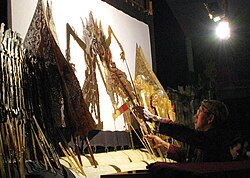
Wayang kulit performance by dalang Manteb Soedharsono (2010) — one of the most celebrated dalang of the contemporary tradition; the dalang sits cross-legged before the screen, surrounded by the banana-log puppet stands into which unused figures are thrust, the gamelan orchestra arranged behind him; a full night performance (pakeliran semalam suntuk) lasts from 9 PM to 5 AM, the dalang maintaining concentration and physical endurance throughout

Shadow projection on the kelir (cotton screen) — the audience watching from the front of the screen sees only the shadows; the puppets' elaborate silhouettes, cut from buffalo hide with extraordinary precision, are designed to be read as shadows, their exaggerated features (elongated noses, stylized eyes, curved bodies) forming a visual language that Javanese audiences learn to read from childhood; the refinement of a character's shadow indicates his moral quality

Gatot Kaca figure (before 1914), Tropenmuseum — the son of Bima, the mightiest Pandava hero; Gatot Kaca can fly, is invulnerable except at his navel, and is one of the most beloved figures in the Javanese tradition; the elaborate pierced-work decoration of the puppet's body — cut through the buffalo hide to create patterns of light and shadow — represents one of the highest achievements of traditional Javanese craft

Kumbakarna figure (before 1914), Tropenmuseum — the giant warrior brother of Ravana from the Ramayana; his massive size relative to other puppets encodes his character: a man of extraordinary physical power who nonetheless chooses to fight on the side he knows to be wrong out of loyalty to his brother; Javanese shadow theater uses size, color, and posture as a consistent moral-characterological vocabulary

Princess Shinta figure (before 1983), Tropenmuseum — Sita (Shinta in Javanese), the wife of Rama whose abduction by Ravana sets the Ramayana in motion; her white coloring, downcast eyes, and refined posture encode the Javanese ideal of feminine nobility (alus — refined, controlled, inward); the contrast between her slender white form and the red-faced, forward-leaning demon figures is one of the tradition's primary visual dramas

Wayang golek performance — the three-dimensional wooden puppet form that developed primarily in West Java (Sundanese tradition); where wayang kulit uses flat leather puppets projected as shadows, wayang golek uses articulated wooden figures performed in full light; the two traditions draw on the same mythological repertoire but developed distinct aesthetic vocabularies; the Sundanese wayang golek is particularly known for the clown-servant figures (Punakawan) who provide comic commentary on the noble characters' dramas

Cepot, wayang golek (2015) — the most beloved Sundanese clown-servant figure; with his red face, bulging eyes, and gap-toothed grin, Cepot is the philosophical heart of the tradition: the apparently foolish servant who speaks truth that the noble characters cannot; the Punakawan (clown-servants) of Javanese tradition — Semar, Gareng, Petruk, Bagong — perform the same function; they are believed to be indigenous Javanese spirit-figures inserted into the Indian epic framework

Dalang in wayang golek performance (1880-1910), Tropenmuseum — the dalang's art is among the most demanding in any theatrical tradition; he must memorize hundreds of characters and their voices, know the complete mythological corpus, direct the gamelan orchestra through a system of foot-signals, improvise dialogue appropriate to the occasion, and maintain philosophical coherence across an eight-hour narrative; the training begins in childhood and the full mastery of the tradition requires decades

Dalang, sindhen (female singer), and wiyaga (gamelan musicians) in wayang kulit performance — the complete ensemble of a wayang kulit performance includes the dalang, the gamelan orchestra (20-40 musicians playing bronze instruments: gongs, metallophones, drums, and rebab fiddle), and the sindhen who sing the mood-songs (sulukan) that accompany scene transitions; the music is not background but a continuous emotional and cosmological commentary on the drama

Palm-leaf manuscript of the Arjunawiwaha (1035 CE) — the oldest surviving Javanese literary text, composed by the court poet Mpu Kanwa for King Airlangga; the Arjunawiwaha retells the Mahabharata episode in which Arjuna meditates on Mount Indrakila and receives divine weapons; this 11th-century manuscript represents the moment when the Indian epic tradition was fully assimilated into a distinctively Javanese literary and spiritual form — the same synthesis that produced the wayang kulit tradition


Comentarios