Wicca: The Old Religion Reborn, Goddess and Craft
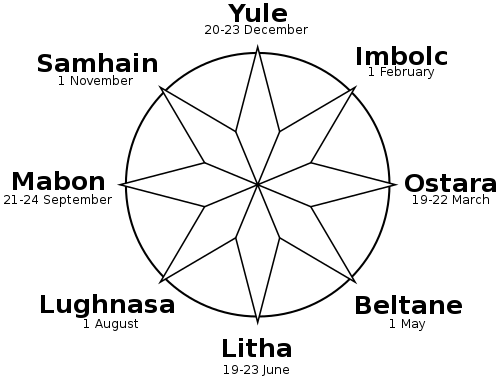
The Wheel of the Year: the eight sacred festivals of Wicca mark the solar cycle — solstices, equinoxes, and the four cross-quarter days between them — tracking the dance of the God and Goddess through the seasons.
In the middle of the 20th century, in a Britain still recovering from two world wars and beginning to shed the last of its Victorian religious certainties, something ancient stirred. A retired civil servant named Gerald Gardner published a novel in 1949 and a nonfiction book in 1954, and in doing so introduced the world to a religion it had supposedly forgotten: a pre-Christian tradition of witchcraft practiced by covens of initiates who worshipped a Horned God and a Triple Goddess, worked magic by the light of the moon, and organized their spiritual year around the eight turnings of the solar Wheel of the Year.
Wicca — the name derives from an Old English word for practitioner of the craft, though its etymology is disputed — grew from this beginning into the fastest-growing new religious movement of the late 20th century. Today millions practice some form of Wicca or Wiccan-influenced paganism, from initiatory coven traditions with formal degrees of initiation to solitary practitioners who work alone by moonlight with a handmade Book of Shadows. It has found adherents among feminists and environmentalists, among seekers disenchanted with monotheism and those drawn to embodied, seasonal spirituality, among those for whom the divine is found not in a transcendent sky god but in the living earth and its cycles.
To understand Wicca is to understand one of the most significant spiritual innovations of the modern age — and to encounter questions about authenticity, tradition, power, and the nature of the sacred that any serious seeker will eventually face.
Gerald Gardner and the Birth of a Religion
Gerald Brosseau Gardner (1884–1964) was a British civil servant, archaeologist, and amateur anthropologist who claimed to have been initiated into an existing coven of witches in the New Forest region of England in 1939. The New Forest coven, he said, represented an unbroken survival of pre-Christian religion — the "Old Religion" that had gone underground during the Burning Times (the witch persecutions of the 16th and 17th centuries) and preserved its practices in secret.
Scholars have since questioned the historical continuity of this claim. The most influential critique came from historian Ronald Hutton, whose Triumph of the Moon (1999) demonstrated that modern Wicca was a largely 20th-century creation, drawing eclectically from esoteric philosophy, ceremonial magic (especially the influence of Aleister Crowley's Thelema), folk magic traditions, classical mythology, and Romanticism — rather than an unbroken tradition from antiquity. Gardner himself acknowledged reworking and supplementing the material he received.
But this historical reassessment does not diminish Wicca's significance. All religious traditions are human creations, synthesized at particular historical moments from available materials. The question is not whether Wicca is old — it is whether it is true, in the sense of being spiritually effective, ecologically wise, and humanly meaningful. By those measures, millions have found it to be powerfully affirmative.
Gardner's collaborator Doreen Valiente (1922–1999) — whom many call the Mother of Modern Witchcraft — was responsible for much of the elegant poetry that gives Wicca its distinctive voice. The Charge of the Goddess, which begins "Hear ye the words of the Star Goddess; she in the dust of whose feet are the hosts of heaven" — one of Wicca's most beautiful liturgical texts — was written primarily by Valiente, who substantially revised the material Gardner brought from the coven. Without her, Wicca would be a significantly poorer tradition.
The Theology: Horned God and Triple Goddess

Sculpture of the Horned God at the Museum of Witchcraft in Boscastle, Cornwall — one of the two primary deities of Wicca, lord of the wild, of animals, death, and rebirth.
At the theological core of Wicca is a duotheistic system: two primary divine principles who together encompass the whole of existence and whose dynamic relationship generates the cycles of the natural world.
The Triple Goddess is the divine feminine in her three aspects: Maiden (youth, new beginnings, the waxing moon), Mother (fullness, creativity, fertility, the full moon), and Crone (wisdom, endings, transformation, the waning moon). She is identified with the moon and its cycles, with the earth's fertility, with the sea, and with the mysteries of birth, life, and death. She is not a distant creator but an immanent presence — the sacred dimension of the natural world itself.
The Horned God (associated with the Celtic deity Cernunnos and the Greek Pan) is the divine masculine: lord of animals and the wild, consort of the Goddess, deity of the sun, of vegetation, of the hunt, and of death and rebirth. In the Wiccan mythological cycle, he is born at the winter solstice as the child of the Goddess, grows to manhood through spring, reaches the height of his power at midsummer, wanes through the harvest, and dies at Samhain — only to be reborn again at the solstice. His death and rebirth mirror the seasonal cycle and embody the central Wiccan understanding of death as not an ending but a transformation.
This theology is deliberately inclusive in a way that monotheism often is not. The Goddess and the God are not rivals; they are complements. Neither is subordinate to the other. Their relationship is one of partnership, balance, and creative love — a vision of the divine that many seekers find more resonant with lived experience than the exclusively masculine sky god of the Abrahamic traditions.
The Wiccan Rede and the Threefold Law
The ethical framework of Wicca rests on two principles. The Wiccan Rede — "An it harm none, do what ye will" — is the central ethical injunction. The phrase echoes Aleister Crowley's "Do what thou wilt shall be the whole of the Law," though Wicca's version adds the crucial qualifier: harm none. The Rede is not a license for hedonism or moral relativism; it is an invitation to take full responsibility for one's actions and their consequences across the full web of life.
The Threefold Law (or Rule of Three) holds that whatever energy one puts out into the world — whether through magic or ordinary action — returns to the sender threefold. This is sometimes interpreted literally (cast a spell to harm someone and you will receive three times as much harm) and sometimes symbolically (the consequences of one's actions ripple outward in ways that inevitably circle back). Either way, it encodes a vision of ethical causality consistent with karma in Eastern traditions: actions have consequences, and the practitioner is responsible for managing them wisely.
The Wheel of the Year
One of Wicca's most culturally significant contributions is its elaboration of the Wheel of the Year — the cycle of eight sabbats that mark the solar and seasonal rhythms of the Northern Hemisphere. This framework has spread far beyond specifically Wiccan practice and now influences much of contemporary paganism and earth-based spirituality.
The eight sabbats are:
Yule (Winter Solstice, ~December 21): The longest night. The God is reborn as the sun. Candles and fires are lit to welcome the returning light.
Imbolc (February 1–2): The first stirring of spring. Sacred to Brigid, goddess of healing, poetry, and smithcraft. Snowdrops push through the frozen ground.
Ostara (Spring Equinox, ~March 21): Balance of light and dark. Fertility, eggs, and new beginnings. The roots of the modern Easter holiday reach into this celebration.
Beltane (May 1): The great fertility festival. Fires lit at dusk, the Maypole as axis mundi, the union of the God and Goddess. Midsummer Eve in the old reckoning.
Litha (Summer Solstice, ~June 21): The peak of the God's power. The longest day. Celebrations of light, fire, and abundance.
Lughnasadh (August 1–2): First harvest. Grain is cut; the God begins to wane. Associated with the Celtic deity Lugh and the gathering of summer's fruits.
Mabon (Autumn Equinox, ~September 21): Second harvest. Balance again. Gratitude for abundance; preparation for the dark half of the year.
Samhain (October 31–November 1): The most sacred Wiccan festival. The veil between the worlds is thinnest; the ancestors are honored; the God has passed into the Underworld. The Wiccan New Year.
Together, these eight festivals create a complete mythological narrative — the story of the God's birth, growth, courtship of the Goddess, sacrifice, and rebirth — and a practical framework for living in conscious relationship with the seasonal cycles of the Earth. Many practitioners find that simply observing these festivals changes their relationship to time, nature, and their own inner life.
Core Practices: Circle, Altar, and Craft

The pentagram inscribed with the five elements (earth, water, fire, air, and spirit/ether) is one of Wicca's central symbols — used in ritual to invoke elemental balance and protection.
Wiccan practice revolves around several core elements that, together, constitute the living body of the Craft:
The Circle: Before any magical or ritual work, practitioners cast a sacred circle — a sphere of energy encompassing the working space, separating it from ordinary reality and creating a contained, protected environment for working. The circle is cast by invoking the four cardinal directions (North/Earth, East/Air, South/Fire, West/Water) and calling upon their corresponding elemental energies. When the work is done, the circle is formally closed, its energy dispersed or grounded.
The Altar: The physical center of Wiccan practice is the altar — a working surface arranged with symbolic and practical tools. Traditional altar tools include: the athame (a ritual knife for directing energy), the wand (for invocation), the chalice (symbol of the Goddess), the pentacle (a disc inscribed with the five-pointed star, for earth energy), and candles representing the God and Goddess. The altar is a microcosm of the practitioner's spiritual universe.
The Book of Shadows: The personal ritual notebook of a Wiccan practitioner — recording spells, rituals, dreams, herbal knowledge, reflections, and received inspiration. In initiatory traditions, a Book of Shadows may be hand-copied from a teacher's book at initiation. Solitary practitioners build theirs gradually over years of practice. It is a living document, a record of a life lived in the Craft.
Magic and Spellwork: Wicca understands magic not as supernatural intervention but as the intentional direction of natural energies — through will, symbol, timing (working with lunar phases and sabbats), and focused ritual — toward desired ends. Spell-casting is not separate from spiritual practice but continuous with it: the same attention, alignment, and ethical awareness required in spiritual work is required in magic. The phrase "the Craft" (Wicca means "craft" in Old English) points to this dimension: magic is a skill, developed through practice, rooted in understanding of natural law.
Wicca Today: A Living Tradition
In the decades since Gardner published Witchcraft Today (1954), Wicca has branched into many streams. Alexandrian Wicca (founded by Alex Sanders, 1926–1988) emphasized ceremonial magic and hermetic ritual. Dianic Wicca (founded by Zsuzsanna Budapest in the 1970s) focused on the Goddess and women's spirituality, largely excluding men. Reclaiming (Starhawk and others, from the 1980s) emphasized activist, ecological, and feminist dimensions. Thousands of eclectic solitaries practice without formal initiation or affiliation, drawing from multiple traditions.
What unites these diverse streams is a recognition of the sacred dimension of the natural world; a commitment to working with natural cycles and elemental forces; a theology that honors the divine feminine as co-equal with (or primary over) the masculine; and an ethical framework centered on the Rede.
Wicca has also profoundly influenced the broader cultural imagination — from the aesthetic of contemporary witchcraft on social media to the feminist reimagining of the witch as a figure of power and nature spirits as living intelligences worthy of respect. The circle of practice, cast and recast by millions of hands across decades, has expanded far beyond any one tradition.
The Goddess dances in the moonlight. The God rides the turning year from birth to death and back again. The Wheel turns. And those who turn with it, consciously and with care, find that the seasons of the earth and the seasons of the soul speak the same ancient language.
— Lux Esoterica
Related Esoteric Inquiries:
- The Wheel of the Year: Wicca's Eight Sacred Festivals and Seasonal Magic
- Wicca: The Modern Craft — History, Cosmology, and the God and Goddess
- Wicca: The Pulse of the Earth and the Wheel of the Year
Lux Esoterica.
2026.


Comments