The Compendium Rarissimum: Late Baroque Demonology, Illustrated Pacts, and the Visual Taxonomy of the Infernal
The Illustrated Theater of the Underworld
In the late eighteenth century, as the intellectual light of the Enlightenment spread across Europe, advocating for reason, empirical science, and the dismantling of superstition, a parallel counter-current of gothic fantasy and occult curiosity emerged in the shadows of the printing press. The most visually stunning monument to this counter-current is the manuscript titled Compendium rarissimum totius Artis Magicae sistematisatae per celeberrimos Artis hujus Magistros ("A rare summary of the entire Magical Art systematized by the most famous Masters of this Art"), dating to approximately 1775. Held in the Wellcome Collection under the shelfmark WMS 1766, this German and Latin manuscript represents a radical departure from the traditional textual grimoires of the medieval and Renaissance periods.
Physical examination of WMS 1766 reveals it to be a small, pocket-sized book of 31 folios, bound in dark, weathered leather with gold tooling along the spine, indicating its status as a luxury item for a wealthy collector's private library. Unlike the Key of Solomon or the Pseudomonarchia Daemonum, which relied on dense paragraphs of ritual instructions, planetary hours, and conjurations, the Compendium Rarissimum is primarily a visual theater of the infernal. It contains relatively little text, focusing instead on a series of forty-two finely executed watercolor and ink illustrations of demons, magical symbols, and the physical process of signing a pact with the forces of the abyss. This late Baroque work belongs to a genre of private, luxury manuscripts created for wealthy collectors and esotericism enthusiasts who sought to explore the forbidden regions of the spirit world through the medium of art, combining the dark allure of demonology with the theatricality of the late Rococo and early Romantic periods.
To the modern scholar, the Compendium Rarissimum is a crucial document of the transition from the religious fear of the demonic to the artistic and psychological fascination with the subconscious. The demons in this manuscript are not merely theological adversaries to be exorcised; they are characters in a dramatic, visual narrative, personifying the deep, unresolved anxieties of a society poised on the threshold of the modern world.
The Visual Taxonomy of the Abyss: The Demons of WMS 1766
The central feature of the Compendium Rarissimum is its meticulous and bizarre taxonomy of infernal entities. The manuscript presents the reader with a gallery of demonic portraits, each rendering the spirit with a level of detail and color that is rare in the grimoire tradition. The entities are depicted as monstrous, composite creatures, blending human anatomy with the features of beasts, reptiles, and insects, reflecting the classic late-medieval iconography of the devil while incorporating the expressive brushwork of late Baroque art.
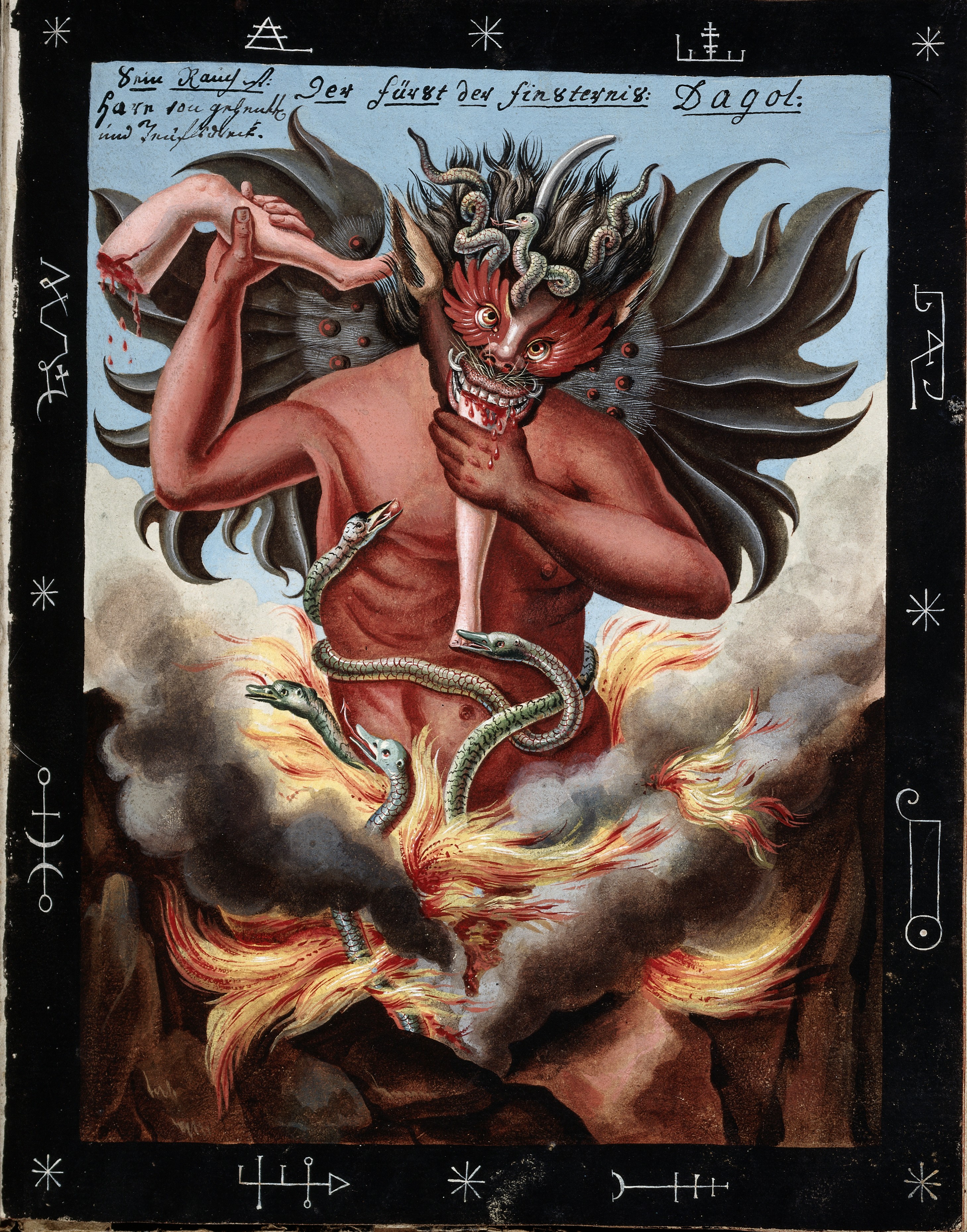
A prime example of this visual taxonomy is the illustration of The Prince of Darkness: Dagol (c. 1775). Dagol is rendered as a terrifying, horned figure with skeletal wings, goat-like legs, and a face that combines human malice with bestial features, holding a skull or a cup of poison. Plate 3 depicts a three-headed demon standing upon the back of a green, scaled dragon, while Plate 12 shows a horned devil with clawed hands offering a purse of gold coins to the viewer. The use of vibrant watercolors—deep reds, dark blues, and earthy browns, applied in delicate washes—heightens the dramatic presence of the entities, transforming the page into a window looking directly into the dark depths of the material world. The text accompanying these images is written in a neat, late eighteenth-century German script, with Latin titles highlighted in elegant calligraphy.
This focus on visual detail served a technical purpose within the context of magic. In the Hermetic tradition, the visualization of the spirit is the first step toward its command. By presenting the operator with a clear, colored representation of the entity, the manuscript provided a focus-tool for the imagination, allowing the magician to fix the volatile presence of the spirit in their mind before commencing the conjuration. The image was a bridge, translating the formless energies of the astral plane into a concrete, visual character that could be bound and directed through the ritual formula.
The Architecture of the Pact: Blood, Paper, and Contractual Art
Beyond the individual portraits of the demons, the Compendium Rarissimum is famous for its detailed illustrations of the ritual mechanics of the pact. Several plates depict the magician standing within a protective circle, holding a magic mirror or a wand, while a demonic figure emerges from a cloud of smoke to present a written contract. The pact is shown as a highly formal, legalistic process, involving the signing of one's name in red ink—symbolizing blood—upon a sheet of parchment.
This focus on the pact reflects a persistent theme in the popular folk magic of the German-speaking lands, drawing upon the theological concept of the chirographum (the handwritten bond) in Christian demonology. This concept was combined with local German folklore about the Teufelspakt (pact with the devil) and the legend of the Freischütz—the free shooter who sells his soul to the devil in exchange for magical bullets that never miss their mark. The contract was seen as a method for regulating the relationship between the human and the spiritual realms, establishing a clear boundary and a defined exchange of services. The magician bargains for material wealth, secret knowledge, or the power to heal diseases, while the spirit demands the eventual possession of the magician's vital energy. The illustrations show that the magic was not a surrender to chaos, but a highly structured, legal confrontation, where the safety of the operator depended upon their ability to maintain the integrity of the magic circle and enforce the terms of the contract.
Late Baroque Esotericism: Sturm und Drang and Occult Theatricality
The creation of the Compendium Rarissimum in 1775 places it at a unique historical junction. This was the era of the Sturm und Drang (Storm and Stress) movement in German literature, the rise of the Gothic novel, and the fascination with figures like Faust, who was popularized in puppet plays and Goethe's early drafts (Urfaust) during this exact decade. The manuscript reflects this synthesis of scientific curiosity, theatrical expression, and esoteric speculation. It is a work of high artistic quality, suggesting that it was commissioned by or created for a member of the nobility or the wealthy bourgeoisie who participated in the private, occult societies that flourished during this period.
This late Baroque magic was characterized by a shift toward the theatrical. The ritual was seen as a performance, a dramatic staging of the soul's ascent or descent, utilizing elaborate costumes, incense, music, and visual art to create a complete sensory experience. The Compendium acts as the storyboard for this performance, providing the visual cues and the aesthetic framework for the ritual drama. The demons are the actors, the magic circle is the stage, and the pact is the script that guides the interaction between the human intellect and the elemental forces of the cosmos.
This framing of magic as theater did not diminish its spiritual seriousness. For the Hermetic practitioner, the performance was a method for operating upon the subtle currents of the universe. By creating a physical, artistic representation of the cosmic architecture, the magician established a resonance between the macrocosm and the microcosm, utilizing the dramatic form to focus and direct the creative will.
Hermetic Analysis: Alchemical Color and the Integration of Shadows
From a philosophical perspective, the Compendium Rarissimum represents a visual mapping of the "outer darkness"—the unrefined, chaotic regions of the human psyche and the cosmos. In the Hermetic cosmology, the demons are not independent, absolute entities of evil; they are the personifications of the passive, chaotic aspects of the prima materia, the dense matter that has not yet been illuminated by the spiritual light.
The colors used in the illustrations have a deep alchemical significance. The dominance of black and deep red represents the transition from the Nigredo (the blackness of dissolution) to the Rubedo (the redness of fixation and completion). The black demon is the raw, unrefined force of the subconscious, which must be brought into the light of consciousness (represented by the white paper) and bound through the red ink of the pact, fixing its energy in a constructive form. By capturing these forces in the form of detailed, colored illustrations, the manuscript performs an act of alchemical separation and fixation. The monster is brought out of the formless dark, named, categorized, and fixed upon the page. The act of looking upon the Prince of Darkness, Dagol, or Beelzebub within the safe, protected framework of the book is an exercise in integration. The magician confronts the dark, chaotic aspects of their own nature—their fears, desires, and anxieties—and binds them through the geometric order of the magical symbols and the legal structures of the pact. The visual grimoire is ultimately a mirror of the soul, showing that the path to spiritual illumination must always pass through the honest, courageous confrontation with the shadows of the abyss.
Lux Esoterica.
2026.


Comentarios