The Golem: Clay Animated by Sacred Word, Guardian of the Ghetto and Mirror of Creation

The Golem and the Maharal — Mikołáš Aleš, illustration for Czech folk tales. The great clay figure towers over its creator: obedient, powerful, mute, awaiting the command of the one whose sacred knowledge called it from formless earth into imperfect life.
In the locked workshops of Kabbalistic imagination — where the letters of the Hebrew alphabet are understood not as symbols for sounds but as the very building blocks of reality — there is a practice so dangerous and so exalted that only the greatest masters may attempt it. It is the practice of creation itself: the assembly, from clay and breath and the sacred Name, of an artificial human being. Not a puppet. Not a machine. Something in between — a creature that walks and obeys, that is alive and yet not fully alive, that demonstrates the power of the divine Word to animate matter and raises, in its very existence, the most urgent questions about the nature of consciousness, the limits of human authority, and the responsibility that comes with the power to create.
The creature is called a Golem — from the Hebrew golem (גֹּלֶם), meaning "unformed matter," "raw material," or "shapeless lump." The word appears once in the Hebrew Bible, in Psalm 139:16, where the Psalmist speaks to God: "Your eyes saw my unformed substance (golmi)" — the formless being before it was shaped into a person. The Golem is the stage before completion: matter that has been given form but not yet the full gift of soul.
The Word That Creates: Language as Cosmic Architecture
To understand the Golem, you must first understand the Jewish mystical tradition's relationship to language. In the Sefer Yetzirah — the "Book of Formation," one of the oldest and most enigmatic texts in Kabbalistic literature, attributed by tradition to the patriarch Abraham but more likely composed between the 3rd and 6th centuries CE — the universe was created not simply by God's will but by God's speech: by the arrangement of the twenty-two letters of the Hebrew alphabet and the ten primordial numbers (sefirot) into the patterns that constitute reality.
The Sefer Yetzirah describes how the letters, in their infinite combinations, generate everything that exists: "He formed substance out of chaos and made nonexistence into existence. He hewed enormous pillars out of ether that cannot be grasped." The letters are not arbitrary human conventions; they are the actual structure of being. To manipulate the letters — to recombine them in the right sequences, to pronounce them in the right order with the right intention — is to participate in the act of creation.

The Golem with EMET (אמת, "truth") inscribed on its forehead — illustration by Philippe Semeria, 2009. The activation word is the key: write it and the creature walks; erase the first letter and it returns to clay. Truth animates; the removal of truth ends life.
This is the foundation of Golem-making. The Talmud records (Sanhedrin 65b) that Rava, a Babylonian sage of the 4th century CE, "created a man" using the combinatory methods of the Sefer Yetzirah and sent him to speak with Rav Zeira. When the man could not respond to questions, Rav Zeira said: "You were made by the fellows [the sages]. Return to your dust." The implication is precise: the Golem could be fashioned, could even be made to appear alive — but it could not speak, because speech requires a soul, and soul is God's alone to give. The Golem is creation without the final gift.
Later traditions specify that the master who creates a Golem must have achieved an extraordinary degree of mystical knowledge — not merely intellectual but transformative. The Sefer Yetzirah instructions involve the combination of the letters of the divine Name (YHWH) with the letters of the Hebrew alphabet in sequences that correspond to the 231 "gates" described in the text. This is not a recipe but a meditation: the creation of the Golem is a spiritual exercise before it is a practical achievement, and whether the creature produced is "real" in a material sense may be less important than what the act of creation does to the creator.
The Prague Golem: The Maharal and the Clay Defender
The most famous Golem in the tradition is the one attributed to Rabbi Judah Loew ben Bezalel (c. 1520–1609), known as the Maharal of Prague — one of the greatest Torah scholars and Kabbalistic thinkers of the Renaissance era. According to the legend that crystallized in the 19th century (though likely drawing on much older oral traditions), Rabbi Loew created a Golem from the clay of the Vltava River and animated it with the divine Name to serve as a protector of Prague's Jewish community.
The context was the recurring nightmare of blood libel — the false accusation that Jews murdered Christian children to use their blood in Passover rituals. These accusations, periodically renewed across medieval and early modern Europe, triggered massacres and expulsions. The Jewish community of Prague lived under the constant threat of such accusations; the Golem was created to watch the ghetto's boundaries, to detect and neutralize plots against the community, to be the guardian that the community's powerlessness in the Christian political order prevented it from otherwise having.

The Golem and Rabbi Loew — Mikoláš Aleš, 1899, from the collection Věnec pražských pověstí (1908). The relationship between master and creature is intimate and asymmetric: the rabbi commands, the Golem serves, but the creator cannot fully control what the power of creation has set in motion.
The Golem in the Prague legend was called Yossele ("little Joseph") and was animated by the word EMET (אמת, "truth") inscribed on its forehead, or sometimes by a shem — a piece of parchment inscribed with the divine Name — placed in its mouth. Every Friday evening before the Sabbath, Rabbi Loew would remove the shem to deactivate the Golem, because the Sabbath is the time of rest that belongs to God alone, and not even a creature of clay should labor on it.
The legend's most dramatic episode concerns the Friday evening Rabbi Loew forgot to deactivate the Golem before sundown. The Golem, left active on the Sabbath, began to rampage — driven, according to some versions, by a kind of mechanistic compulsion in the absence of the commanding intelligence. Rabbi Loew rushed back into the synagogue during the Friday evening service and removed the activation word. The Golem collapsed into a heap of clay. And ever since, it is said, the body of the Prague Golem rests in the attic of the Old New Synagogue (Staronová Synagoga), deactivated but not destroyed — waiting, should the need ever arise again, to be reanimated by one who knows the Name.
The Mechanics of Animation: EMET and MET
The activation and deactivation of the Golem through the word EMET encodes one of the most elegant theological statements in the entire mythology. EMET (אמת) means "truth" — it is one of the divine attributes, associated with God's absolute reliability, the correspondence between word and reality, the quality of being that cannot be falsified.
To deactivate the Golem, one erases the first letter, Aleph (א), leaving only MET (מת) — the Hebrew word for "dead." Truth animates; the removal of truth brings death. A being whose life is founded on sacred truth ceases when that truth is withdrawn. The theological implication resonates throughout the legend: life is truth. The Golem's existence is not metaphorical but literal — it lives because truth sustains it, and dies because death is what remains when truth is taken away.

The Old New Synagogue (Staronová Synagoga), Prague — the oldest active synagogue in Europe, dating to the 13th century. The legend holds that the remains of the Prague Golem lie deactivated in the sealed attic, ready to be reanimated in times of persecution. The synagogue has survived every catastrophe that destroyed the community around it.
The Golem's muteness — it cannot speak, and in most versions cannot be given the gift of speech — is another precise theological distinction. In the Jewish tradition, speech (dibbur) is the uniquely divine and human gift: God speaks the world into being; human beings are defined by their capacity for language. The Golem, created by human hands however mystically empowered, cannot receive this gift because it comes from a level of the divine that no human act can replicate. The Golem can serve, protect, labor, and obey — but it cannot pray, cannot study Torah, cannot engage in the acts of consciousness that define a full human being in Jewish theology.
The Golem of Chelm and the Creative Danger
Before the Prague legend, the most important Golem tradition involves Rabbi Elijah Ba'al Shem of Chelm (16th century), who also created a Golem — and was forced to deactivate it when the creature grew too large and too powerful, threatening to destroy its creator. In this version, the Golem's growth is literal and unstoppable: the creature made from earth has the nature of earth, which tends to expand and accumulate without the ordering principle of intelligence to govern it.
The Chelm Golem story preserves a warning that the Prague story sometimes obscures: the power to create carries within it the seeds of catastrophe. The master who animates clay does not simply gain a servant; he gains a responsibility he may not be able to discharge. The creature, once given the semblance of life, has its own momentum — and that momentum, separated from the wisdom that initiated it, can become destructive.
This is why the creation of a Golem, in the tradition, is not a sign of mastery to be celebrated but a proof of attainment to be used with extreme caution. The stories of Golem-making are almost universally cautionary as much as celebratory: the creature serves, but it also threatens; it protects, but it also requires a vigilance of its creator that never fully relaxes.
The Modern Golem: From Meyrink to Frankenstein
The Golem entered modernity through a series of literary and cinematic transformations that stripped away the mystical specificity of the original tradition and revealed the archetype underneath. Gustav Meyrink's novel Der Golem (1915) — one of the masterworks of German Expressionism — uses the Golem legend as the framework for a nightmare journey through the decaying Jewish ghetto of Prague, in which the Golem appears as a recurring apparition symbolizing the collective trauma of the community, surfacing every thirty-three years like a recurring psychic event.
Paul Wegener's silent film Der Golem: Wie er in die Welt kam (1920) gave the legend its most influential visual form: the creature as a massive, shambling, tragic figure — not a monster in the simple sense but a being of pathos, animated by a force it cannot understand, capable of both protection and destruction, ultimately a victim of the gap between its servitude and its dim yearning for something beyond servitude.
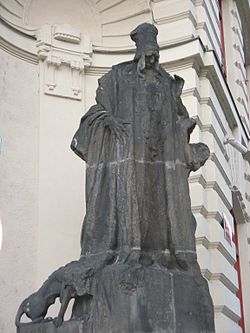
Statue of Rabbi Judah Loew ben Bezalel, the Maharal of Prague — sculptor Ladislav Šaloun, outside Prague's New City Hall. The great rabbi whose scholarship transformed Jewish thought and whose legend gave Western culture one of its most enduring images of the danger and grandeur of human creation.
The influence of the Golem on Mary Shelley's Frankenstein (1818) is widely noted and debated: Shelley's Victor Frankenstein who animates dead matter with electricity and is destroyed by his own creation follows the exact structure of the Golem myth, transferred from the mystical to the scientific and stripped of the theological framework that gave the original its moral coherence. Without the Sefer Yetzirah's understanding of why creation matters — without Rabbi Loew's sense of purpose and responsibility — the act of creation becomes merely transgression, and the creature becomes merely monster.
Jorge Luis Borges wrote a poem, "El Golem" (1958), that captures the recursive tragedy of the legend with characteristic precision: Rabbi Loew creates the Golem, and God looks at what Rabbi Loew has made just as Rabbi Loew looks at the Golem — one creator observing another's imperfect imitation, the chain of creation stretching backward to a first Maker who may have had similar doubts about His own work.
The Esoteric Golem: What Creation Teaches the Creator
In the Kabbalistic tradition, the deepest purpose of creating a Golem was never the creature itself. The Talmud's account of Rava creating a man and the creature being unable to speak is not a story of failure — it is a story about what the practice of Golem-making does to the practitioner. The meditative process of combining the letters of the divine Name in the patterns described by the Sefer Yetzirah was understood as an initiatory experience: the mystic who performed it correctly would achieve a state of consciousness in which the creative process of the cosmos became directly perceptible — in which the practitioner understood, not merely intellectually but experientially, how reality is structured and how language underlies being.
The Golem, in this reading, is almost secondary. The point is the transformation of the creator. To make a Golem is to enact the creation of the world in miniature, to retrace the steps by which formless potential became formed being — and in retracing those steps, to understand at the deepest level what it means to be human: a being made of clay who has been given speech, who has been given Torah, who has been given the capacity to study the same letters that built the universe and to work with them toward further creation and further understanding.
The Golem is what happens when you attempt to be God without being God: when the power of sacred speech is used to create, but the fullness of divine wisdom that would make such creation fully alive is not available to a finite human being. The creature that results is real but incomplete — alive but mute, obedient but not free, powerful but not self-governing. It is the mirror image of what the human being is: also formed from clay, also given life by divine breath — but given the gift that the Golem cannot have, the gift that makes all the difference.
The Golem waits in the attic of the Old New Synagogue. The community it was made to protect has been destroyed and rebuilt and scattered and gathered. The danger it was created to answer has appeared in different forms across the centuries, always recognizable in its structure — the accusation, the collective threat, the moment when a people needs a defender it cannot otherwise have. And the attic remains sealed. The clay remains. The question of when truth might be written again — and whether there is anyone left who knows the letters — remains open.
— Lux Esoterica


Comments