The Mari Lwyd: The Gray Mare's Skull at the Midwinter Door and the Battle of Rhymes
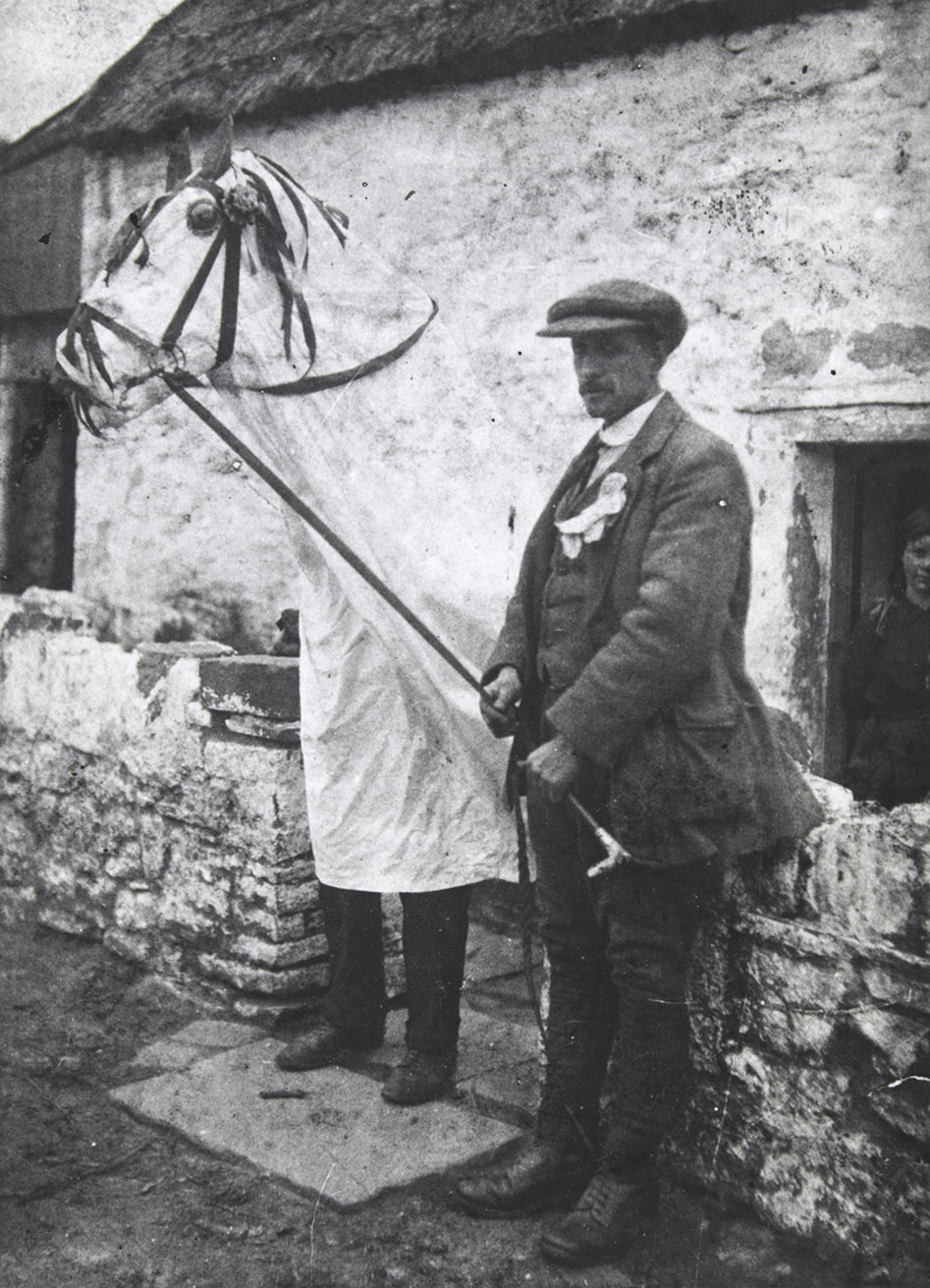
In the dead nights between Christmas and Twelfth Night, in the valleys of south Wales, a knock would come at the door—and outside in the dark stood a dead horse, singing. The Mari Lwyd: a horse's skull, exhumed or kept from year to year, bleached and beribboned, its eye-sockets set with bottle-glass baubles, its jaw hinged with a spring to snap at the unwary, the whole mounted on a pole and carried by a man hidden under a white sheet, so that the creature stood taller than any living thing at the door. Around her clustered her party—the Leader with his staff and ribbons, Sergeant, Merryman, sometimes Punch and Judy with blackened faces—and what they wanted was entry. But entry, by the iron rule of the custom, could not be forced and could not be begged. It had to be won in verse. Through the closed door began the pwnco: the battle of rhymes, stanza against stanza, the dead horse's party singing their claim to come in, the household singing back their refusals, insults, and challenges—wit against wit in the cold—until one side ran dry. If the house won, the Mari went into the night. If the Mari won—and the Mari, with her practiced poets, usually won—the door was opened, and the gray mare came in among the children and the crockery, snapping her jaw, chasing the girls, blessing the house by the sheer chaos of her presence, until she and her men were paid off with ale and cakes and silver and sent singing to the next farm. She is the strangest caroler in Europe, and one of the oldest: death itself, wearing ribbons, demanding hospitality at the darkest hinge of the year—and consenting, marvelously, to argue for it.
The Gray Mare and Her Names
What does Mari Lwyd mean? The antiquaries have quarreled pleasantly for two centuries. Llwyd is gray—or holy, or blessed, by an older shading; Mari may be simply Mary, giving "Holy Mary" and a legend to match: the gray mare, turned out of the stable at Bethlehem to make room for the Mother of God, wanders the world each Christmas seeking shelter—refused at the first door forever, knocking still. Others hear "Gray Mare" plain and simple, and set her beside her undeniable kin: the hooded animal processions that haunt the midwinter of the whole island—the Hoodening Horse of Kent, the Broad of the Cotswolds, the Láir Bhán, the White Mare, that walked Ireland's Samhain. Church condemnations as far back as the sixth and seventh centuries thunder against those who go about at the Kalends of January made up as stags or as old women or as horses—which tells us with documentary precision that the bishops of the early Middle Ages were already fighting, and already losing, the same battle the chapel deacons of Victorian Glamorgan would fight and lose against the Mari. A custom condemned for thirteen centuries is not a custom; it is an institution.
And the horse beneath the ribbons is older still. The white or gray horse is the great psychopomp beast of the northern world—the pale mare of the death-roads, bearer of sovereigns and souls, the shape that carries riders between worlds wherever legend needs a crossing made, from the eight-legged stallion of the northern sky, whose passage between the realms we have followed elsewhere, to the fatal water-steeds of the fords. Wales, whose hills are cut with the chalk memory of horse-worship, kept her goddess-mare in poetry as Rhiannon, the lady on the shining horse whom no pursuer could overtake. The Mari Lwyd is the winter face of that lineage: the mare reduced to her imperishable part—the skull—and brought to the door at the season when the boundary between the living parish and the dead one wears thinnest. The bottle-glass eyes glitter; the spring-jaw snaps; the dead beast is animated by a living man beneath a shroud—and the whole rite says what it says without a word of theology: at midwinter, the dead ask back into the houses of the living, and the living must answer.
The Pwnco: Singing With the Dead
It is the answer that makes the Mari Lwyd unique in the world's masking customs, for the answer is poetry under examination. The pwnco was no fixed liturgy; the opening stanzas were traditional—Wel dyma ni'n dwad, gyfeillion diniwad, i ofyn am gennad i ganu: "Here we come, harmless friends, to ask leave to sing"—but after the openings, the contest went freestyle: the Mari's poets improvised taunts about the household's ale, thrift, and courage; the household's champion improvised back about the party's sobriety and the state of their horse; and the exchange ran, in the great households of the custom's prime, through dozens of rounds, remembered and repeated for years when the sparring was fine. Note the structure with an esoteric eye. The dead thing at the door is not exorcised, not barred with iron, not appeased with silent offerings. It is engaged in formal wit—and the door opens not when the house is defeated by force but when it is out-sung: when the living can no longer match the visitor verse for verse. Hospitality to the uncanny is owed, says the rite, but owed only to the uncanny that can prove its life—rhyme, humor, invention being precisely the currencies no mere corpse commands. The pwnco is a Turing-trial older than its inventors' ancestors: the parish tests whether what knocks in the dark carries living spirit within its dead frame, and the man under the sheet, sweating out stanzas through a horse's jaw, is the proof incarnate—death animated by wit, winter with a poet inside it.
And when she enters—this is the rite's second doctrine—she misrules. The Mari does not stand solemnly; she careers, snaps at the girls, knocks the furniture, while Merryman fiddles and the party drinks the house's ale. The blessing she leaves is the blessing of survived disorder: the household that has admitted death at midwinter, argued with it, laughed at it, fed it, and seen it out the door singing has rehearsed, in one riotous evening, the whole human relation to mortality—and the luck of the year, the old people held, followed the rehearsal. The houses that never opened were not safer. They were only unrehearsed.
Death, Refused and Readmitted
The chapels nearly killed her. The nineteenth century's respectability campaigns—temperance above all, for the Mari's route was a route of ale—drove the gray mare out of parish after parish; by the 1960s she knocked at a handful of doors in Glamorgan, and folklorists wrote her obituaries. The obituaries were premature. The custom that survived thirteen centuries of bishops survived the sociologists too: Llangynwyd kept her unbroken; Chepstow raised a January festival where scores of Maris now clatter over the old bridge; and across Wales the schools and folk societies have re-taught the pwnco to children who take to flying insult-verse, unsurprisingly, like foals to a meadow. The revival is sometimes dismissed as pageantry, and the dismissal misses the point the custom itself makes: the Mari was always pageantry—ribbons on a skull—and her power never lay in antiquarian purity but in the transaction at the door, which has not aged a day. A community still needs, at the darkest turn of the year, to practice opening its door to what frightens it, on terms that honor both the fear and the door.
For that is the esoteric sum of the gray mare's rite, and it deserves stating plainly. Every soul keeps a house, and every winter—calendar or otherwise—something dead arrives at its threshold: the old year, the old grief, the buried and beribboned past, singing to be let in. The two familiar errors are the two the custom forbids: to bar the door absolutely (the unvisited house, the unrehearsed heart, brittle with everything it never faced), or to fling it open unconditionally (misrule without contest, the dead thing enthroned at the hearth). The Mari's people knew the third way and set it to music: meet the dead at the door with living verse. Answer it; test it; demand it prove there is spirit under the sheet; yield only to the visitation that can out-sing you—and then admit it fully, feast it, let it snap and career through the rooms of the psyche until it has had its honor, and send it out again into the snow with cakes and silver and a final stanza. What is refused at the door, the old carols might have told the psychologists, does not leave the doorstep; what is admitted rightly leaves luck behind it.
In Chepstow each January the Maris gather at the old bridge in the dark, glass eyes catching the lamplight, jaws clacking over the Wye, and for a few minutes the crowd falls quiet in a way that has nothing to do with folklore societies. A horse's skull on a pole, a man under a sheet, a few verses of Welsh against the cold: the machinery is absurd, and the presence is not. The gray mare turned from Bethlehem's stable is still looking for shelter; the old year's dead still knock; and the door still opens—now as always, now as ever—only to the singer who can prove, rhyme by rhyme through the long contest on the doorstep, that what stands knocking in the skull of death is life.
Lux Esoterica.
2026.


Comments