The Leviathan: Primordial Sea Dragon and the Mystery of Chaos
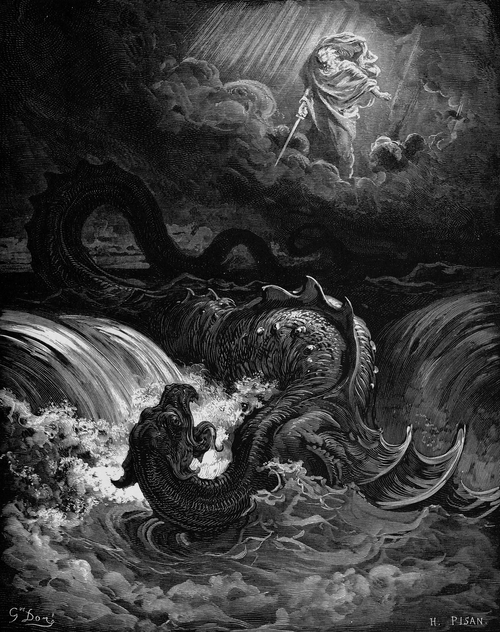
*Destruction of Leviathan* by Gustave Doré (1865) — the divine defeat of the primordial sea-dragon, one of the most powerful images in the long tradition of Leviathan iconography.
At the outermost edge of the ancient world's cosmological imagination — beyond the ordered creation, beyond the firmament and the deep, beyond even the categories of good and evil — there lies something that cannot be easily named or fully described: the Leviathan. This colossal sea-dragon of the Hebrew Bible is not simply a large and dangerous animal. It is the mythological embodiment of the primordial chaos itself — the power that existed before creation, that was subdued but not destroyed in the making of the ordered world, that continues to exist at the boundaries of existence as both threat and mystery, and that only the divine power itself can ultimately face and overcome.
The Leviathan is among the most theologically serious and philosophically complex creatures in the entire biblical tradition. It appears in the Hebrew Bible in contexts that give it cosmic rather than merely natural significance: in the Book of Job, God invokes it as a demonstration of the limits of human understanding; in the Psalms and Isaiah, it appears as a primordial power defeated in the cosmic battle that preceded creation; in the kabbalistic tradition, it becomes the guardian of the abyss and the counterpart of the heavenly order; and in Thomas Hobbes's Leviathan (1651), it lends its name and its image to one of the most important works in the history of political philosophy. Few creatures in any mythological tradition have been pressed into such varied and serious symbolic service.
The Leviathan in the Hebrew Bible: The Face of the Incomprehensible
The Leviathan's most sustained and theologically challenging appearance in the Hebrew Bible is in the Book of Job — the great poem of innocent suffering and the limits of human understanding. In the climax of the poem, God speaks to Job from the whirlwind (chapters 38–41), challenging Job's assumption that his own suffering can be understood within the framework of ordinary human justice. God's challenge takes the form of a series of cosmic questions: Where were you when I laid the foundations of the earth? Have you entered the springs of the sea? Can you bind the Pleiades or loose the belt of Orion?
And then, in the final chapter (Job 41), God describes Leviathan at length and in extraordinary detail — an extended portrait of the sea-dragon whose power, wildness, and utter incomprehensibility to human beings is used as the final demonstration of the limits of Job's understanding:
"Who can strip off his outer garment? Who can penetrate his double coat of armor? Who dares open the doors of his mouth, ringed about with fearsome teeth? His back has rows of shields tightly sealed together; each is so close to the next that no air can pass between them... His snorting throws out flashes of light; his eyes are like the rays of dawn. Flames stream from his mouth; sparks of fire shoot out. Smoke pours from his nostrils... His chest is hard as rock, hard as a lower millstone. When he rises up, the mighty are terrified; they retreat before his thrashing. The sword that reaches him has no effect, nor does the spear or the dart or the javelin... Nothing on earth is his equal — a creature without fear. He looks down on all that are haughty; he is king over all that are proud."
The description is extraordinary in its detail and in its theological purpose. Leviathan is invoked not as a horror to be fled but as a demonstration: this is what exists at the edge of your understanding. If you cannot comprehend a creature, how do you presume to comprehend the Creator of all creatures? The Leviathan is the face of the incomprehensible — the being whose very existence marks the limits of human knowledge and the irreducible mystery at the heart of reality.

Leviathan (sea), Behemoth (land), and Ziz (sky) — the three primordial creatures that rule the three domains of the created world, from a medieval Hebrew manuscript.
The Pre-Creation Battle: Leviathan and the Cosmic Order
In Psalms and Isaiah, the Leviathan appears in a different context — not as a present reality but as a defeated past power, a chaos-dragon that the divine power overcome in the primal act that made creation possible:
"It was you who split open the sea by your power; you broke the heads of the monster in the waters. It was you who crushed the heads of Leviathan and gave it as food to the creatures of the desert." (Psalm 74:13–14)
"In that day, the LORD with his fierce, great and powerful sword will punish Leviathan the gliding serpent, Leviathan the coiling serpent; he will slay the dragon of the sea." (Isaiah 27:1)
These passages place the Leviathan in the context of the ancient Near Eastern mythological pattern of the cosmic combat — the primal battle between the divine champion and the chaos-dragon that precedes and makes possible the creation of the ordered world. This pattern appears most explicitly in the Babylonian Enuma Elish (Marduk defeating Tiamat), in the Canaanite Ugaritic texts (Baal defeating the sea-dragon Lotan), and in Vedic mythology (Indra defeating the serpent Vritra). The Hebrew Bible's references to the divine defeat of Leviathan draw on this common Near Eastern mythological inheritance, though they interpret it within the framework of Israelite monotheism.
The crucial difference in the Hebrew biblical tradition is that the Leviathan is not an eternal divine adversary — not a second divine power genuinely opposed to God — but a creature, however vast and terrifying, that remains within the sovereign power of the divine. God does not defeat Leviathan through a desperate cosmic battle but through the exercise of a creative power so overwhelming that the chaos-dragon's subjugation is not a victory but a creative act — like the making of any other feature of the world.

Leviathan in a 13th-century English manuscript (British Library Add MS 38121) — the great sea-dragon depicted in the medieval bestiary tradition, its hellish mouth gaping wide.
Leviathan, Behemoth, and Ziz: The Triple Guardians
In the rabbinic tradition that developed from the Hebrew Bible, the Leviathan was part of a triple of primordial creatures that together govern the three domains of the created world: Leviathan (the sea), Behemoth (the land), and Ziz (the sky). These three beings were created at the beginning of the world, survived the primordial chaos, and remain as the most powerful representatives of their respective domains — so powerful, in fact, that the rabbis speculated about whether they had been created male and female and what would happen if they were allowed to reproduce.
The traditional answer is that God slew the female Leviathan and preserved her flesh in salt for the messianic banquet at the end of time, while the male Leviathan remains alive and will be slain only at the eschatological moment. This tradition — of the chaos-dragon's body becoming food for the righteous at the end of time — transforms the Leviathan from a threat to a resource: the primordial chaos, preserved and contained, will eventually become the very substance of the messianic feast. Chaos is not destroyed but transmuted — reserved for the moment when it can nourish the redeemed rather than threaten the living.
The Kabbalistic Leviathan: Guardian of the Abyss
In the kabbalistic tradition, the Leviathan acquired additional layers of cosmic significance. In the Zohar and related texts, the Leviathan is associated with the cosmic serpent that encircles the created world — an image that resonates with the Ouroboros tradition of world-serpent mythology (the Norse Jörmungandr, the Aztec Cipactli, the Egyptian Apep). The kabbalistic Leviathan is the guardian at the outer boundary of the created order — the power that holds the world together by pressing against it from the outside, the chaos that defines the limit of the cosmos.
In some kabbalistic readings, the Leviathan corresponds to the qliphoth — the "shells" or "husks" of the kabbalistic tree, the evil counterpart of the divine emanations. The Leviathan-Samael complex represents the shadow side of the divine creative power — not an independent evil principle (Judaism, like most monotheistic traditions, resists genuine dualism) but the aspects of divine energy that have been directed outward from the divine center and have hardened into the form of apparent opposition to the good.
This kabbalistic reading places the Leviathan in the same structural position as the alchemical prima materia — the raw, unformed, chaotic potential that must be engaged, not avoided, if the work of transformation is to be accomplished. The kabbalist who understands the Leviathan understands the full scope of the divine power — including its shadow, its apparent opposite, its manifestation in the realm of apparent evil that is in fact the absence of divine light rather than a positive principle in its own right.

William Blake's illustration to the Book of Job (Linell set, plate 6) — Blake's visionary treatment of Job places the Leviathan and Behemoth within a cosmic drama of the human soul's encounter with the abyss.
William Blake and the Leviathan: The Body of the Infinite
The English poet and visionary William Blake (1757–1827) gave the Leviathan one of its most powerful and idiosyncratic literary and visual interpretations. In Blake's mythological system, the Leviathan appears as a figure of the materialist philosophy that Blake saw as the great spiritual danger of his age — the Newtonian worldview that reduced reality to matter in motion, that eliminated the divine from nature, and that imprisoned the human imagination in the "mind-forged manacles" of rational materialism.
Blake's Leviathan-as-materialism is a profound inversion: the chaos-dragon that the biblical tradition placed outside the created order, Blake relocated inside the human mind — the mental construct of a reality reduced to the merely material is itself the Leviathan, the monster that devours the living soul. His illustrations to the Book of Job depict the Leviathan and Behemoth as creatures of a cosmos that is genuinely frightening to Job precisely because it is the cosmos as seen without the divine light — the world as pure power without mercy or meaning.
For Blake, the defeat of the Leviathan was not a past mythological event but an ongoing spiritual task: to see through the materialist reduction of reality to its imaginative and divine depth, to recognize the body of the natural world as the body of the Infinite clothed in appearances. This Blakean reading turns the Leviathan from a monster to be destroyed into a veil to be seen through — chaos as the face of a reality whose true nature is divine, obscured by the limited perceiving instrument of the ordinary mind.
Thomas Hobbes and the Political Leviathan
In 1651, the English philosopher Thomas Hobbes published the work that would become one of the foundational texts of modern political philosophy, and he titled it Leviathan — after the biblical sea-dragon. The frontispiece of the first edition, designed with Hobbes's participation, depicted a colossal human figure — composed of multitudes of smaller human figures — rising above a landscape, crowned and holding a sword and a crozier. This is Hobbes's Leviathan: the sovereign state, the artificial person constructed from the consent of individual human beings, whose power must be as overwhelming as the biblical monster's if it is to fulfill its function.

The frontispiece of Thomas Hobbes's *Leviathan* (1651) — the sovereign state as a colossal artificial person composed of its citizens, wielding the absolute power of the biblical sea-dragon to enforce civil peace.
Hobbes's choice of the Leviathan as his political symbol is theologically audacious. The chaos-dragon that the biblical tradition placed in opposition to the divine order becomes, in Hobbes's system, the guardian of the only order available to human beings in the absence of divine intervention: the artificial, coercive order of the sovereign state. Without the Leviathan-state, Hobbes argued, the natural condition of human life is "the war of all against all" — the chaos that the Leviathan was supposed to represent becomes the human condition itself, and the Leviathan-state becomes the instrument of its suppression.
Hobbes's appropriation of the Leviathan demonstrates the extraordinary symbolic richness of the figure: a being that in one tradition embodies the chaos that must be overcome for creation to be possible becomes, in another tradition, the very instrument of overcoming chaos. The Leviathan as both problem and solution — both the chaos that threatens and the overwhelming power that suppresses chaos — is the deepest ambivalence in the figure's symbolic history.
The Leviathan as the Face of God's Freedom
The theological climax of the Leviathan tradition — and arguably its most challenging reading — comes from the perspective of the Book of Job itself. God's response to Job's suffering is not an explanation but a demonstration: the Leviathan is not invoked as a reason for Job's suffering but as an image of the divine freedom that transcends Job's categories of justice and injustice.
The Leviathan, in this reading, is not the face of evil but the face of divine freedom — the aspect of the divine creative power that exceeds every human category, that cannot be measured by human notions of justice, that operates at a level so far beyond the human moral framework that the encounter with it can only produce awe rather than understanding. Job's suffering is not explained by the Leviathan; it is placed, alongside the Leviathan, within the context of a reality so vast and so complex that human categories of justice are simply inadequate to it.
This is the deepest esoteric reading of the Leviathan: not as the enemy of the divine but as the face of the divine that cannot be approached without the dissolution of the ordinary human ego, the face of reality that only survives being seen by those who have been stripped of the comfortable illusion that they understand the world and their place in it. Job, stripped of everything — health, wealth, children, comfort, the explanations of his friends — is finally prepared to face the Leviathan: not because he is strong enough, but because he has nothing left to protect.
And in that encounter — in the whirlwind, before the face of the incomprehensible — something extraordinary happens: Job is restored. Not because he submitted to an unjust power, not because he accepted an explanation, but because he faced the face of mystery with his whole being and was not destroyed by it. The Leviathan, seen truly, does not annihilate the soul that can bear to see it; it restores it.
Conclusion: The Dragon at the Edge of Everything
The Leviathan endures at the edge of Western mythology's imagination because it embodies the most fundamental of human experiences: the encounter with something that utterly transcends human categories, that cannot be explained or controlled or even fully described, but that is somehow, despite everything, the context within which human life occurs and finds its meaning.
Every great tradition that has seriously engaged with the Leviathan — the Hebrew Bible's God speaking from the whirlwind, the Kabbalists who mapped it onto the outer edges of the divine emanations, Blake who saw in it the face of the infinite clothed in matter, Hobbes who named the modern state after it — has recognized that the chaos-dragon is not simply an enemy but a necessary presence: the boundary that defines the created order, the mystery that gives depth to every apparent certainty, the abyss that makes genuine transcendence possible because it makes genuine humility necessary.
To face the Leviathan, as Job faced it, is not to understand it. It is to stand in the presence of something genuinely beyond understanding — and to discover, in that standing, that the self which can bear to face the incomprehensible is stronger, deeper, and more alive than the self that insisted on understanding everything before it agreed to exist.
— Lux Esoterica
Related Esoteric Inquiries:
- Dragons: The Cosmic Serpent, Symbol of Power Across the Ages
- The Chimera: Fire-Breathing Chaos, Symbol of the Impossible and the Untamed
- The Gorgons: Three Sisters of Terror, Apotropaic Power, and Sacred Mystery
Lux Esoterica.
2026.


Comments