Jasy Jateré: The Golden Child Who Steals the Siesta
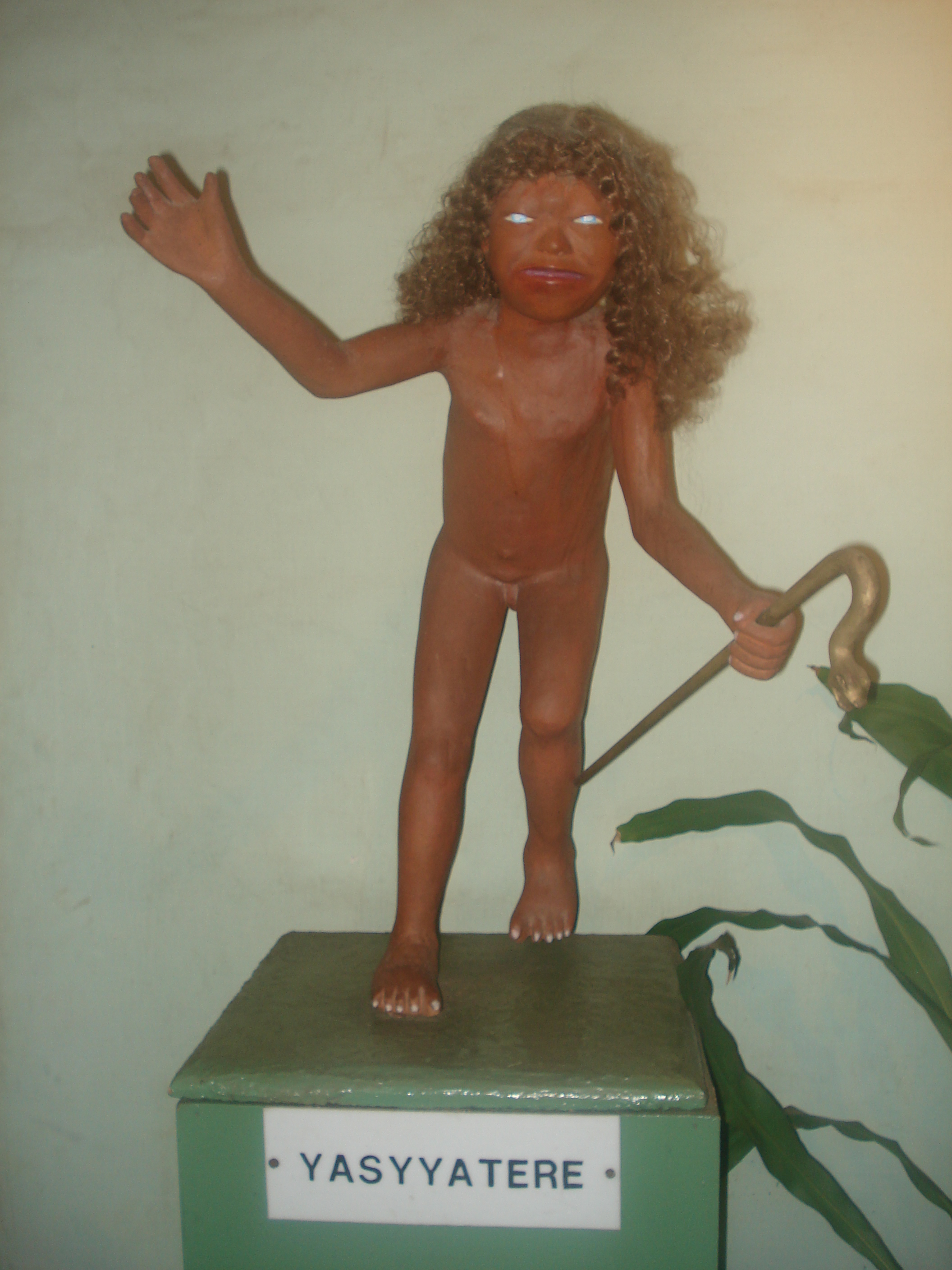
In Paraguay, and across the Guaraní country that spills into northern Argentina and southern Brazil, the dangerous hour is not midnight. It is two in the afternoon. The sun stands molten over the red earth; the dogs lie flat in the shade; every shutter is drawn and every hammock full, for this is the siesta — and the siesta, the grandmothers will tell you, is not merely a custom. It is a curfew. Children especially must sleep, or at least lie still indoors, because the burning, silent, empty hour belongs to someone. Out there in the shimmering heat, along the forest edges and the lanes between the manioc fields, walks a small figure that the noon light does not seem to touch: a beautiful boy-child, golden-haired, naked as the sun, carrying a staff of gold and a little whistle. And any child still awake and wandering when his whistle sounds — thin, sweet, impossibly far and near at once — will follow it. They always follow it.
He is Jasy Jateré — in the Guaraní tongue, something like "little piece of the moon" — and he is at once the loveliest and the most unsettling of all the beings of South American myth: a child who steals children, at the hour when only children are awake.
The Seventh Family of Monsters
To understand the golden boy, you must meet his terrible family, for Jasy Jateré is no orphan spirit; he has a genealogy as formal as a royal house's, and it is one of the great mythic pedigrees of the Americas. In the deep story of the Guaraní, the spirit Tau, an evil power, loved and abducted Kerana, the most beautiful of mortal women; and for that violation the highest divinity cursed their line: the seven sons of Tau and Kerana would all be born monsters. Seven brothers, each a legend in his own right, each a chapter of fear: among them the great serpent Teju Jagua; Mboi Tui, the parrot-headed snake of the marshes; the Luison, the wolf-dread that falls upon seventh sons; Ao Ao, the devouring sheep-beast of the hills; and Kurupi, the crude fertility dwarf of the fields. Monsters all — scaled, fanged, dreadful to see. And then, in the middle of the seven, the exception that proves the curse crueler than any fang: the fourth brother, born beautiful. Small, golden, forever a child. The curse did not disfigure Jasy Jateré's body. It disfigured his place in the world — a child eternally, who can never grow, never join, never be anyone's son or brother in the daylight world — and so he walks the siesta, the children's stolen hour, whistling for company.
That is the heartbreak coiled inside the warning, and the Guaraní tellers never hide it. Jasy Jateré does not eat children, as his brother Ao Ao would. He plays with them. The tales agree on the sequence: the disobedient child — the one who slipped out while the household slept — hears the whistle and follows it into the forest, and there the golden boy is waiting, and what follows is, at first, pure delight. He shares wild honey with them, the sweetest in the forest, gathered where only he knows. He leads them to the secret streams and bathes with them, shows them games, gives them, for one shining afternoon, the perfect playmate every child has imagined. And then — because he is cursed, because the afternoon always ends, because he cannot keep what he takes — it goes wrong. He leaves them. Deep in the forest, tangled in the lianas, glazed and wordless; the searchers find such children at dusk, unharmed in body but strange for days — mute, the grandmothers say, their eyes full of something they cannot tell, as if the golden hour had been rinsed out of their memory, leaving only its shape. Some versions say he kisses them senseless; some, that whoever eats his honey forgets; the darkest add that a child taken twice is not found at all — or is passed along, the whisperers say, to his brother Ao Ao, at which point the nursery tale drops its flowers and shows its teeth.
The Staff, the Whistle, and the Rules of Noon
Like his cousins in the world's forests, the golden boy runs on rules, and the country people keep his dossier with juridical precision. His power lives in his golden staff — some say also in the whistle — and if a person can snatch it from him, the terror of the siesta collapses on the spot into a weeping child, begging for his treasure, offering anything: wishes, honey, the safe return of the lost. (His whole family of forest kin plays this scene — the Kapre of the Philippine balete has his white stone, the Alp of German nights his precious cap — as though every hidden power everywhere kept its whole soul in one small portable thing, one theft away from tears.) His whistle obeys the acoustics of enchantment, not physics: heard loud and close, he is far away; heard faint and far, he is standing behind you. Adults cannot see him — or see only a flicker, a gold shimmer like heat-haze between the trees — for the siesta hour and its lord belong to children, and the tale is told by adults precisely because none of them can testify. And he keeps, in his way, a moral ledger: it is the disobedient child he takes, the one outside the shutters when the whole visible and invisible world has agreed to stillness. The siesta, in Guaraní country, is a covenant. Jasy Jateré is its enforcement.
Folklorists read him, rightly, as the genius of the noonday — and note with delight that the world's great traditions, which crowd their terrors into midnight, keep a small select company of noon spirits: the Slavic Lady Midday who strikes down reapers in the wheat, the "destruction that wasteth at noonday" of the Psalm, and this golden boy of the Paraguayan siesta. Noon, like midnight, is a hinge of the day — the sun at dead center, shadows at their shortest, the world stunned and silent — and the old peoples everywhere sensed that a door stands open then. The Guaraní gave the door a child's face, which is the most accurate face for it: for who is abroad at siesta, in all the sleeping country, but children and spirits?
An Esoteric Reading
Read with the inner eye, Jasy Jateré is the golden peril of the unguarded hour — the teaching that enchantment does not stalk the soul at its dark extremities only, but precisely at its brightest standstill: the noon of life, the pause of achievement, the shining lull when everything sleeps and nothing seems required of us. Midnight's dangers we are warned of and armored against; the siesta finds us shutterless. What comes then does not come as a horror — it comes as delight: golden, childlike, whistling a tune that is always farther and nearer than it sounds, offering honey and streams and the perfect afternoon. The masters of the inner life have a name for this visitor in every tradition — the sweetness that interrupts the appointed rest, the luminous distraction that is more dangerous than any demon because it asks only that you come out and play while the household of the soul sleeps. And its fruit is exact: the children are found unharmed and mute, emptied of the hour, unable to say where the sweetness went. That is enchantment's true price everywhere — not death, but the afternoon of one's life rinsed of memory, honey with forgetting in it.
Yet the legend, like all the deep ones, will not let us hate its monster, and its compassion is the second teaching. The golden boy takes children because he is one, forever — the beautiful thing that cannot grow, cursed into eternal noon, hungry not for flesh but for playmates. Every soul keeps such a resident: the radiant, arrested, forever-young piece of itself — the little piece of the moon — that never joined the household of the grown person, and that comes whistling at the unguarded hours, luring the childish part of us out through the shutters. The rules for him are the rules for it. Keep the covenant of rest — the appointed stillnesses of a life are not idle customs but defenses. If you must deal with him, go for the staff: the shining power of the arrested self is all stored in one bright scepter of glamour, and stripped of it he is not a lord but a lost child weeping — to be pitied, bargained with kindly, and given his toy back at the threshold, outward bound. And if one afternoon you hear the whistle — sweet, far, and therefore near — the grandmothers of Paraguay have already given you the whole of the doctrine in one domestic sentence, and it holds for sirens, for glamours, and for every golden interruption the noonday can send: lie still, child. It is the siesta. Whatever is whistling out there in all that light — it is not whistling for your good, and it was never going to let you stay.
Lux Esoterica.
2026.


Comments