The Futakuchi-Onna: The Woman with a Second Mouth
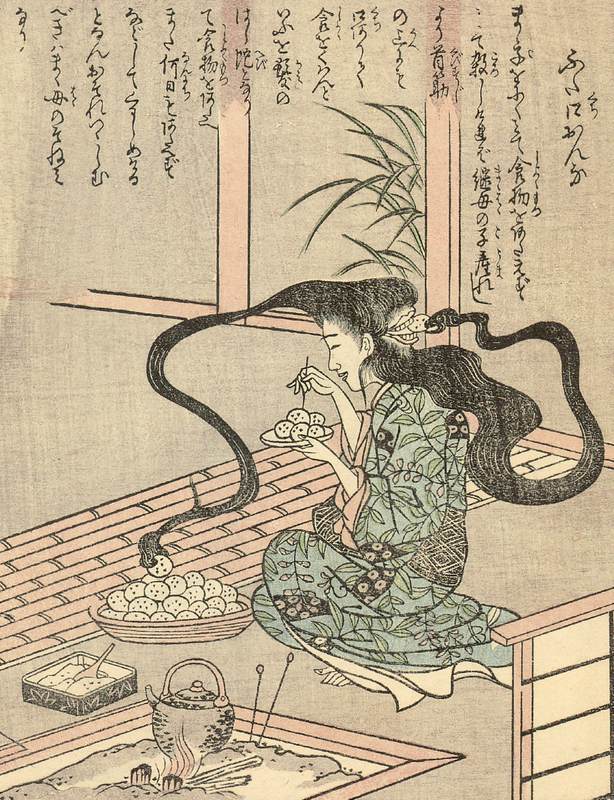
The story begins, as the sharpest Japanese stories so often do, with a man congratulating himself on a bargain. He is a miser — in the classic telling, a miser of the deep-grained, proverb-quality kind, a man who had never married because a wife eats — and at last he finds the impossible woman: beautiful, industrious, sweet-tempered, and possessed of the one virtue he prizes above all others. She does not eat. Truly: she sits with him at meals and takes nothing, or a grain or two of rice for politeness; the storehouse stays full; the miser is in paradise. And yet — the rice is going. Sack by sack, the stores dwindle, faster than one hearty eater could account for, let alone a wife who touches nothing. So the miser does what misers do: he spies. He pretends to leave for the day, creeps back, and watches his wife through a crack — and sees her undo her long black hair. And the hair parts itself — and at the back of her skull, where no face should be, a second mouth opens: huge, red-lipped, full of teeth, grinning through the parted tresses. The hair itself rises like arms, seizes rice-balls by the dozen, and feeds them back into the hungry dark — the mouth champing, gulping, sighing with relief — while the woman at the front sits modest and slender, her lips together, eating nothing at all.
She is the futakuchi-onna — the two-mouthed woman — fixed forever in the illustrated storybooks of Edo Japan, and she is one of the most unsettling figures in the whole yokai gallery precisely because her horror is arithmetic: everything the front of her refuses, the back of her devours. The books of the period, like the Ehon Hyaku Monogatari of 1841 whose famous picture heads this page, told her story as a shiver with a smirk in it. The centuries since have kept the shiver and lost the smirk, for the longer one looks at the two-mouthed woman, the more clearly one sees who she is.
Where the Second Mouth Comes From
The tellings give her several origins, and each is a different accusation. In the miser's tale, the second mouth is the house's creation: a woman who does not eat is what he demanded, so a woman who does not eat is what he received — with the eating relocated out of his sight, hunger driven around to the back of the head, where the master of the house never looks. Some versions make it explicit punishment: the mouth appears on the miser's wife because of his stinginess, the household's suppressed appetite bursting out on the body of the person required to suppress it, and thereafter the mouth speaks — mutters, curses, shrieks at him in the night if not fed, until the tightest man in the province is ruined feeding a mouth his greed itself opened.
But there is a darker origin, told with the quiet of a true grievance. In it, the woman was once a stepmother — or is the victim of one, the versions trade places — in a house with two children: her own, and the dead first wife's. Her own child ate; the stepchild was starved, quietly, bowl by withheld bowl, until it died. And forty-nine days after — the number is the Buddhist interval of the wandering dead — the woman's husband, or fate itself, swung an axe that slipped, or a blow that was no accident, and struck the back of her head; and the wound did not heal. It became a mouth. It grew lips from the torn flesh and teeth from the splinters of bone, and it hungers — always, without remedy — and in the worst nights it speaks with the starved child's voice, demanding the food that was withheld, feeling pain unless it is fed. The woman conceals it under her beautiful hair and marries a man who admires how little she eats. Both origins arrive at the same anatomy: the second mouth is the withheld portion. Someone was denied — the wife her appetite, the child its food — and the denial did not vanish. It opened, at the back of the head, in the blind spot, a mouth of its own.
The Edo period, it is worth adding, was precisely the right audience for her. The great cities of the shogunate ran on rice as literal currency — stipends were paid in it, wealth measured in koku of it, and the granary was the household's bank vault; a wife's appetite was, in the ledger-minded merchant class, a line item. The storybooks that fixed the futakuchi-onna were read by exactly the men who joked, over accounts, that the ideal bride eats nothing — and the yokai walked into that joke and turned it inside out, as yokai do. She was, among her other offices, a piece of marital satire with teeth in the back of its head: the bride the misers ordered, delivered precisely to specification.
She has kin throughout Japan's night-gallery of divided women — the Rokurokubi, whose neck wanders while her day-self sleeps innocent; the Nure-onna at her shoreline, woman before and serpent behind — and the family resemblance is the doctrine: the front that society sees, and the back where what was refused takes up residence. But the futakuchi-onna is the most domestic of the sisterhood, and the most economical. She needs no shoreline and no midnight; she sits at the family table, at noon, eating nothing, while the household's books quietly bleed rice.
An Esoteric Reading
Read with the inner eye, the futakuchi-onna is the definitive parable of the starved thing that learns to feed itself in secret — and every clause of her legend is a clinical observation wearing a ghost-story's clothes. Begin with the location. The second mouth opens at the back of the head: in the one place its owner can never see directly, the blind spot of the self — for the appetites we refuse to own do not relocate to somewhere visible and negotiable; they open exactly where our own eyes cannot go, and are groomed over daily, and fed by hands we half-notice at hours we half-remember. The hair that hides the mouth also serves it — the tellings insist on this dreadful detail: the beautiful covering, the very adornment that makes the front-face presentable, doubles as the tentacled feeder of the hidden one. So it always is: the more perfect the presentation, the more efficiently something is being fed behind it.
Then the economics, which are the tale's cold heart. The wife who eats nothing costs more than any honest eater — the storehouse drains faster through the secret mouth than it ever would through an open one — and this is the miser's lesson and the whole world's: suppressed appetite is not saved appetite; it is appetite plus concealment plus interest, and the household that celebrates its members for needing nothing is running up, in the granary of the soul, exactly that compounding bill. The front mouth's abstinence is paid for by the back mouth's gluttony; no one in the history of the legend has ever had only one mouth by refusing to feed it. And the origin-tales fix the moral order of the hunger with terrible justice: the mouth is opened by denial — the husband's stinginess, the stepmother's withheld bowls — and it speaks, when it finally speaks, in the voice of whoever was starved. What a house refuses to feed, the legend says, will be fed anyway — from that same house's stores, through a wound, with rage — and the voice demanding the food will be the voice of the one you shorted.
The cure, as always in the deep tales, is hidden in the telling like a coin in rice. Nothing in any version harms the two-mouthed woman by force; the miser who shrieks and flees learns nothing and loses everything. The versions that end well — and there are some, quiet ones — end the same way: the mouth fed openly. The husband who, having seen, sets a second bowl at the table; the household that admits the hunger to the front of the head, where it can chew in daylight with everyone else. Fed honestly, the tellings say, the second mouth quiets — some say it dwindles, some that it merely sleeps, and the wisest say the question becomes moot, because a hunger acknowledged at the table is just an appetite, and an appetite is just a person, eating. That is the whole of the doctrine the Edo storytellers folded into their shiver: count the bowls in your house — the visible ones and the true number; ask who at your table is admired for needing nothing; and if the rice is going faster than the mouths you can see should manage — do not spy through the crack. Set another place. Whatever has been eating in the dark at the back of someone's life would rather, by every account we have, come around to the front; it only needs to be asked while its portion is still warm, and called by its right name, which was never monster. It was hungry.
Lux Esoterica.
2026.


Comentarios