The Gaki: The Hungry Ghost Whose Throat Is Thin as a Needle
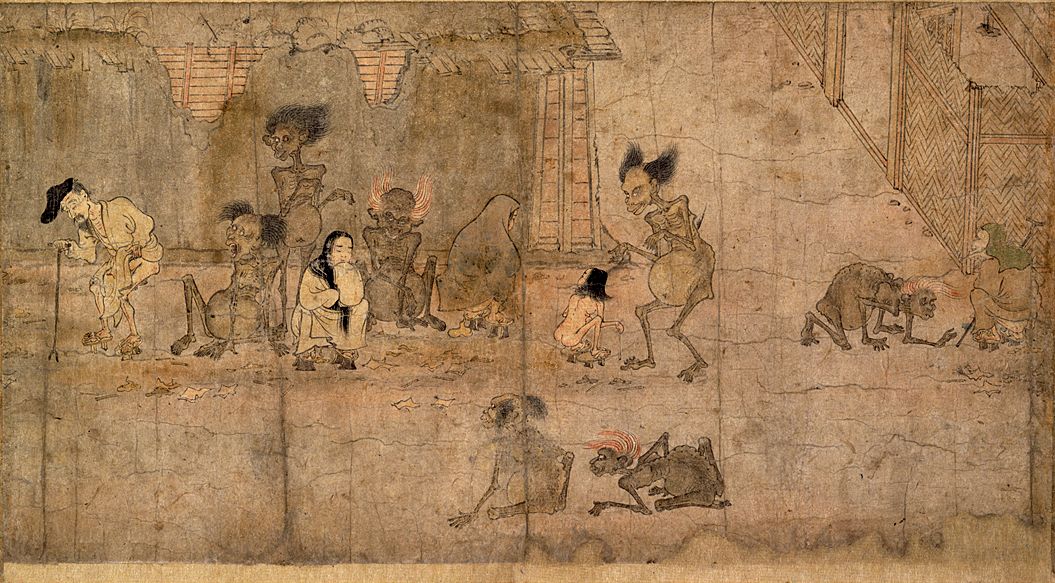
Across the whole Buddhist and Hindu world — from India, where they are the preta, to China and Japan, where they are the gaki — there wanders a class of the suffering dead so precisely and terribly imagined that no other figure in this chronicle's whole gallery of hungers can quite match it. The gaki, the hungry ghost, is one of the realms of rebirth in the Buddhist cosmos — the fate of those who die consumed by greed, by grasping, by envy and unappeasable craving — and its torment is written into the very shape of its body, drawn in the great medieval Japanese scrolls and the Tibetan wheel of life with anatomical exactness. The gaki has an enormous, swollen, distended belly — a vast hollow of appetite, a hunger the size of the world — and, above it, a neck and throat thin as a needle, a mouth pinched to a pinhole: so that it is all hunger and no capacity to feed it. It is ravenous beyond all bearing — its whole being is one starving belly's-worth of craving — and it can never eat, or never enough, because whatever food it finds cannot pass the needle-thin throat; and in the crueler tellings, the food it does manage to bring to its pinhole mouth bursts into flame, or turns to filth, or to fire, as it swallows, so that the little that passes the needle-throat becomes torment rather than nourishment. The hungry ghost is eternal starvation with a mouth too small to feed it — greed given a body, and the body made a perfect engine of its own unappeasable want.
The Feeding of the Ghosts
And here the tradition turns, with a compassion as vast as the torment is terrible, to the relief of the hungry ghosts — for the gaki are not merely to be feared but to be pitied and fed, and one of the greatest and most beloved festivals of the Buddhist world exists precisely to feed them. The story is that of Mokuren (Maudgalyayana), the great disciple of the Buddha, who with his spiritual sight saw that his own dead mother had been reborn as a hungry ghost, starving in the gaki realm, and who tried to bring her food — but every morsel he offered her burst into flame at her needle-throat, as the hungry ghost's food does, and he could not feed her. In grief he went to the Buddha, who taught him that no single offering, however loving, could feed her — that the hungry ghost's hunger could be relieved only through the combined merit of the whole community of monks, offered on her behalf, food given not directly to the grasping mouth but given away, in her name, to the sangha and the needy. Mokuren did as the Buddha taught, made the great communal offering, and his mother was released from the gaki realm. And from this comes the festival of Ullambana — the Obon of Japan, the Ghost Festival of China — in which, every year, the living make offerings of food to feed the hungry ghosts of their ancestors and of all the wandering starved dead: setting out food for the gaki, offering merit on their behalf, feeding, in a great communal act of compassion, exactly the beings whose whole torment is that they cannot feed themselves. The needle-throated ghost that can eat nothing directly is fed, indirectly, by the generosity of the living made on its behalf.
The gaki are woven into the very structure of the Buddhist cosmos and into the daily texture of Buddhist practice. In the great Wheel of Life, the bhavachakra painted at the door of every Tibetan temple, the realm of the hungry ghosts is one of the six realms of rebirth — below the humans and the jealous demigods, above the hells — and the wandering pretas are shown there with their swollen bellies and needle throats, gathered around food and water they cannot reach; the realm is the destined rebirth of those whose lives were ruled by miserliness, envy, and unappeasable craving. The medieval Japanese made them the subject of some of the most extraordinary painting of the age — the Gaki-zōshi, the twelfth-century Hungry Ghosts Scroll, depicts the gaki with unforgettable, pitiable exactness, gaunt and swollen and desperate, lurking at latrines and graveyards and among the feasting living, invisible to the humans around them, scrabbling for the scraps and the offerings that are all they can hope to take. And the practice of feeding them is not confined to the great annual festival: in many Buddhist traditions a small offering is set aside at meals for the hungry ghosts, a few grains of rice placed out for the wandering starved, a daily miniature of the great compassion — so that the gaki are, in the lived religion, not merely a warning against greed but a continual object of the practitioner's cultivated generosity, present at the edge of every meal as a reminder both of what greed becomes and of the open-handedness that is its only cure.
An Esoteric Reading
Read with the inner eye, the gaki is the most anatomically perfect parable of greed in all the world's imagining — the being whose torment is not the absence of food but the incapacity to be fed, the vast belly and the needle throat, the hunger the size of the world served by a mouth the size of a pinhole. And every element is exact. The swollen belly: greed is a hunger without bottom, a craving the size of the world, a demand for more that no amount could ever fill — the hungry ghost's belly is the appetite of avarice given its true dimensions, vast and hollow and howling. The needle throat: and this is the genius of the image, the thing that lifts it above every ordinary picture of hunger — the greedy soul cannot be fed, not because there is no food but because its very greed has narrowed its capacity to receive to nothing; the grasping that demands everything can take in almost nothing, because grasping and receiving are opposites, and the hand clenched to seize cannot open to accept. The gaki starves in the midst of whatever it seizes because the seizing itself has pinched its throat to a needle: it wants the whole world and cannot swallow a crumb, for want and greed are not the road to fullness but the very thing that closes the throat against it. And the food that bursts to flame: even the little the hungry ghost forces down its needle-throat turns to fire — because to the greedy, even what they do manage to consume brings not satisfaction but torment, the seized thing burning rather than nourishing, so that greed is punished not by starvation alone but by the way its every acquisition scorches instead of feeds. This chronicle has met the hunger that will not be filled in the Futakuchi-onna's second mouth and the Baykok's insatiable prowess; the gaki is the pure and cosmic form of it — greed as a realm of rebirth, the belly of the world and the throat of a needle.
But the deepest teaching of the gaki is not the torment but the cure — and it is one of the most beautiful in all this chronicle. The hungry ghost cannot be fed directly: the food offered straight to its grasping mouth bursts into flame; Mokuren could not feed his starving mother with any morsel handed to her craving. The needle-throat of greed cannot be widened by feeding the greed. It can be relieved only indirectly — by the food given away in the ghost's name to others, by the merit of generosity made on its behalf, by the very opposite of grasping performed for the grasper's sake. And this is the whole spiritual physics of the release from greed: the pinched throat of avarice is not opened by getting more (that only feeds the flame) but by giving — the greedy self is freed from its torment not by satisfying its craving, which cannot be satisfied, but by the practice of generosity, the giving-away that is the exact reversal of the grasping, performed until the clenched hand learns again to open and the needle-throat learns again to receive. Feed the hungry ghost by giving its food to others; free the greed in yourself by the practice of open-handed generosity; for the belly of craving is bottomless and the throat of grasping is a needle, and the only thing that ever widens that throat is the giving-away that greed thought was its enemy. The festival of the ghosts is the doctrine enacted: the living feed the starving dead not by cramming the needle-throats but by giving food away, in the ghosts' names, to the community and the poor — relieving the hunger of the grasping dead through the generosity of the living, teaching, in the greatest communal rite of compassion the Buddhist world knows, that the way to feed a hungry ghost, and the way to be freed from the hungry ghost in oneself, is the same and single way: not to grasp more, which burns, but to give away, which at last, and only, opens the throat. Set out the food for the wandering starved; give in their names; and know that every act of generosity is the widening of a needle-throat somewhere — your ancestors', the world's, your own — the one medicine for the hunger that grasping made, offered back to the grasping as the gift they could never seize but can, at last, receive.
Lux Esoterica.
2026.


Comentarios