The Rainbow Serpent: The Great Creator Snake of Aboriginal Australia
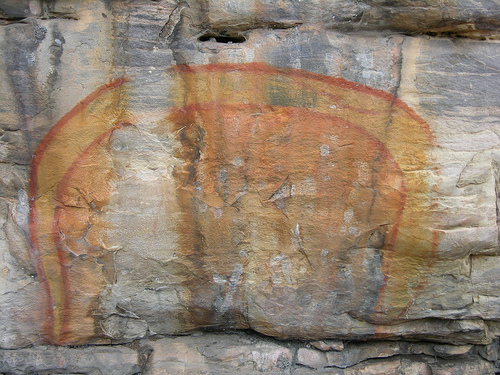
The oldest god still worshiped on earth is, by a strong scholarly argument, a snake. The Rainbow Serpent—the name is the anthropologists' umbrella, coined in the early twentieth century, for a being the hundreds of Aboriginal nations of Australia know under their own names: Ngalyod to the Kunwinjku of Arnhem Land, Wagyl to the Noongar of the southwest, Yurlunggur, Kanmare, Goorialla of the great Lardil telling, and many more—coils through the rock art of the continent in an unbroken iconographic tradition that the archaeologists trace back some six thousand years and more in Arnhem Land alone: the same great looped body, the kangaroo-eared or crocodilian head, repainted and repainted at the galleries as the generations renewed their relationship with what the paintings are—not depictions, in the traditions' own understanding, but presences. The Serpent belongs to the Dreaming—the Tjukurpa, the Everywhen: the foundational epoch that is not past but underlying, present beneath the present—and its work is the land itself: in the Dreaming, the great Serpent moved across the unformed country, and its passage made the geography—the winding riverbeds are its tracks, the gorges its pushings-through, the waterholes the places it plunged and dwells; where it rested, hills; where it coiled, the round lagoons. And its signature in the sky seals its office: the rainbow is the Serpent seen arching between waterholes, traveling; the rainbow's appearance over country means the Serpent is moving between its waters, and the two great signs—the arc in the sky, the permanent pool in the drought-country—are one being's two postures.
The Keeper of the Waters and the Law
The Serpent's portfolio, across its hundreds of local statutes, is remarkably constant, and it is the deepest portfolio a dry continent can assign: water and law. It made and keeps the permanent waters—the drought-proof holes on which all life in the hard country depends are its dwellings, and they are approached, in the traditions, with the protocols of a sovereign's residence: announced, sung to, entered rightly or not at all; the deep pools are not swum for pleasure; strangers are introduced to the water by its traditional custodians, who call out to the Serpent naming the visitor—a rite still performed across northern Australia, and not as theatre. It gives the monsoon: the great build and break of the wet season is its rising; it swallows and regurgitates—the flood is its swallowing of country, and more than one initiatory tradition, most famously the Yurlunggur cycle of Arnhem Land, turns on the Serpent swallowing persons (the Wawilak sisters and their children, in that great telling) and regurgitating them transformed: the swallowing-and-return that is the very grammar of initiation, death-and-rebirth administered by the water's own body. And it enforces: the Serpent's wrath—flood, storm, the drowning of the transgressor, sickness in the camp—falls on the breakers of the water-law and the sacred law generally: those who foul the pools, take without protocol, profane the sites, or spill the wrong blood near the waters; menstrual and birth blood, in many traditions, must be kept from its pools with particular care, for the Serpent scents it and rises. Under its government, the scarce waters of the driest inhabited continent were kept, for tens of thousands of years, unfouled, unfought-over, and alive: the Rainbow Serpent is, among everything else it is, the most successful water-management regime in human history.
The great regional tellings give the Serpent its faces. In Arnhem Land, Ngalyod the mother-serpent both nurtures and punishes: the Kunwinjku account tells of camps swallowed for the crying of a child wrongly hushed, of the Serpent rising through the floor of the world where taboo was broken—and the painted galleries of the escarpment, some images maintained across millennia, are her standing presence, retouched by the custodians as an act of relationship, not restoration. The Wawilak cycle of the northeast gives the initiatory masterpiece: the two sisters traveling with their children camp beside the sacred waterhole of Yurlunggur; blood falls where it must not; the great python rises, circles the camp in the guise of the first monsoon, and swallows sisters and children whole—then, questioned by the other serpents of the country at a gathering of the powers, admits the swallowing and returns them; and from the pattern of that swallowing and disgorgement descend, in the tradition's own account, the initiation ceremonies by which boys are taken from their mothers, enclosed, and given back transformed: the ritual system of a whole civilization derived from the Serpent's digestion. In the southwest, the Noongar Wagyl made the Swan River and its wetlands and remains their custodian—the being whose displeasure Perth's engineers have learned to reckon with; in the Kimberley the serpent-powers braid into the Wandjina cloud-beings; across the deserts the water-serpents guard the precious permanent soaks under a dozen names. The anthropologists' umbrella-term flattens what the country keeps distinct; but the constants under all the names—water, law, swallowing, return, the arc between pools—are the oldest stable theology mankind possesses.
The Esoteric Reading: The Serpent Under the Country
Set beside the world's other great snakes, the Rainbow Serpent reveals its singular position: the Near East cast its cosmic serpent as the enemy—the chaos to be slain by the storm-god, the Leviathan whose defeat founds the ordered world; the Norse bound theirs under the sea to await the last battle; Australia alone kept the great serpent as the founder and current administrator: never slain, never bound—the world is not built from its corpse but is its living track, and the power is in office to this day. The esoteric reading follows the water down. The creator is not departed but coiled in the deep pools: the Dreaming's genius is the doctrine of the Everywhen—the formative power of the world, and of a life, is not a past event but a present underlay: the great Serpent that shaped your riverbeds is still in your waterholes, and the deep permanent pools of a soul (the enduring loves, the vocation, the springs that never dried in any drought) are precisely where it dwells and precisely where protocol is owed. The rainbow and the waterhole are one being: the arc of highest beauty in the sky and the dark permanent water in the gorge are the same power in two postures—the tradition's standing correction to every spirituality that wants the rainbow without the deep pool, the epiphany without the sober protocols of the water's edge; whoever sees the arc is being shown where the Serpent travels between its residences, and the residences, not the arc, are where relationship happens. The Serpent swallows and returns: the floods of a life—the engulfings by the deep power at its seasons—are, rightly undergone, initiations: the swallowed are regurgitated transformed, and the traditions' cycles teach the posture: not flight from the rising water, and not presumption in it, but the ordered surrender of the initiand. And the law is the water's: the Serpent's oldest teaching is the fusion its portfolio declares—law and water are one substance: the rules of a community and the springs it lives from stand or fall together; foul the waters and the law sickens; break the law and the waters rise; and a people, or a person, keeps both by the same protocols of announcement, restraint, and respect at every deep pool.
The galleries of Arnhem Land are still repainted by the custodians whose right and duty it is; the Wagyl's opinion is formally consulted, in our own generation, on Perth's riverworks—the Serpent, like its Maori colleagues, has entered the age of environmental-impact assessment without surrendering an inch of jurisdiction; and the rainbow still arcs over the drought-country between the permanent pools, on schedule. Of all the powers in this long survey of legends, the Rainbow Serpent asks the least translation, for its country's condition is becoming everyone's: a dry world, living on few deep waters, under law that frays as the pools are fouled. Its protocols travel intact: know the permanent waters of your country and your life, and who their custodian is; announce yourself at their edges, and bring strangers to them rightly or not at all; keep the wrong blood and the casual filth out of the deep pools; read the rainbows as itineraries, not destinations; and when the wet season of the great power rises around you—go under with the initiand's trust, for the Serpent has been swallowing and returning its people, transformed and alive, since before the pyramids, and it has not lost one yet that kept the law of the water.
Lux Esoterica.
2026.


Comments