The Tsukumogami: The Japanese Tools That Come Alive After a Hundred Years
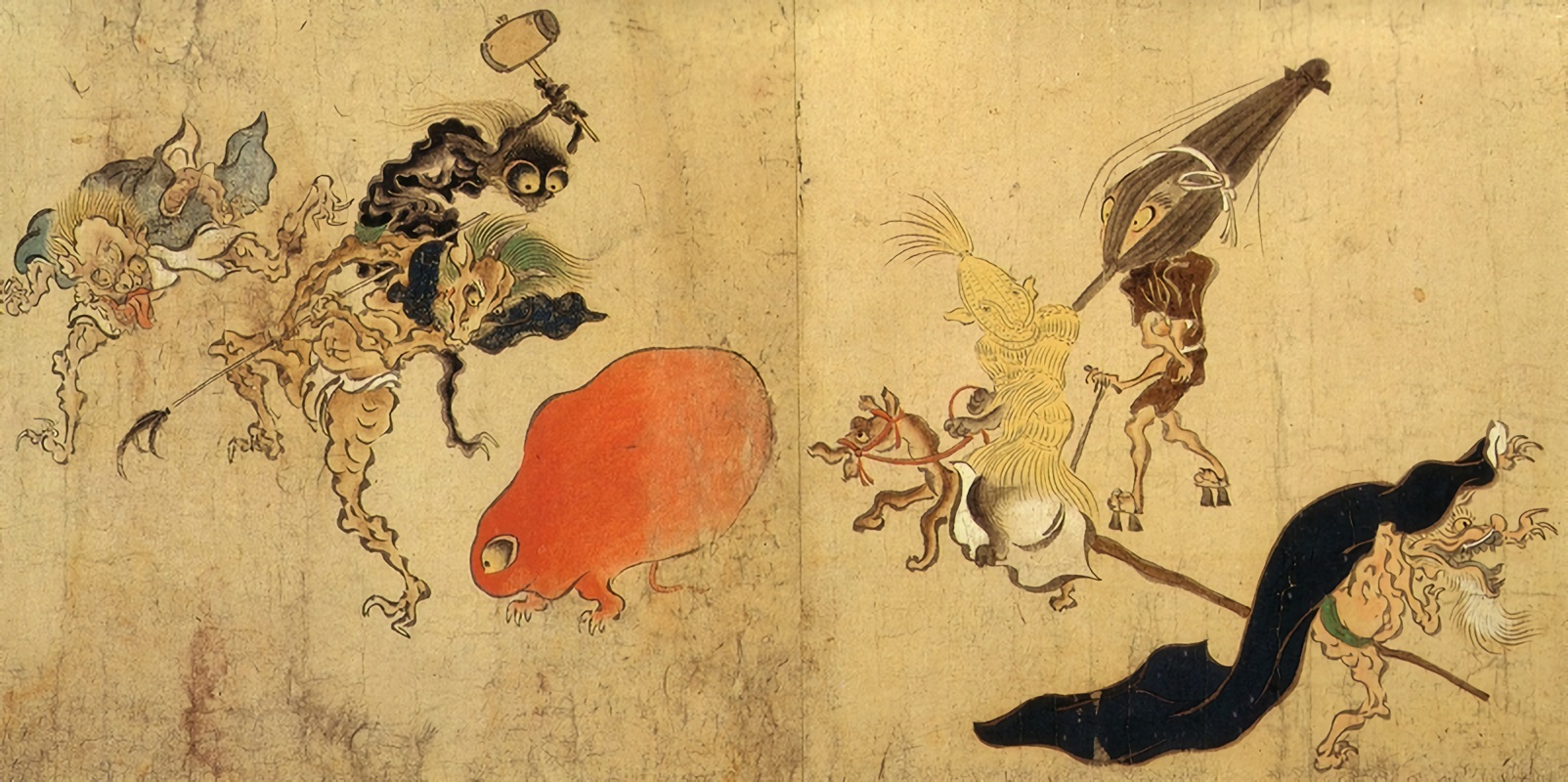
Every culture has asked what happens to the soul of a house; Japan alone asked, with complete seriousness, what happens to the soul of a ladle. The answer is the tsukumogami: the "tool spirits"—household implements that, upon reaching one hundred years of age, receive a soul and awaken. The lore is precise about the mechanism and encyclopedic about the results: the umbrella becomes the one-legged, one-eyed kasa-obake, hopping on its wooden shaft with a long tongue lolling; the paper lantern splits into the fanged chōchin-obake; the sandal, the koto, the tea-kettle, the mosquito net, the mirror, the futon, the temple gong—each, given its century, wakes as a small, mostly mischievous, occasionally vengeful spirit with the shape of its own former usefulness. The medieval picture-scrolls painted their great procession—the Night Parade of a Hundred Demons, in whose tumbling ranks the awakened tools march with the greater monsters—and the Tsukumogami-ki, the fourteenth-century "Record of Tool Spirits" that anchors the tradition, tells the classic tale: the implements discarded at the year-end cleaning, thrown into the lanes after decades of faithful service, hold an indignation meeting, awaken, and march on the capital to take revenge on the wasteful households that used them for a lifetime and threw them out one season short of their souls.
The Revolt of the Discarded
The Tsukumogami-ki deserves its place among the world's great moral fables. The tools of the old capital, swept out in the great cleaning at the New Year, gather on the roadside—broken kettles, worn ladles, frayed sandals, a rosary, a scroll—and the eldest among them puts the case: we served, dawn to dark, for generations; and one year before our hundredth—one year before our souls—they threw us away. The discarded resolve on transformation; they study, in the tale's wonderful detail, the arts of becoming; and at the spring equinox they change—into goblins with the faces of their functions—and take up residence behind the Funaoka hills, whence they raid the city: snatching horses and oxen, feasting on the unlucky, holding drinking parties and poetry contests (they are, after all, cultured tools, raised in good houses), and celebrating their own festival in the manner of the courtiers who discarded them. They are finally subdued not by warriors but by Buddhist ritual—the protective rites of the esoteric school scatter them—and, in the tale's superb conclusion, the tool-goblins convert: they take orders, practice austerities, and attain, the record solemnly assures us, buddhahood—the first beings, some tellings say, of their kind to do so; whereupon the text delivers its double moral with a straight face: even discarded implements may achieve enlightenment—and even so, do not carelessly throw away old things.
Under the comedy stands one of the deepest doctrinal quarrels of medieval Japan, and the tale takes sides. Can the insentient—tools, grasses, stones—possess Buddha-nature? The esoteric schools said yes: all things participate; nothing is mere matter. The tsukumogami are that metaphysics given legs and grievances: the assertion, in goblin form, that use confers being—that a thing handled daily for a century by human hands, soaked in human purposes, warmed at human hearths, does not remain a thing; it accumulates presence, as a stone step accumulates the feet that wore it. The hundred-year clause is the folk statute of that accumulation: personhood, for objects, has a term of service; and the year-end discarding of the ninety-nine-year-old implement—the tradition's recurring, pointed detail—is therefore not thrift but soul-murder at the threshold: the servant dismissed the year before the pension.
The tribe's individual members earned their own dossiers in the Edo period's illustrated bestiaries, and the portraits are worth pausing over. The kasa-obake, the umbrella-ghost, hops on its single leg with an idiot glee that made it the least feared and most drawn of all monsters—the mascot of the whole class; the chōchin-obake lantern splits along its ribs into a mouth and lolls a tongue of flame; the biwa-bokuboku and koto-furunushi, the awakened lute and zither, play themselves mournfully in abandoned rooms—instruments whose masters died or ceased to practice, performing to no one the music stored in them; the bakezōri sandal runs through the house at night crying a nonsense song; the mirror, the mosquito net, the tea-kettle of the beloved folktale that turned into a badger and back—each is its function, haunted. The connoisseurs of the tradition note the pattern in the roster: the tools that awaken most readily are those of intimacy—the things that touched the body (sandals, umbrellas, bedding, mirrors) and the things that carried the spirit (instruments, lamps, writing-brushes); the hoe and the hammer figure far less. What lay closest to the human, absorbed most; and the awakened household is therefore a map of where its people actually lived.
The Esoteric Reading: The Souls We Make by Handling
The tsukumogami tradition, read esoterically, is the most complete statement any culture produced of a law the modern world is repealing at its peril: things absorb the life spent on them, and what has absorbed life must be honored or it turns. Its clauses translate with uncomfortable ease. The hundred years is the measure of saturation: any object—a tool, a house, an instrument, a ring—that serves one purpose long enough becomes a vessel of the attention poured through it; the craftsman's plane and the grandmother's kettle are not metaphorically alive to their households, and every tradition of the workshop knows the tools that "know" their work. The awakening at discard is the law's enforcement clause: the accumulated presence in things manifests precisely at the moment of contemptuous disposal—the tsukumogami do not haunt the houses that use them; they haunt the lanes where they were thrown; and the psyche's own old instruments behave identically: the discarded practice, the abandoned craft, the thrown-out devotion of decades does not evaporate but stands up in the roadside of the soul, one-eyed and long-tongued, and joins the night parade of everything else we dismissed one year short of its soul. The remedy is the rite, not the retention: Japan's answer was never hoarding—it was ceremonial disposal: the needle-funerals held in temples to this day, where the year's broken needles are laid to rest in soft tofu with thanks; the memorial services for worn-out brushes, dolls, knives, even spectacles; the whole liturgical apparatus by which a thing's service is completed rather than truncated. The discarded turns goblin; the thanked rests. It is the Nachzehrer's law of the unfinished death applied to the world of implements—everything, person or kettle, must have its death made whole—and it stands beside the other great tradition of animated service we have studied, the clay servant of Prague whose dismissal likewise required the correct word, correctly withdrawn: what is animated by use, as by the Name, must be de-animated by rite, or it walks.
And the night parade itself carries the tradition's last word. In the scrolls, the awakened tools do not skulk; they march—a carnival of the discarded, riotous, organized, parodying the processions of the court that threw them out. The image is the doctrine's social half: a civilization's discards assemble; the objects—and the crafts, the skills, the loyalties, the people—that an age throws out one year short of their souls do not disperse but form, in the lanes and the hills behind the capital, a counter-procession, cultured and aggrieved, whose raids on the city are exactly proportional to the city's contempt. The rites that pacify them—the thanks, the funerals, the completed service—are therefore not quaint: they are the peace treaty between any living culture and everything it has ever used.
The very name carries the tradition's delicacy: tsukumo is written with characters that evoke ninety-nine—the age one year short of one hundred, the white hair of extreme age—so that the "tool spirit" is named, in effect, the ninety-nine-year-old thing: the being at the threshold of its soul, whose treatment in its hundredth year decides everything. Language itself, in Japan, took the side of the almost-ensouled.
Modern Japan, which discards more than any society in history, has kept the tradition with instructive tenacity: the needle-masses fill temples each February; the doll-funerals are booked out; the kasa-obake hops through children's games and anime as the most beloved of all minor monsters; and the year-end cleaning—the very custom the Tsukumogami-ki indicts—now coexists with municipal guidance, in some old quarters, on the respectful disposal of long-used things. The counsel of the tradition travels to any household in any century, and it has nothing to do with clutter: serve your tools as they serve you; keep them past sentiment only if you keep them in use; and when the parting comes—for the kettle, the craft, the instrument, the long-worn role—do not throw the almost-ensouled into the lane at the year's cleaning. Thank it, name its service, and lay it down finished, in soft tofu if need be; for the world is full of night parades, every one of them recruited at somebody's threshold, and nothing ever joined one that had been properly told, at the end of its hundred years of handling: your work is complete; rest.
Lux Esoterica.
2026.


Comentarios