Ball Lightning: The Living Fire That Drifts Through Walls and No One Can Explain
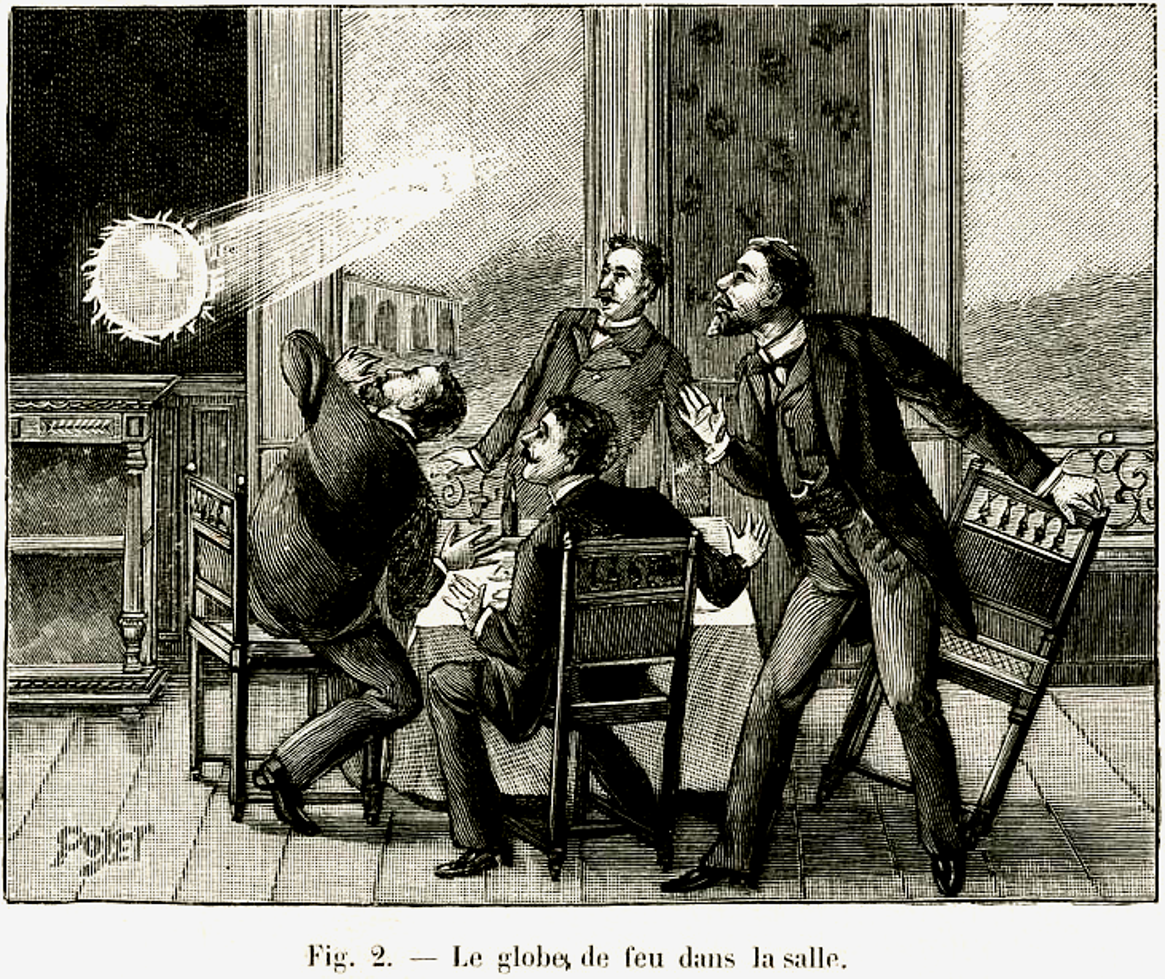
For as long as people have huddled indoors during thunderstorms, a small number of them have witnessed something that should not be possible. In the midst of the tempest, a glowing sphere of fire appears — a luminous ball, often the size of a grapefruit or a little larger, burning with a steady or flickering light. It floats. It drifts slowly through the air, sometimes drifting in through an open window or down a chimney, moving across a room past terrified onlookers, hovering, wandering, seeming almost to possess a purpose. It lasts a few seconds, occasionally longer, and then it either fades away, or vanishes silently, or bursts with a sharp report, sometimes leaving behind a sulfurous smell and scorched traces of its passing. This is ball lightning, and though it has been reported for centuries by witnesses of every kind, from peasants to sea captains to scientists, no one has ever been able to fully explain what it is. It is one of the oldest and most stubborn unsolved mysteries of the natural world — a phenomenon that science long refused to believe was real, and still cannot account for.
Centuries of Witnesses
Accounts of glowing spheres appearing during storms reach back through the whole of recorded history. Sailors told of luminous balls that came aboard their ships in foul weather and rolled along the decks. Villagers described fireballs that entered their homes, drifted through the rooms, and departed. There are famous historical reports of such spheres appearing inside churches during violent storms, moving among the congregation before exploding with deadly force. The witnesses come from every walk of life and every century, and their descriptions, gathered across vast distances of time and place, agree with one another to a remarkable degree: a spherical shape, a diameter usually of some inches, a glowing light of white, yellow, orange, red, or blue, a slow drifting motion often near the ground, a brief lifetime of seconds, and an ending that is either a quiet dissolution or a sudden bang.
The consistency of these reports is one of the strongest arguments for the reality of the phenomenon. People separated by centuries and oceans, who could not have influenced one another, have described the same strange thing in the same strange terms. And yet for a very long time, the scientific establishment refused to accept that ball lightning existed at all. It was too bizarre, too resistant to explanation, too much like a fireside tale. Reputable scientists dismissed the accounts as illusions, as the tricks of dazzled eyes after a bright flash of ordinary lightning, or as the imaginings of frightened people. The phenomenon lived in a strange limbo, witnessed by many and believed by few, an experience real enough to those who had seen it and yet officially denied by the guardians of knowledge.
The Reluctant Acceptance
Over time, as the reports continued to accumulate and as more and more credible witnesses — including trained observers and scientists themselves — came forward with firsthand accounts, the reality of ball lightning became harder to deny. There were even rare instances in which the phenomenon appeared to have been captured or measured by chance, lending physical weight to the mass of eyewitness testimony. Gradually the consensus shifted, and ball lightning came to be accepted as a genuine natural phenomenon rather than a myth or an illusion. But acceptance of its existence did not bring understanding of its nature. Scientists now agreed that the glowing spheres were real; they simply could not say what they were, how they formed, or what sustained them.
The difficulty is profound, and it lies at the very heart of the mystery. The behavior of ball lightning is deeply strange and hard to reconcile with any simple physical process. The spheres can persist for seconds — an eternity for a ball of glowing fire, far longer than any ordinary flame or spark of that size should endure. They move slowly and can float against the wind or descend gently, rather than rising as hot gases do. They can pass through small openings, through windows and gaps, and reports even tell of them passing through solid glass. They give off light but often, according to witnesses, little heat, until the moment they explode. No ordinary fire, no ordinary electrical spark, behaves in this way. Whatever ball lightning is, it obeys a logic of its own that has resisted every attempt to pin it down.
The Theories That Cannot Quite Catch It
Many explanations have been proposed over the years, each capturing some features of the phenomenon and failing to explain others. One influential idea holds that ball lightning forms when an ordinary lightning strike hits the ground and vaporizes minerals in the soil, throwing up a cloud of tiny burning particles — a floating ball of slowly oxidizing vapor that glows as it burns, drifting on the air until its fuel is spent. This theory can account for some cases and has even been partly reproduced in the laboratory in modest form, but it struggles to explain the spheres reported far from the ground, aboard ships or high in buildings, or those that pass through windows. Other theories invoke trapped bundles of energy, self-contained knots of electrical and magnetic force sustaining themselves in the air; still others suggest that at least some sightings are not external objects at all but visions produced within the eye and brain of a witness exposed to the powerful magnetic fields of a nearby storm, a hallucination of a floating light where none exists.
None of these explanations has won the field, because none accounts for the full range of what witnesses describe. The phenomenon is maddeningly various: some balls are small and some large, some silent and some explosive, some harmless and some deadly, some fading gently and some passing through walls. It has never been reliably summoned or reproduced in the laboratory in a form that matches the wild spheres of the storm. It cannot be studied at will, for it comes unbidden and unpredictably, lingers only for seconds, and leaves little behind. And so, despite centuries of witnesses and decades of serious study, ball lightning remains genuinely unexplained — a real thing that science admits exists and confesses it cannot understand, a living fire that drifts through the storm and through the walls of our knowledge alike, and slips away before it can be grasped.
An Esoteric Reading
To the student of the sacred traditions, ball lightning is a phenomenon of extraordinary resonance, for it is the appearance in the modern record of something the old wisdom always insisted was real: the living fire, the spirit of the element made visible, the intelligent flame that moves with a purpose of its own. Long before science reluctantly admitted the reality of the glowing spheres, the traditions of the world spoke of fiery beings and wandering lights — the salamander, the fire-spirit of the alchemists, said to dwell within and to embody the element of fire; the will-o'-the-wisp and the corpse-candle, the luminous orbs that drift across marsh and moor and were held to be spirits, omens, or souls; the tongues of flame that descend as signs of the divine presence. The witnesses who saw a ball of fire drift purposefully through a room, hover as though considering, and depart, described in the language of their fear exactly what the old traditions described in the language of their reverence: fire that lives, that moves, that seems to will.
Consider the qualities that make ball lightning so inexplicable to the physicist, and see how precisely they answer to the ancient conception of the fire-spirit. It gives light but little heat, as the traditions said of the sacred and spiritual fire, which illumines without consuming — the flame that burned in the bush and did not burn it away, the cool fire of the spirit as opposed to the devouring fire of mere matter. It moves against the wind and drifts where it will, obeying no law of ordinary flame, as a being of the element moves by its own volition rather than by the mechanics of combustion. It passes through solid barriers, through glass and wall, as a spirit passes through the boundaries that confine material things. And it endures far longer than any spark of its size has any right to, sustained by some inner principle that the investigators cannot find — precisely as the traditions held that the elemental beings are sustained not by fuel but by the living essence of the element itself. The mystic does not claim that every fireball is a conscious spirit; but he observes that the very features which defeat the physical explanation are the features the old wisdom attributed to the living fire, and he wonders whether the ancients, in their symbolic language, were pointing at a reality that our instruments still cannot capture.
And here the tradition offers its deepest reflection, on the meaning of a thing that appears unbidden, lingers only a moment, and cannot be summoned or held. The mystics have always taught that the manifestations of the spiritual world do not come at our command; they arrive by grace or by chance, in the midst of the storm and the disturbance, and they cannot be captured, reproduced, or made to perform for the investigator who wishes to pin them to a table and take their measure. Ball lightning is the perfect emblem of this elusiveness. Science, which masters what it can repeat and control, is helpless before a thing that comes only when it wills, stays only for seconds, and leaves almost nothing behind — and this helplessness is itself the lesson. The tradition teaches that there are realities which by their very nature cannot be grasped by the grasping method, that the living fire flees the hand that would seize it, and that some truths reveal themselves only to the witness who happens, in the chaos of the storm, to be present and open, and never to the one who lies in wait to trap them. The glowing sphere that drifts through the wall and vanishes is a reminder, written in fire, that the world is not exhausted by what we can command, that the elements may yet be alive in ways our knowledge cannot hold, and that the sacred visits us on its own terms — briefly, unpredictably, luminously — and is gone before we can reduce it to an explanation, leaving behind only the scorch-mark of its passing and the testimony of those fortunate and frightened few who saw the living fire drift through the storm and knew, past all argument, that it was real.
Related Esoteric Inquiries:
- Overtoun Bridge: The Scottish Span Where Dogs Leap to Their Deaths
- The Taos Hum: The Droning in the Desert That Only Some Can Hear
- The Naga Fireballs of the Mekong: The Silent Flames That Rise From the River Each Autumn
Lux Esoterica.
2026.


Comments