The Whaley House: The Man Who Watched a Hanging and Then Built His Home on the Gallows
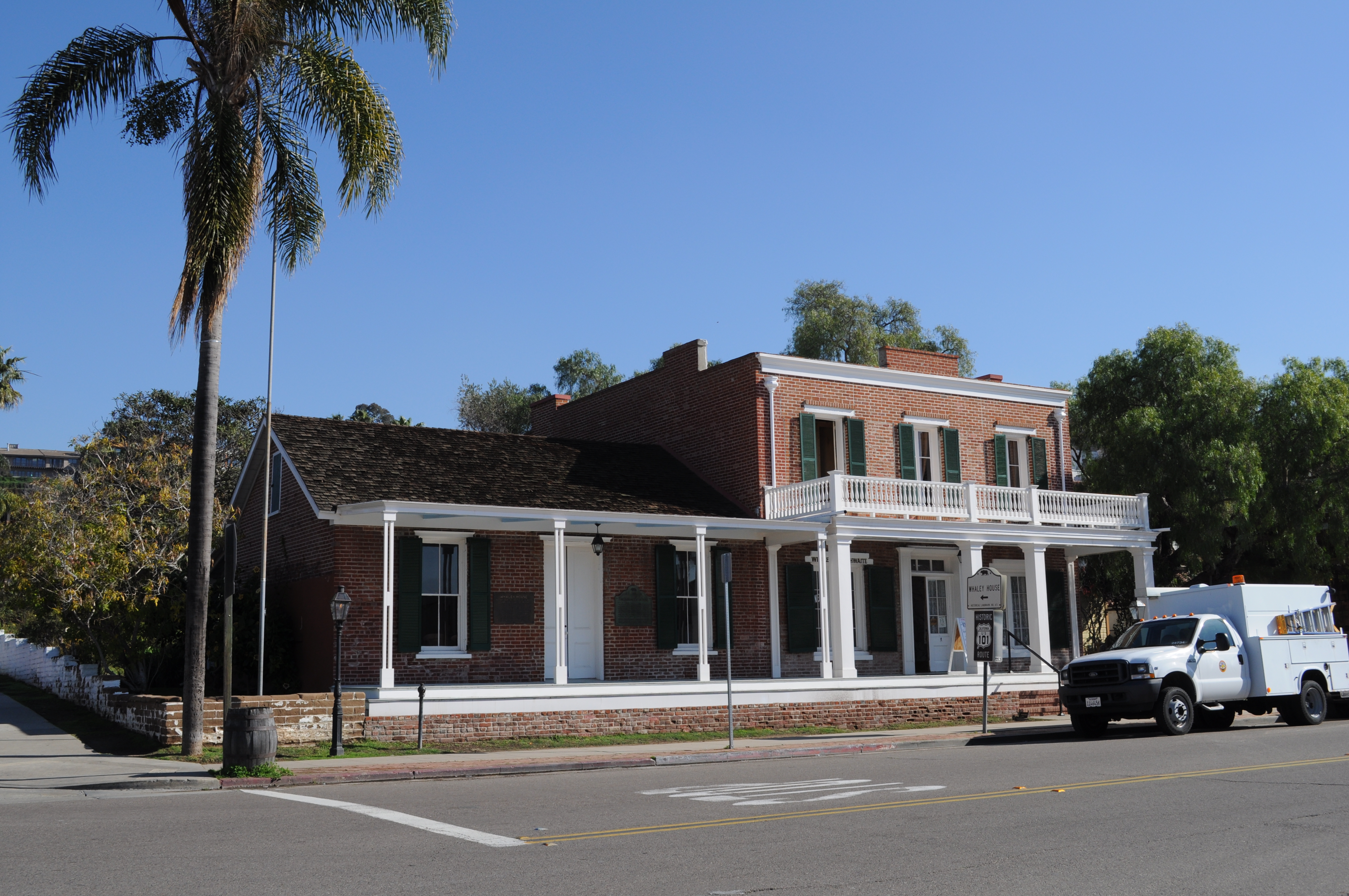
Most haunted houses are accidents. Someone builds a home, and then something terrible happens inside it, and the terrible thing stays. The sequence matters: first the house, then the horror. The family is a victim of its own address.
The Whaley House in Old Town San Diego reverses that order, and the reversal is the whole story. The horror came first. Thomas Whaley stood in the crowd and watched it happen with his own eyes. And then, four years later, he bought the ground it happened on and raised his family's roof directly over the spot.
He knew. That is what nobody ever quite absorbs about this house. He was not an innocent buyer who discovered the history afterward. He was a witness who came back with money.
The Hanging of Yankee Jim
In the summer of 1852, a drifter named James Robinson — everyone called him Yankee Jim — stole a rowboat in San Diego Bay along with two other men. It was a pilot boat, worth a few hundred dollars. They were caught almost immediately.
What happened next was less a trial than a formality. Robinson was struck in the head during his capture and appears to have been genuinely addled through the proceedings that followed; witnesses said he did not seem to understand what was being decided about him. He was convicted of grand larceny and sentenced to hang. For a boat.
On August 18, 1852, they took him to a gallows erected on a plot of open ground on the outskirts of town, and they made an error that the town would talk about for fifty years. Yankee Jim was a very tall man. The drop had not been figured for a man of that height, and the scaffold arrangement — a wagon pulled out from beneath him — did not give him enough fall to break his neck.
So he did not die of a broken neck. He strangled. Slowly, in front of everyone, his feet reportedly touching or nearly touching the wagon bed as it drew away, kicking and turning while the crowd stood and watched and nobody stepped forward to pull down on his legs and end it. Accounts differ on how long it took. None of them say it was quick.
Thomas Whaley was in that crowd. He was twenty-nine years old, a New York-born merchant who had come out during the gold rush and drifted down to San Diego to open a store. He watched a confused man take a long time to die over a stolen boat.
The Man Who Bought the Ground
In 1855 Whaley purchased that lot.
He built on it the finest house in Southern California — the first brick structure in the region, brick he fired himself from clay he dug out of a nearby riverbed, two stories of proper East Coast propriety plunked down in a dusty Mexican-American frontier town that had never seen anything like it. He moved his wife Anna and their children in. He was, by all evidence, extremely proud of it.
Why there? The unromantic answer is that it was good land, cheap, near his business interests, and a hanging ground in 1852 California was not the sort of thing that clouded a title. The frontier had a short memory and a large appetite. Men died badly everywhere and the living built on top of them and that was simply how the country got made.
But that unromantic answer does not survive contact with what Whaley himself wrote afterward.
The Boots on the Upper Floor
The family had barely settled in when the sounds began. Heavy footsteps on the upper floor — slow, deliberate, and by every description the tread of a big man in boots, walking above their heads in rooms they knew to be empty.
Thomas Whaley did not dismiss this. He did not blame the timbers or the wind. He wrote it down in a letter, plainly, and he named the cause without hesitation: it was Yankee Jim, walking the ground where he had been hanged.
Sit with that a moment. The master of the house — a hardheaded brick-making merchant, not a mystic — identified his own home's disturbance as the man he had personally watched strangle on that spot. He made the connection immediately and completely, because of course he did. He had been there. Some part of Thomas Whaley had been waiting to hear those footsteps since the day he signed the deed.
The House That Could Not Decide What It Was
Then the building began to change function, over and over, in a way that few houses ever do.
It was a family home. It was also Whaley's general store. Part of it became a granary. In 1868 a theatrical company, the Tanner Troupe, took over a room and ran it as a playhouse. And in 1869, the county rented the upstairs and turned the Whaley residence into the San Diego County Courthouse.
So on that one small parcel of earth, within twenty years, we get: a scaffold where a bewildered man was hanged badly for theft, and then a courtroom where the county handed down its judgments — the bench sitting almost directly above the place where the rope had done its work. The verdict and the drop, stacked one atop the other, under the same roof, with a family sleeping in between and actors performing farces down the hall.
The Night They Took the Records
The courthouse ended in violence of a bureaucratic kind. San Diego's center of gravity was shifting toward the new downtown, and in the spring of 1871 a party of men came to the Whaley House at night, forced their way into the county rooms, and carried the records away by lamplight. Whaley protested; he was one man. The county courthouse simply ceased to exist in his home, taken out the door in armloads.
He spent the rest of his life trying to be compensated for it and never was. The grievance ran through his remaining decades like a crack through a wall. A man who had built the finest house in the territory was left holding an empty upstairs and an unpaid claim.
Violet
The worst thing that happened in that house was not the hanging that preceded it.
Violet Whaley, Thomas and Anna's daughter, married a man in 1882 who turned out to be a fraud — he took what money there was and abandoned her within weeks. She came home and obtained a divorce, and in the San Diego of the 1880s a divorce was not a misfortune a young woman survived socially. She was talked about. She was, by the family's account, unable to leave the house without feeling the town's eyes on her.
On August 18, 1885, Violet went to the outbuilding behind the house, put a .32 caliber pistol against her chest, and shot herself through the heart.
She left a note. It quoted Thomas Hood's The Bridge of Sighs, a poem about a woman who drowns herself:
Mad from life's history, / Swift to death's mystery.
Note the date. August 18. The same calendar day, thirty-three years later, on which Yankee Jim was hanged on that ground. Whether Violet knew it, whether it means anything at all, or whether it is simply the kind of coincidence that the year is full of — that is precisely the question the house exists to ask and refuses to answer.
Thomas Whaley never recovered. The family moved out for a time. They came back. He died in 1890.
Who Walks There Now
The house today is a museum, and the reports have been consistent for a century and are now so numerous they have their own bureaucracy of docents and log books.
The heavy boots upstairs — still Yankee Jim, still crossing rooms that are empty. Anna Whaley in the parlor and the garden, small and dark-haired, sometimes accompanied by the smell of perfume. Thomas himself at the top of the stairs in a frock coat, and the sudden unmistakable smell of cigar smoke in a building where nobody has smoked for generations. Violet, weeping, in the room where she waited. A little girl who runs in the dining room. Even a small dog, brushing past ankles.
In the 1960s, when such lists were still compiled with a straight face, the United States Department of Commerce identified it as an authentically haunted house — one of a tiny handful the federal government ever put its name to. It has been called the most haunted house in America for sixty years and has never seriously relinquished the title.
An Esoteric Reading
Every tradition that has thought carefully about the dead agrees on one point: it is not death that makes a restless spirit. It is the manner of it.
The Greeks had two words for the ones who do not settle. The aoroi were the untimely — those taken before their portion was spent. The biaiothanatoi were the violently killed, and they were understood to be the most dangerous of all the dead, because the violence leaves the life unfinished in the way an interrupted sentence is unfinished. A man who dies in his bed at eighty has completed something. A man who dies at the end of a rope, in confusion, over a rowboat, with a whole town watching and none of them helping — that man has completed nothing. The thread is not cut. It is snarled.
And the botch matters enormously. A hanging that breaks the neck is, whatever else it is, an ending: instantaneous, clean, the passage accomplished. Yankee Jim was given the wrong drop, and so he was not passed through the threshold — he was held in it, strangling, for minutes, in front of the crowd. He was suspended between the two states in the most literal way a body can be suspended. The gallows is a doorway. He got stuck in the door.
Now consider what Whaley did. In nearly every old building tradition on earth there is some version of the foundation offering — the deposit placed beneath the threshold or the cornerstone, so that the house may stand and something may keep watch over it. The logic is grim but coherent: the structure is bought from the ground with a life, and the life becomes the guardian of the structure. The rite always requires that the offering be made deliberately, by the builder.
Thomas Whaley did not make an offering. He found one already lying in the ground, still warm in living memory, and he built on top of it and paid nothing.
That is the difference between a consecrated house and this one. He took the benefit of the covenant — the ground, cheap and good, and a guardian already installed — without ever having performed the rite or acknowledged the debt. And so the arrangement was never sealed. The offering never became the protector. It simply stayed what it had always been: a strangled man on the property, walking.
And once the seal is missing, the ground does not distinguish between the stranger and the family. The house Whaley raised on that spot proceeded to consume his own household by exactly the means the ground already knew — a violent death, at the hands of the occupant, on the eighteenth of August. What the earth had been taught to do in 1852 it did again in 1885, to the builder's own daughter.
He watched a man die on that patch of dirt, and then he came back and made it his hearth. There is no curse in that. There is only a man who saw the price posted, decided it did not apply to him, and moved his children in.
Lux Esoterica.
2026.


Comentarios