Aboriginal Australian Art: The World's Oldest Living Tradition
Aboriginal Australian art is the oldest continuously practiced art tradition on Earth — stretching back at least 50,000 years, making it contemporaneous with the earliest cave paintings of Europe and predating all other surviving artistic traditions. But what makes it singular is not merely its antiquity. It is the fact that it has never stopped: the traditions of painting, carving, body decoration, and ground marking that were practiced before the last ice age are still being practiced today by communities who understand themselves as the custodians of the same knowledge, the same Songlines, the same relationship to Country that their ancestors maintained. This is not a museum tradition. It is a living transmission — one that survived colonial genocide, forced removal of children, and the suppression of language, and continues to generate new works in old forms as the knowledge moves from elder to student, from grandmother to grandchild, as it has moved for fifty thousand years.
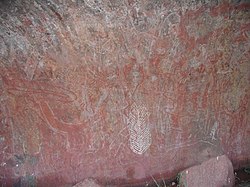
Uluru (Ayers Rock), Northern Territory — the sandstone monolith sacred to the Anangu people, whose Tjukurpa (sacred law and Dreaming) is encoded in every feature of its surface; Uluru is not merely a sacred site — it is a being, older than memory, whose stories are still taught and whose surface paintings are renewed in ceremony

Bradshaw (Gwion Gwion) rock art, Kimberley, Western Australia (c. 17,000 BCE) — among the most ancient figurative paintings in Australia, depicting human figures in movement with an elegance that has never been surpassed; the Ngarinyin people, on whose Country these paintings stand, know them as Gwion Gwion and understand them as figures from the Dreamtime

Baiame Cave, New South Wales — the cave painting of Baiame, the All-Father creator deity of the Wiradjuri and Kamilaroi peoples; Baiame is depicted with outstretched arms, his face showing the radiant lines of divine energy; the cave was a sacred initiation site where young men came to encounter the creator directly

Rock art, Barnett River, Kimberley — fish, human figures, and spirit beings recorded in ochre on sandstone; the Kimberley region contains one of the densest concentrations of rock art in the world, with sites that have been continuously painted for 50,000 years, each generation adding to what the previous ones left

Yirrkala bark painting, Arnhem Land — the bark painting tradition of northeastern Arnhem Land encodes sacred Dreaming stories in a visual language of crosshatching (rarrk) that can be read only by initiates; the patterns are owned by specific clans and cannot be used without permission — they are copyright in the most ancient possible sense
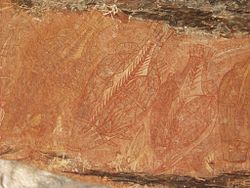
Barramundi rock art — the barramundi fish depicted in X-ray style, showing the skeleton and internal organs within the body outline; X-ray art is distinctive to Arnhem Land and reflects the Aboriginal understanding that all bodies are transparent to the spirit world — the interior is always visible to those with eyes to see

Yankee Hat rock shelter paintings, New South Wales — human figures, animals, and geometric forms accumulated over thousands of years at this sacred site; the layering of images from different periods creates a visual archaeology of spiritual practice, each generation adding its own mark to a surface already made sacred by previous contact

Chasm Island rock art, drawn by William Westall (1802) — among the earliest European records of Aboriginal rock art; Westall, the official artist on Matthew Flinders's circumnavigation of Australia, documented these Groote Eylandt paintings with the same care he applied to coastal charts; the images were already ancient when he saw them

Ochre pit, Central Australia — the red, yellow, and white ochres of the Australian interior are not merely pigments; they are sacred substances, their colors corresponding to the blood, fat, and bones of the Dreaming ancestors; access to specific ochre sources was and remains controlled by the traditional custodians of the land

Rainbow Serpent (Horned), John Mawurndjul (1991) — the Rainbow Serpent is the most important Dreaming figure across Australia, the creator of rivers, valleys, and waterholes; John Mawurndjul is one of the great masters of Arnhem Land bark painting; his rarrk crosshatching achieves a density and precision that makes the surface shimmer


Comentarios