Archangel Michael: The Celestial Warrior, Protector of Souls, and Prince of Heaven
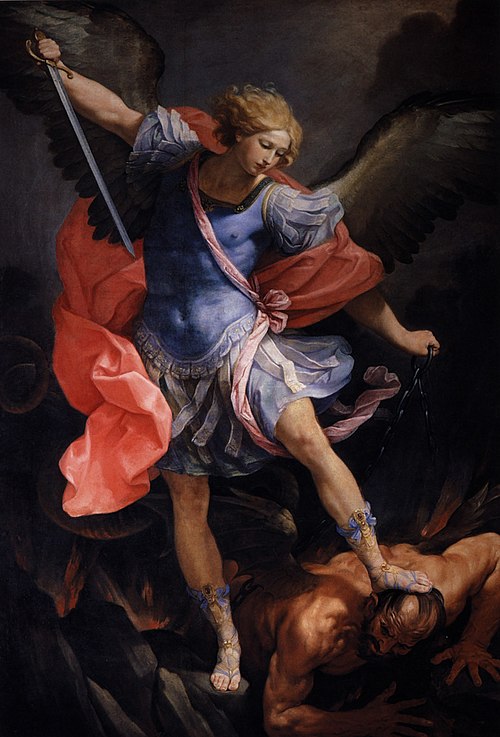
Guido Reni, "Saint Michael Archangel" (1635, Santa Maria della Concezione dei Cappuccini, Rome) — one of the most famous images of Michael in Western art, the warrior-angel standing triumphant with the morning star beneath his feet, his face turned upward toward the source of his authority.
Of all the named angelic beings in the great traditions of the world, none stands more universally recognized, more widely venerated, or more dramatically present across cultures, religions, and millennia than Michael — the Archangel whose very name is a battle cry and a theological declaration simultaneously. Mi-cha-El in Hebrew: "Who is like God?" — a rhetorical question that declares, with absolute force, that nothing and no one compares to the divine, that every power in heaven and earth must bow before the one source of all being.
Michael appears in Jewish scripture, in Christian apocalyptic literature, in Islamic tradition, in Zoroastrian angelology, and in the folk spirituality of hundreds of cultures across thousands of years. He is the captain of the heavenly host, the defender of Israel, the warrior who cast Satan from heaven, the psychopomp who escorts souls to their judgment, the patron of soldiers, police officers, doctors, and the sick, the guardian of the Church, the protector at the hour of death. He is, in short, the supreme champion — not of any human power or institution, but of the divine order itself against every force that opposes it.
The Name: A Question That Answers Itself
The name Michael (Mi-ka-el, מִיכָאֵל) is composed of three Hebrew elements: mi (who), ka (like, as), and El (God, the divine). Taken together: "Who is like God?" This is not a genuine question requiring an answer. It is a negative rhetorical declaration — the angelic equivalent of "No one and nothing is like God." Michael's very name announces the absolute transcendence of the divine, the incomparability of the ultimate reality before which all other powers are relative.
This theological content embedded in the name tells us something essential about Michael's function. He does not fight in his own name or by his own power. He fights in the name of God — the declaration "Who is like God?" is simultaneously his battle cry and his identity. When Michael advances against the rebel angels, against the forces of chaos and evil, he does so not as a powerful individual asserting his dominance, but as the living question mark that dissolves every false claim to ultimate authority: "You think you are like God? You are not. I carry the sign of that truth."
The Warrior of Heaven: The Great Conflict
Michael's most dramatic and theologically significant role is as the leader of the loyal angels in the cosmic conflict against the forces of rebellion. The fullest account is in the Book of Revelation (chapter 12):
"Then war broke out in heaven. Michael and his angels fought against the dragon, and the dragon and his angels fought back. But he was not strong enough, and they lost their place in heaven. The great dragon was hurled down — that ancient serpent called the devil, or Satan, who leads the whole world astray. He was hurled to the earth, and his angels with him."
The imagery is overwhelming: a cosmic war in which the fate of the entire created order hangs in the balance. The dragon — the ancient adversary, the intelligence that opposes the divine order — commands an army of fallen angelic intelligences. Against them stands Michael and his host. The conflict is not between equals; the text is clear that the adversary "was not strong enough." But the war is real, the stakes are ultimate, and Michael's role as champion of the divine order is established beyond question.

Andrei Rublev, icon of Archangel Michael (c. 1408, Dormition Cathedral, Vladimir) — the great Russian iconographer captures Michael's essential nature: a being of serene, sovereign power, whose strength flows entirely from the divine it serves.
This is the foundational vision: Michael as the defender of the sacred order — not a capricious fighter, not a warrior who relishes battle for its own sake, but a being whose entire martial capacity is devoted to a single purpose: ensuring that the divine order, the reality of things as they truly are, is not displaced by the illusions and distortions of the adversarial powers.
Michael in the Book of Daniel
Long before Revelation, Daniel describes Michael with a specificity that gives him a distinctive role in Jewish theology. In Daniel 10, the angel who appears to Daniel (often identified as Gabriel) reveals: "the prince of the Persian kingdom resisted me twenty-one days. Then Michael, one of the chief princes, came to help me." And later: "At that time Michael, the great prince who protects your people, will arise." (Daniel 12:1)
Here Michael appears not as a universal cosmic warrior but in a specific national role: he is the heavenly prince of Israel, the angelic being assigned to watch over and protect the Jewish people in the great spiritual conflicts that shape their history. When the Prince of Persia (the angelic power governing the Persian Empire) opposes the divine messenger, it is Michael who breaks the deadlock. When the final great tribulation comes, it is Michael who arises in defense of his people.
This dimension of Michael — as the protector of a specific people — reveals an important aspect of his character. He is not merely an abstract principle of cosmic order; he is a being of personal, passionate, particular loyalty. He fights for those entrusted to his care with the dedication of a knight who has sworn an oath to protect his lord's people. His universality does not diminish his particularity; rather, the universal principle of divine order expresses itself through particular acts of faithful protection.
Michael as Psychopomp: Escort of Souls
One of Michael's most important — and perhaps least expected — roles in the tradition is that of psychopomp: the guide of souls at the moment of death and into the afterlife. This function, prominent in Eastern Christian and Catholic tradition, represents a different dimension of protection: not from physical enemies or spiritual adversaries during life, but from the disorientation and danger of the transition between worlds.
In Catholic tradition, Michael is invoked specifically at the moment of death — in the prayers of the Anointing of the Sick, in the Commendatio animae (Commendation of the Departing Soul), and in the famous prayer of Pope Leo XIII: "Saint Michael the Archangel, defend us in battle, be our protection against the wickedness and snares of the devil..." Michael is asked not merely to protect in life but to stand at the threshold of death and escort the soul safely through.

Hans Memling, detail from "The Last Judgment" (c. 1467–1471, National Museum, Gdańsk) — Michael holds the scales of divine justice, weighing souls at the threshold of eternity. This image of Michael as psychopomp and divine judge's assistant is one of the most enduring in all of Christian sacred art.
The image of Michael with a scale — weighing the souls of the dead to determine their destiny — is one of the most ancient and widespread in the entire tradition. It connects directly to the Egyptian concept of the weighing of the heart by the god Thoth (or Anubis), and it appears throughout medieval Christian art as a central scene of the Last Judgment. Michael does not merely escort the soul; he participates in the act of cosmic justice that determines each soul's eternal orientation.
Michael Across Traditions
Michael's presence extends far beyond Jewish and Christian scripture. In Islamic tradition, Michael (Mikail or Mika'il) is one of the four great angels (alongside Gabriel, Israfil, and Azrael) and is associated with natural phenomena — rain, thunder, the growth of plants — and with the distribution of divine provisions to all creatures. His role as sustainer and provider complements his role as warrior and protector.
In Zoroastrian angelology, the figure of Vohu Manah (Good Mind) bears significant parallels to Michael: a supreme divine intelligence whose role is to align creation with the divine order and to fight the forces of the Lie (Druj) — the cosmic adversary of truth and order. The structural similarity suggests that the figure of the divine champion-archangel touches on something universal in human spiritual experience: the intuition that the forces of order, truth, and goodness in the cosmos are not passive, that they are actively championed by a supreme celestial intelligence.
The Art of Michael: Beauty in the Service of Power
Sacred art across the centuries has returned again and again to the figure of Michael, drawn by the visual challenge and spiritual invitation he presents: how do you depict sovereign power in the service of love? How do you show a warrior who is simultaneously a being of absolute purity and serenity?

Archangel Michael with trumpet and orb — a Nubian wall painting from the Cathedral of Faras (c. 8th–12th century, now in the National Museum Warsaw) — one of the most beautiful early Christian images of Michael, showing the African Christian tradition's reception of the archangel.
The great tradition of Michael iconography ranges from Andrei Rublev's ethereally serene Byzantine icons to Guido Reni's baroque triumph, from the massive bronze angel crowning Castel Sant'Angelo in Rome (commemorating a vision of Michael by Pope Gregory the Great during the plague of 590 CE) to the extraordinary Nubian wall paintings of Faras Cathedral. In each tradition, each culture, each artistic language, something essential remains constant: the combination of indomitable power and perfect purity, the warrior who fights without hatred, the champion who is entirely at peace.
The Inner Michael: Courage Without Cruelty
For the contemplative and esoteric traditions, Michael embodies an inner principle: the capacity for genuine courage — the willingness to confront what is false, disordered, or harmful, not out of anger or desire for dominance, but out of love for what is true and good.
The sword Michael carries is the sword of discernment — the capacity to cut through illusion, to name what is real, to refuse to accommodate to what is untrue even when accommodation would be easier and more comfortable. This is the inner Michael: not the part of us that picks fights, but the part of us that is willing to stand firm when it matters, to say "No" to what opposes the sacred, to protect what is genuinely valuable even at personal cost.
In every soul, something of Michael's vocation lives: the call to champion the divine order not in the abstract but in the specific, concrete circumstances of our lives — in our families, our communities, our inner lives, wherever truth and goodness need a defender. To invoke Michael is not merely to ask for external protection; it is to awaken, within oneself, the capacity for that kind of faithful, fierce, serene courage that his name embodies.
Who is like God? No one. And that truth — held firmly, at whatever cost — is the beginning of everything.
— Lux Esoterica


Comentarios