Buddhist Stupas: Sacred Architecture of the Awakened Mind
The stupa is the fundamental architectural form of Buddhism — a solid hemisphere of brick or stone, capped by a spire, built to contain a relic of the Buddha or an enlightened teacher, and consecrated as a focus of circumambulation, devotion, and meditation. Its form is not arbitrary. The hemisphere represents the dome of heaven; the square base represents the four directions and the earth; the central axis (the harmika and its spire) represents the axis mundi, the cosmic axis connecting earth to heaven. To walk clockwise around a stupa (pradakshina) is to align the body with the movement of the cosmos, to make the self a satellite of the sacred center. The stupa form has spread from its origins in northern India across the entire Buddhist world, transforming as it travels: from the flat-domed Sanchi in Madhya Pradesh to the golden Shwedagon in Rangoon to the white Boudhanath in Kathmandu to the towering pagodas of China, Japan, and Southeast Asia — each a local expression of the same universal symbol.
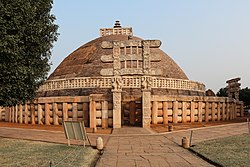
Great Stupa at Sanchi, Madhya Pradesh, India (3rd century BCE–1st century CE) — the oldest stone structure in India and one of the oldest Buddhist monuments; commissioned by Emperor Ashoka after his conversion, its four elaborately carved gateways (toranas) tell the story of the Buddha's previous lives in stone

Boudhanath Stupa, Kathmandu, Nepal — one of the largest stupas in the world; the all-seeing eyes of the Buddha painted on the four sides of the harmika watch in all four cardinal directions; the prayer flags radiating from the summit send mantras into the wind with every flutter

Shwedagon Pagoda, Rangoon, Myanmar — rising 99 meters above its hilltop, plated in gold leaf and crowned with 5,000 diamonds and 2,000 rubies; said to enshrine eight hairs of the historical Buddha; a center of Burmese Buddhist life for over 2,600 years

Ruwanwelisaya Stupa, Anuradhapura, Sri Lanka (2nd century BCE) — the great 'jewel of stupas,' 103 meters high, containing relics said to include the alms bowl of the Buddha and his right collarbone; it has been continuously maintained and venerated for over two thousand years

Samye Monastery, Tibet (8th century CE) — the first Buddhist monastery built in Tibet, designed as a three-dimensional mandala representing the Buddhist cosmos; its central temple represents Mount Meru, the surrounding buildings the continents, oceans, and celestial realms of Buddhist cosmology

Stupa at Vaishali, Bihar, India — one of the eight original stupas built immediately after the Buddha's death to contain portions of his ashes, distributed among the kingdoms whose rulers requested relics; the stupa tradition begins here, at the moment of the first Buddhist sacred geography

East Gateway and railings, Bharhut Stupa, Madhya Pradesh (2nd century BCE) — among the earliest examples of Buddhist narrative sculpture; the railings carved with yakshi (fertility spirits), jataka tales, and floral abundance represent the integration of pre-Buddhist folk religion into the new dharma

Stupa No. 2, Sanchi — the smaller of the Sanchi stupas, its railings carved with medallions of lotus, horse, and elephant motifs; the three Sanchi stupas together constitute the most complete surviving Buddhist sacred complex from the Mauryan and Shunga periods

Northern gateway of the Great Stupa, Sanchi — the carved stories of the Buddha's life crowd every surface; the Buddha himself is never depicted in human form in the early tradition — his presence is indicated by symbols (footprints, the Bodhi tree, the wheel) rather than his image, a restraint that lasted five centuries

Butkara Stupa, Swat Valley, Pakistan (3rd century BCE) — in the ancient kingdom of Gandhara, Greek artistic conventions met Buddhist theology to produce the first images of the Buddha in human form; this stupa stands in the region where that transformation occurred


Comentarios