Caravaggio and the Baroque Sacred: Light, Shadow, and the Divine
Michelangelo Merisi da Caravaggio (1571-1610) did not merely paint differently from his predecessors — he made a different theological claim. Where Renaissance sacred art placed the divine in idealized, luminous, transcendent figures remote from everyday human experience, Caravaggio placed it in darkness, in the specific, in the body of a peasant woman who might be found dead in the Tiber River. His St. Matthew was a rough-handed laborer. His Virgin was the corpse of a drowned woman, her feet bare, her body swollen. His apostles were old men with dirty feet. The scandalized reaction of his patrons (several paintings were refused by the churches that commissioned them) was the appropriate response to what he was doing: insisting that the sacred was not located above human experience but within it — in the darkest, most specific, most physical moments of human life. The Council of Trent (1545-1563), the Catholic Church's response to the Protestant Reformation, had demanded that sacred art be emotionally accessible to ordinary people. No one fulfilled that demand more completely, or more dangerously, than Caravaggio.

The Calling of Saint Matthew (1599-1600) — the moment Christ calls the tax collector Matthew from his table; the shaft of light that enters from the right (from the direction of Christ, whose face is in shadow) falls on Matthew's face, which shows astonishment mixed with self-awareness; the other figures barely notice; Caravaggio stages the miracle as a private psychological event in a tavern

Judith Beheading Holofernes (c. 1599) — Caravaggio gives Judith an expression not of triumph but of concentrated effort and mild revulsion — the face of someone doing a necessary thing they would rather not be doing; the psychological realism is devastating; the blood spurts realistically from the partially severed neck; this is not a heroic allegory but a murder
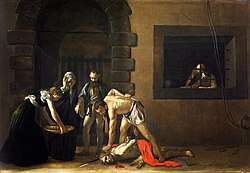
The Beheading of Saint John the Baptist (1608) — painted for the oratory of the Co-Cathedral of St. John in Valletta, Malta; the largest canvas Caravaggio ever painted; Caravaggio signed it in the blood flowing from the Baptist's neck — his name literally written in the martyr's blood; the composition's ruthless emptiness (half the canvas is shadow) makes the violence more, not less, present
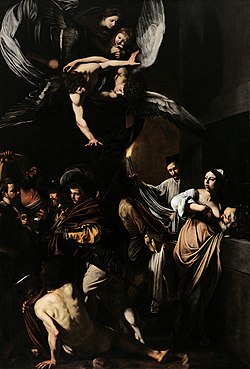
The Seven Works of Mercy (1606-1607) — painted for the Pio Monte della Misericordia in Naples; all seven corporal works of mercy (feeding the hungry, giving drink to the thirsty, clothing the naked, sheltering the stranger, visiting the sick, visiting the imprisoned, burying the dead) compressed into a single street scene, the Virgin and angels observing from above; the divine witnesses the human from a careful distance

Death of the Virgin (1601-1606) — refused by the church that commissioned it because Caravaggio modeled the Virgin on a prostitute drowned in the Tiber; the swollen feet, the undignified pose, the grief-wrecked faces of the apostles — everything here is too specific, too physical, too human for a Counter-Reformation church hoping for transcendence; Rubens bought it for the Duke of Mantua
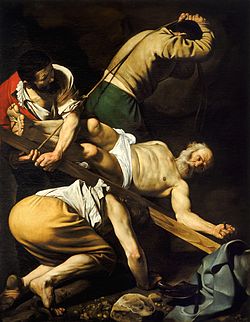
The Crucifixion of Saint Peter (c. 1600) — Peter being hoisted upside down on the cross; what should be a scene of triumphant martyrdom becomes an exercise in physical effort — the men hoisting the cross grunt with exertion, one of them shows us only his straining back; the theology of the body made completely literal: salvation happens in flesh, in effort, in the specific indignity of suffering

The Denial of Saint Peter (1610) — Peter's face in the moment he denies Christ; painted in the last year of Caravaggio's life, after years of flight from a murder conviction; there is something autobiographical in the failed man's face, the knowledge of weakness meeting its own reflection in the candlelight; Caravaggio died six weeks after this painting was completed


Comentarios