Cerberus: The Hound of Hades, Guardian at the Edge of All Things

Hades enthroned with Cerberus — ancient Greek vase painting. The lord of the dead and his monstrous hound, inseparable guardians of the realm beneath.
At the border between the living world and the dead, where the rivers Styx and Acheron flow through eternal twilight, there stands a guardian unlike any other in world mythology. He does not wield a sword. He does not demand a toll. He simply sits — three-headed, mane of writhing serpents, tail tipped with the head of a dragon — and allows the dead to enter freely. What he will not permit is for anyone to leave.
Cerberus, the Hound of Hades, is not the monster many imagine: a ravening beast that devours the innocent. He is something far more philosophically precise — a gatekeeper of irreversibility, a guardian of the threshold that runs in only one direction. He keeps the dead in the underworld not out of cruelty but because that is the nature of death: it does not give back what it takes. And he keeps the living from venturing too far into the realm of the dead — because those who linger there are changed by what they encounter, and not all of them find their way back.
To pass Cerberus is to cross the most fundamental boundary in human experience. And only three living beings in all of Greek myth manage it: a hero armed with divine favor, a musician with a lyre, and a young woman carrying a honey cake.
Origins: The Monster Born from the World's Deepest Fear
In Hesiod's Theogony, Cerberus is born from Echidna and Typhon — the most terrifying pair in Greek cosmology. Typhon is the last great challenge to the Olympian order, a being so enormous that his head brushed the stars and his voice was a chorus of animal roars; the gods themselves fled before him, temporarily disguised as animals, until Zeus rallied and defeated him with thunderbolts. Echidna — half beautiful woman, half monstrous serpent from the waist down — is the "mother of all monsters," who produced with Typhon the full catalog of Greek mythological terrors: the Hydra, the Sphinx, the Nemean Lion, the Chimera, and Cerberus.
Hesiod calls Cerberus "the hound of Hades, with fifty heads" — a number meant to convey sheer overwhelming multiplicity. Later tradition settled on three heads as the canonical number, and this reduction is itself significant: the three-headed form is not a diminishment but a focusing. Three is the number of structure, of dynamic tension resolved, of beginning-middle-end. It is the minimum number required for a thing to have both complexity and completeness.
Cerberus is described with serpents growing from his back and mane, his tail ending in a serpent's head or a dragon's head depending on the source. He is not simply a large dog. He is a convergence of every animal that the Greeks associated with death, transformation, and the chthonic underworld: the dog (psychopomp, companion at the threshold), the serpent (underworld, regeneration), the dragon (primordial chaos, hoarded treasure — in this case, the hoard is the dead themselves).
The Function of the Guardian: Asymmetric Passage
The most philosophically striking thing about Cerberus is his asymmetry. He allows the dead in without resistance. The shades of the newly deceased drift past him without challenge, descending to the halls of Hades to be judged and assigned to their final place. He does not threaten them or demand passage. He simply lies at the gate, and they go in.
What he prevents is exit. The dead who attempt to leave, and the living who venture too deep, are turned back by his three-headed, serpent-maned ferocity. He is the biological lock on death: the principle by which the dead do not return, by which the underworld holds what it receives.
This asymmetry maps onto a profound psychological truth. It is easy to descend into certain states of being — grief, depression, obsession, the underworld of the psyche — and very hard to return from them. Not because the entry is inviting, but because the direction of descent is always available, while the direction of return requires active effort, help, and usually some form of song or cunning.

Heracles capturing Cerberus — black-figure amphora, 6th century BCE. Musée du Louvre, Paris. The hero leads the three-headed hound by a chain.
The Twelfth Labor: Heracles and the Power of Presence
Of all twelve labors of Heracles, the capture of Cerberus is the last, the most dangerous, and the most remarkable for what is absent from it. Heracles is specifically forbidden from using his weapons: no arrows, no club, no lion-skin armor. He must subdue Cerberus with his bare hands alone, through sheer physical and psychic force of presence.
Heracles descends to the underworld and goes directly to Hades, asking permission to borrow the hound as a proof of his labor. Hades agrees, on the condition that Heracles uses no weapons. Heracles finds Cerberus at the gates of Acheron, seizes him with his bare arms, and squeezes until the hound submits — Cerberus's serpent-tail biting futilely at the hero's lion-skin, which remains from his very first labor. He then leads the monstrous dog back to the surface, presents it to the terrified Eurystheus (who famously hides in a large jar), and returns Cerberus to the underworld.
The detail that no weapons are permitted is crucial. The twelve labors progress from increasingly external to increasingly internal forms of challenge. The first labors involve monsters at a distance: Heracles kills the Nemean Lion, the Lernean Hydra, the birds of the Stymphalian Lake. The later labors involve tasks of cunning, endurance, and relationship — cleaning the Augean stables, fetching the cattle of Geryon, retrieving the golden apples of the Hesperides. The final labor is a confrontation without weapons, in the realm of death itself. The hero must overpower not with technology or distance but with embodied presence.
In esoteric terms, this is the labor of the self confronting its own mortality without defensive armor — and finding that mortality, when met directly, can be temporarily held and led, though never permanently conquered.
Orpheus: The Sovereignty of Music Over Death
The second passage of Cerberus is the most beautiful in all Greek myth. Orpheus — son of a Muse, player of the lyre, the first musician who could move rocks and trees with his song — descends to the underworld to reclaim his wife Eurydice, killed by a serpent's bite on their wedding day.
Where Heracles overcame Cerberus with force, Orpheus does not even need to overpower him. He plays, and Cerberus simply listens. The three-headed guardian of the irrevocable sits down and is still.

Orpheus with his lyre, charming all creatures — Roman mosaic, 3rd century CE. National Museum of Athens. Music as the universal solvent of resistance.
Music stops Cerberus because music speaks directly to whatever is beyond thought, beyond decision, beyond the structured judgment that governs who may pass and who may not. The lyre of Orpheus does not argue, does not fight, does not bribe. It simply sounds, and in the sounding, the rules of the underworld briefly suspend themselves. Persephone weeps. Even the Furies, who had never before shed a tear, find their iron cheeks wet.
Orpheus proceeds to Hades and Persephone, sings his petition, and is granted Eurydice — on the condition that she walk behind him and he does not look back until they have reached the surface world. He fails, at the last moment. He turns. She is lost again.
The Orphic tradition read this failure not as weakness but as initiation: Orpheus, having penetrated the underworld and returned, founded the mystery religion that bore his name — the Orphic mysteries — built on the knowledge that the soul can survive death, and that the journey back from the underworld is the most demanding passage of all, requiring trust in what cannot yet be seen.
Cerberus in the Orphic tradition becomes the guardian of initiation: the threshold test at the entrance to the mysteries, the force that can be stilled only by music — that is, by a consciousness elevated beyond ordinary thinking.
Psyche's Honey Cake: Feminine Cunning at the Threshold
The third passage belongs not to a hero or a musician but to a mortal young woman. Psyche, set her impossible tasks by the jealous Aphrodite, is sent to the underworld to retrieve a jar of Persephone's beauty ointment. She is instructed beforehand by a mysterious voice — in Apuleius's The Golden Ass, some versions suggest it is a tower that speaks — and the instructions include a very specific item: two honey cakes (offae in Latin), one for each hand.
When she reaches Cerberus on her way in, she gives him one. When she returns, she gives him the other.
The honey cake bypasses force, bypasses music, bypasses divine favor. It is simply food — a gift, an acknowledgment of the hound's nature, a fulfillment of his appetite. Cerberus is appeased not by being overcome but by being fed. His ferocity dissolves in the face of something he simply wants.
This is the wisdom of the feminine approach to the threshold: not confrontation, not enchantment, but recognition. The guardian is not the enemy; he is a being with needs. Meeting those needs is the key. Psyche carries two cakes because she must pass twice — in and out — and the voice's foresight encompasses both journeys. She is the only one of the three mortals who plans her return from the beginning.
Virgil and the Drugged Sop: Aeneas in the Underworld
In Virgil's Aeneid, the Trojan hero Aeneas descends to the underworld guided by the Sibyl of Cumae, who carries with her a golden bough (the key to Persephone's hospitality) and a drugged sop of honey and grain — essentially a stronger version of Psyche's honey cake, laced with soporific herbs. When Cerberus approaches them with all three heads barking, the Sibyl tosses the sop. Cerberus seizes it greedily, eats it, and falls into a drugged sleep across the entirety of the cave entrance, his enormous bulk blocking nothing now.
Virgil's Cerberus is more explicitly animal — he can be simply sedated. But the sop still works by giving rather than taking. The underworld admits those who bring gifts.
Aeneas proceeds to meet his father Anchises in the Elysian Fields, where he is shown the souls of future Romans waiting to be born — a vision of Roman destiny, history as a continuous thread of souls cycling between the world of the living and the world of the dead, with Cerberus as the custodian of the border between turns.
Dante's Cerberus: The Glutton at the Gate of Appetite
In the Inferno, Dante transforms Cerberus once more. He appears in the Third Circle, the circle of the gluttons — those whose lives were consumed by physical appetite — where he stands in the sleet and filth, his three heads ravenous, clawing and biting the souls of the condemned. The pilgrim Dante and his guide Virgil cannot pass until Virgil scoops up a handful of earth and flings it into the three gaping maws. Cerberus stops and eats the dirt.
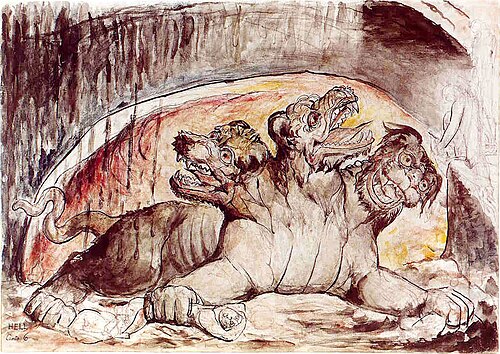
William Blake — Cerberus, illustration for Dante's Inferno, c. 1824–1827. Tate Britain, London. A monstrous figure of pure appetite, his three heads ravenous.
Dante's placement of Cerberus in the circle of gluttony is a brilliant piece of medieval moral allegory. The hound of uncontrollable appetite guards those whose uncontrollable appetites defined them in life. He is not arbitrary — he is appropriate. His three-headed hunger is the mirror of what the souls beneath him suffered from. And Virgil's solution — dirt, the most basic, most valueless substance, the opposite of delicate food — shows that the essence of appetite, pushed far enough, does not discriminate. It will consume anything.
William Blake's illustration (c. 1824–1827) renders Cerberus as a vast, humanoid shape rising from the murk, his three heads enormous and gaping, the souls of the damned tiny beneath him — a vision of appetite made structural, made architectural. He does not look like a dog. He looks like what unintegrated desire becomes when given total freedom.
The Three Heads: A Millennium of Interpretation
The three heads of Cerberus have been interpreted through every lens available to Western esotericism.
Macrobius, the 5th-century Latin commentator, identified the three heads with past, present, and future: Cerberus devours all three modes of time, consumes all human experience in the end. This reading makes him not a monster but a cosmological principle — time's hunger is absolute.
Medieval bestiaries read the three heads as birth, life, and death: the three phases of mortal existence, all of which the underworld eventually receives. To pass Cerberus is to have traversed all three.
The alchemical tradition identified the three heads with the Tria Prima — sulfur, mercury, and salt — the three fundamental principles of matter that Paracelsus named as the constituents of all things. Cerberus, in this reading, is the guardian of material existence itself: the force that holds bodies together in their three-fold composition.
The Orphic tradition saw the three heads as three modes of consciousness: the waking mind, the dreaming mind, and the deep unconscious — the three levels of the psyche that must all be brought into harmony before the soul can pass freely between the living and the dead.

Heracles presenting Cerberus to the terrified Eurystheus — black-figure hydria, c. 525 BCE. Musée du Louvre, Paris. Eurystheus hides in a storage jar at the sight of the beast.
The Dog as Psychopomp: Cross-Cultural Guardians of the Threshold
The dog's association with death and the passage between worlds is one of the most universal symbols in human mythology. It is worth situating Cerberus in this broader tradition.
In Norse mythology, Garm guards the entrance to Hel — the realm of the dead — chained at the cave Gnipahellir. Like Cerberus, he is released at Ragnarök, the final battle, and fights the god Tyr. His howl is one of the signs of the end.
In Aztec mythology, Xolotl is the dog-god who guides the dead through the nine levels of Mictlán, the underworld, accompanying them on a journey that takes four years. Xolotl is not a threat but a companion — the hairless xoloitzcuintli dog was bred by the Aztecs specifically as a funeral animal, to be sacrificed and buried with the dead as a guide. Here the dog's association with death is tender rather than ferocious: the hound goes with you into the dark.
In Egypt, Anubis — the jackal-headed god who presides over embalming and the judgment of the soul — is the Egyptian counterpart of Cerberus, though his function is more elaborate. He weighs the heart of the deceased against the feather of Ma'at (truth); if the heart is heavier than the feather, the monster Ammit devours it. Anubis, like Cerberus, stands at the threshold — but his role is active judgment, not passive obstruction.
Across cultures, the dog knows the way between the worlds. Dogs are associated with the threshold — they sleep at doors, alert to both inside and outside, belonging fully to neither. They can sense what humans cannot. In many traditions, a dog howling at night is an omen of death because the dog has sensed something passing that human senses cannot register. Cerberus is this threshold quality pushed to its mythological extreme: the dog who does not merely sense the border but is the border.
The Esoteric Cerberus: The Guardian at Every Threshold
In the long tradition of Western esotericism — Hermetic, Rosicrucian, and later theosophical — Cerberus became a symbol of the lower guardian, the force that stands at the threshold of each stage of inner development and refuses passage to those not yet prepared.
The Hermetic tradition read the three heads as the three obstacles that the initiate must overcome before ascending: the weight of the past (what has been done and cannot be undone), the anxiety of the present (the fear that prevents clear action), and the uncertainty of the future (the paralysis of not-knowing). To pass Cerberus is to have developed a relationship with all three — not to have dissolved them, but to have something to offer them.
Rudolf Steiner, in his lectures on spiritual science, spoke of a Guardian of the Threshold (Hüter der Schwelle) — a being encountered in spiritual development that confronts the student with everything in themselves that is unintegrated, unowned, unredeemed. The Guardian does not attack. It simply shows. What it shows is what the student has not yet faced. Only by honestly confronting this — not by violence, not by music that sidesteps the confrontation, but by full, patient acknowledgment — can the student advance.
Cerberus in this reading is not an enemy but a necessary teacher: the force that prevents premature passage, that insists on preparation, that keeps the worlds separate until the crossing can be made with integrity.
The Irreversible, the Music, and the Gift
Three living humans cross Cerberus, and each represents a different mode of approach to the threshold of death and transformation.
Heracles crosses by force of embodied presence — the willingness to go bare-handed into the worst place, without weapons, without ego-defense. This is the way of the warrior-mystic: not aggression but radical openness.
Orpheus crosses by music — by the consciousness that is elevated beyond ordinary thinking, that moves directly to what is deepest in all things. This is the way of the artist-shaman: the song that dissolves the fixed order of things, if only for a moment.
Psyche crosses by cunning and preparation — by knowing what the guardian needs, by having thought far enough ahead to bring it. This is the way of the devoted lover: the practical wisdom that serves even the gods by anticipating the needs of the journey.
Each method works. None of them is permanent. Cerberus returns to his post. The threshold closes. The worlds remain separate.
But the fact that three ways of crossing exist is the myth's most generous teaching: the threshold between the known self and the deeper unknown is not impenetrable. It can be passed. The guardian is not the enemy. He is the test — the test of whether you are ready to encounter what lives in the dark, and whether you have thought carefully enough about how to come back.
The honey cake in both hands. The thread of Ariadne. The wings of Daedalus. The lyre that moves what cannot be moved by argument. The stories of the underworld teach the same lesson across a thousand years of telling: the dark does not yield to force alone, and the way back is always the harder road — but it exists, for those who have prepared and those who have listened.
— Lux Esoterica


Comentarios