Chartres Cathedral: The Light That Becomes God
The medieval builders of Chartres Cathedral understood something that modern architecture has largely forgotten: that the purpose of a sacred building is not to shelter the congregation from the elements, but to dissolve the boundary between the human and the divine. Their tool was light — specifically, the transformation of ordinary white sunlight into colored light through stained glass, a technology so sophisticated that its blue (the famous Chartres blue, produced with cobalt and other minerals whose exact formula was lost and has never been fully recovered) remains unmatched seven centuries later. To stand inside Chartres on a clear afternoon and watch the light move through the nave is not an aesthetic experience. It is something closer to what the builders intended: the direct perception that matter, shaped with sufficient precision and devotion, can become transparent to the divine.

The West Rose Window, Chartres Cathedral (c. 1215) — the Last Judgment in glass; Christ in Majesty at the center, surrounded by angels, the dead rising, and the weighing of souls; the entire theological narrative of Christian eschatology compressed into one circular image

The lancet windows beneath the west rose — the Virgin and Child flanked by kings and prophets; the lancet windows are the oldest glass in Chartres, dating to approximately 1145, and include the famous 'Blue Virgin' lancet

Notre-Dame de la Belle Verrière (Our Lady of the Beautiful Window) — 12th century, the most celebrated single window in Chartres; the Virgin enthroned as Queen of Heaven, the deep Chartres blue surrounding her in an intensity that has awed pilgrims for nine centuries

Detail of the Belle Verrière — the faces of the angels attending the Virgin; the glass painters of Chartres achieved a delicacy of expression in colored glass that rivals the finest panel painting of the period

The North Transept Rose (c. 1230) — donated by the Queen of France, Blanche of Castile; the fleur-de-lis pattern of the French royal house surrounds the central Glorified Virgin; the north rose celebrates the Old Testament and the Virgin's place in sacred history

The South Transept Rose (c. 1221-1230) — donated by the Count of Dreux; Christ in Majesty at the center, surrounded by the four evangelists, the twenty-four elders of the Apocalypse, and angels; the south rose encodes the New Testament and the eternal kingdom

The Good Samaritan Window — a typological program connecting the Old Testament allegory to the New Testament story to the cosmic narrative of human salvation; each narrative window at Chartres is a theological treatise in glass

The Vendôme Chapel Window (c. 1415) — late medieval glass showing the transition from the saturated blues and reds of the 12th century toward the more naturalistic painting style of the 15th; two centuries of Gothic glazing contained within one cathedral
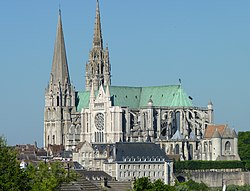
Chartres Cathedral exterior — the two towers of different heights (the north tower raised in the 16th century, the south in the 12th) give the cathedral its characteristic asymmetry, a visual reminder that it was built over four centuries by many hands

The nave vault interior — the ribbed vaults rise 36 meters above the floor; the flying buttresses that support them from the outside freed the interior walls to become almost entirely glass, creating the characteristic Gothic experience of sacred space as pure light

The Veil of the Virgin — the most sacred relic at Chartres, a piece of cloth said to have been worn by the Virgin Mary, donated by Charlemagne in 876; the entire cathedral was rebuilt around it after a fire in 1194; the architecture is the relic's setting


Comentarios