Dionysus: God of Wine, Ecstasy, and the Dissolution That Liberates — The Olympian Who Refuses to Stay in His Place
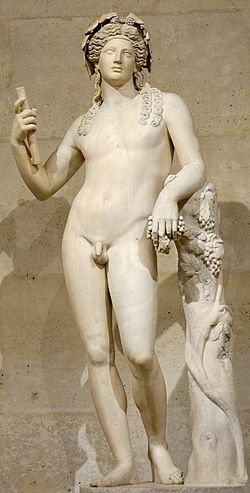
Dionysus — Roman marble sculpture after a Hellenistic model, 2nd century CE, Musée du Louvre, Paris. The god in his most composed form: youthful, androgynous, serene — the still center of a deity whose mythological role is defined by the opposite of stillness, by the dissolution of every boundary that gives a still center its definition.
There is a paradox at the heart of Dionysus that the ancient Greeks seem to have understood perfectly and that we are still trying to articulate: he is the god of the loss of self, and yet he is a very specific, very particular god. He is the deity of dissolution, and yet his cult produced the most precisely crafted dramatic art in the ancient world. He is the outsider who is always arriving, always foreign, always the stranger at the gate — and yet he is one of the twelve Olympians, born from the supreme god himself, enshrined at Delphi alongside Apollo.
Dionysus (Roman Bacchus; also Bromios, "the Roarer"; Iacchos in the Eleusinian Mysteries; Zagreus in the Orphic tradition) is the Greek god of wine, theater, religious ecstasy, fertility, and the dissolution of individual boundaries — the experiences that happen when the ordinary structure of the self relaxes enough to let something larger in, whether that something is divine inspiration, collective feeling, the altered state produced by intoxicants, or simply the depth of experience that ordinary waking consciousness tends to keep at a safe distance.
He is, in Nietzsche's famous formulation, the opposite and complement of Apollo: where Apollo is the principle of form, clarity, individual boundaries, and rational order, Dionysus is the principle of formlessness, darkness, the dissolution of individual boundaries, and the creative chaos from which new forms emerge. The Greeks, Nietzsche argued, understood that civilization required both — that the Apollonian structure without Dionysian renewal becomes rigid and dead, and that the Dionysian energy without Apollonian form becomes mere destruction.
The Twice-Born God: Dionysus's Origins
Dionysus's birth story is the mythological statement of his paradoxical nature. His mother was Semele, a mortal princess of Thebes; his father was Zeus. When Zeus's jealous wife Hera tricked Semele into asking Zeus to appear before her in his full divine form — knowing that no mortal could survive the sight of the god of lightning in his complete power — Semele was destroyed by the thunder and fire of Zeus's true nature.
Zeus rescued the unborn child from Semele's body and sewed him into his own thigh to complete the gestation. When the time came, Dionysus was born from Zeus's thigh — the second birth from a god, after the first birth from a mortal had been interrupted by mortality's contact with full divinity.
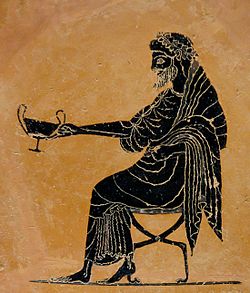
Dionysus with kantharos (wine-drinking cup) — Attic black-figure amphora, late 6th century BCE, British Museum. The god holding his characteristic vessel, the great two-handled cup that identifies him as immediately as the thyrsus: wine is not merely his attribute but his medium, the substance through which he acts on human consciousness.
The twice-born quality — born once from a mortal and killed by the encounter with full divinity, born again from the body of the god — encodes the central theological structure of the Dionysian mystery: the experience of dissolution (the mortal's death in the presence of the divine) followed by the experience of rebirth (the second birth from the divine). The devotee who enters the Dionysian ritual is, in some sense, Semele: brought to the edge of their ordinary self's endurance by the presence of the divine, and then reconstituted as something slightly different, slightly larger, slightly more capable of holding the experience.
In the Orphic tradition, Dionysus-Zagreus was born from Zeus's union with Persephone, was torn apart and eaten by the Titans, and was then reconstructed from his heart — which Athena had saved — and reborn as the Dionysus of the Olympic tradition. The Titans who ate Zagreus were struck by lightning, and humanity was formed from their ashes, which contained both the Titan nature (heaviness, materiality, resistance) and the divine Dionysian nature (the divine spark swallowed with the god's flesh). Humanity, in this myth, carries divinity inside itself — consumed, digested, incorporated — and the spiritual work is to separate what is Dionysian in oneself from what is Titanic.
The Thyrsus, the Vine, and the Maenads
Dionysus's characteristic attributes carry his theology in compressed form. The thyrsus — a fennel stalk topped with a pine cone, often wrapped with ivy or vine leaves — is simultaneously a weapon (it can kill when wielded by a Maenad in the grip of divine frenzy), a scepter (the emblem of his divine authority), and a symbol of the biological principle he represents (the fennel stalk's hollow interior can carry fire; the pine cone is one of the most exuberant expressions of plant reproduction; the ivy climbs and proliferates without apparent effort). It is the fertility principle embodied as a weapon: the life-force that becomes dangerous when it is resisted rather than cooperated with.

Bacchic procession with Maenad and satyrs — Roman marble relief, c. 100 CE. The Maenad in the full expression of Dionysian possession: the head thrown back, the body in motion, the wild animal energy of the deity's female devotees released in the ritual context of the procession. The thyrsus and the wine are the tools; the Maenad's body is the instrument.
The Maenads (or Bacchants) — the female devotees of Dionysus, named for mania ("madness") — are the most dramatic expression of Dionysian possession. In ritual, they left the city, went into the mountains, and there entered states of divine frenzy in which they were understood to be possessed by the god himself. In this state, they reportedly could perform extraordinary acts: tearing apart animals with their bare hands (sparagmos, the ritual dismemberment), dancing without tiring, nursing the young of wild animals at their breasts, carrying fire without being burned.
The Maenad tradition is one of the most extraordinary phenomena in Greek religious history: a cult in which women left the domestic sphere in which Greek culture rigorously confined them, went into the wilderness, and achieved through ritual practice a state of superhuman capacity. Whether what the ancient sources describe was literal or metaphorical, it represents a form of religious experience that provided access to power and freedom that the ordinary social structure entirely denied to women.
The Bacchae: Euripides and the Theology of Resistance
The most penetrating ancient analysis of what Dionysus means — and what happens when a society refuses to acknowledge his power — is Euripides's tragedy Bacchae (405 BCE, produced posthumously). It is one of the strangest and most unsettling plays in the Greek repertoire, and one of the most sophisticated theological statements about the nature of divine ecstasy and its relationship to human rationality.
The plot: Dionysus arrives in Thebes, the city of his mother's family, demanding recognition. The young king Pentheus — rational, controlling, deeply anxious about the disorder that the Dionysian worship would introduce into his city — refuses. He tries to imprison Dionysus. He tries to suppress the Bacchic rites. He fails, because you cannot imprison the god of dissolution. Dionysus escapes, drives the women of Thebes to the mountains in Bacchic frenzy, and then — in the play's most chilling episode — persuades Pentheus to dress as a woman and spy on the Maenads. Pentheus is discovered, and his own mother Agave, in the full grip of divine madness, tears him apart with her bare hands, believing him to be a lion. She carries his head back to Thebes, still under the delusion. When the madness clears, she understands what she has done.

Dionysus Triumph mosaic — House of Poseidon, Zeugma (modern Gaziantep, Turkey), 2nd–3rd century CE. The god in his victory procession: surrounded by the symbols of his nature (the vine, the cup, the attendant figures), riding in triumph over the world that tried to refuse him. The triumph of Dionysus over Pentheus's resistance is the central narrative of the *Bacchae*, enacted here as a permanent image in floor mosaic.
The Bacchae is not a simple story of divine punishment. It is an analysis of what happens when the Dionysian is suppressed: when the forces of ecstasy, dissolution, and communal release that human beings need are denied, they erupt in their most destructive form. Pentheus denies Dionysus, and Dionysus does not simply punish him — the god uses Pentheus's own repression against him, inviting him to do covertly (dress as a woman, spy on the Maenads) what he publicly refuses. The destruction of Pentheus is Pentheus's own repressed desire turned against him.
The theological conclusion is precise: the refusal of Dionysus does not eliminate the Dionysian energy but makes it dangerous. What is acknowledged and honored and given its proper ritual context remains within bounds. What is suppressed erupts without bounds, in its most destructive form. The Maenads of the ritual (safely controlled ecstasy with a return to the city) and the Maenads of Pentheus's end (uncontrolled ecstasy that tears a human being apart) are the same force in two different contexts.
Theater: The God Who Created Fiction
Dionysus's most culturally productive contribution to human civilization is his patronage of theater. Greek tragedy and comedy both evolved from the Dionysian festival (Dionysia) in Athens, in which the performances of plays were understood as acts of religious worship. The theater was, in origin and in ongoing practice, Dionysus's space: the masks, the chorus, the collective catharsis that Aristotle identified as tragedy's purpose — all of these belong to the Dionysian tradition.
The connection between Dionysus and theater is not accidental. Theater requires exactly what Dionysus provides: the temporary dissolution of individual identity (the actor becomes someone else through the mask), the creation of a collective state of heightened emotion (the audience shares the catharsis together), the safe exploration of experiences that would be dangerous or impossible outside the ritual frame (murder, incest, divine punishment — the themes of tragedy — can be witnessed and processed without being literally undergone).
The theatrical mask is the most Dionysian of theatrical instruments: it both conceals and reveals, it transforms the wearer into a different being without eliminating the wearer's actual existence, it allows the audience to see what the character is feeling rather than what the actor looks like. The mask is the technology of Dionysian possession — the tool that enables the actor to be someone else while remaining themselves, which is the experience the god provides.
Nietzsche's Dionysus: The Philosophical Legacy
Friedrich Nietzsche's The Birth of Tragedy (1872) transformed Dionysus from a minor figure in classical scholarship into one of the central concepts of modern philosophy and aesthetics. Nietzsche argued that Greek tragedy — and by extension all great art — was produced by the tension between two principles: the Apollonian (the drive toward form, clarity, beauty, individuation) and the Dionysian (the drive toward dissolution, collective experience, the destruction of individual boundaries).
The Dionysian, for Nietzsche, is not simply destructive: it is the necessary ground of creation. Without the Dionysian break with established form, art becomes merely decorative; without the Dionysian contact with the elemental energies of life and death and suffering, philosophy becomes merely consolatory. Nietzsche's Dionysus is the god of amor fati — the love of fate — the embrace of life including its suffering, its chaos, its dissolution. He is the alternative to the otherworldly hope that Nietzsche identified as the defining feature of Christian thought and that he considered a falsification of the real conditions of existence.
The Esoteric Dionysus: The God Who Arrives
The deepest theological characteristic of Dionysus in both the ancient and the esoteric tradition is that he is always arriving: always coming from elsewhere, always appearing in a city that initially rejects him, always the stranger whose strangeness is precisely his divine qualification. He is the god who comes from the margins — from Asia, from the east, from the wild places outside the city — and demands recognition at the center.
This perpetual arrival is the mythological encoding of the Dionysian experience itself: ecstasy arrives. It is not produced by effort; it cannot be manufactured by intention; it cannot be kept once it has passed. The wine ferments; the festival comes; the divine possession descends. The god is always the one who comes rather than the one who stays — and what makes him divine is precisely this quality of advent, of arrival from beyond the ordinary.
The city that refuses him will be destroyed by what it refuses. The city that receives him will be transformed by what it admits. The choice, the Bacchae insists, is not whether the Dionysian will arrive but whether the door will be open or will need to be broken down.
The ivy is already growing up the walls.
— Lux Esoterica


Comentarios