Egyptian Mummies and Funerary Art: Death as Sacred Technology
For the ancient Egyptians, death was not the opposite of life but its continuation by other means — and mummification was the technology that made that continuation possible. The body had to be preserved because the soul (the ka and the ba) needed a physical anchor to return to; without it, the elaborate afterlife described in the Book of the Dead could not proceed. Mummification was therefore not a macabre obsession but a loving investment in the future — the most expensive thing a family could do for one of its members was to ensure their body's preservation and their tomb's proper equipment. The art that accompanied the Egyptian dead — the painted coffins, the golden death masks, the shabtis (small figurines who would perform labor in the afterlife), the canopic jars holding the preserved organs, the decorated walls of the tomb — constitutes a complete theological and artistic program: the most comprehensive visual meditation on death and survival ever created by any civilization.
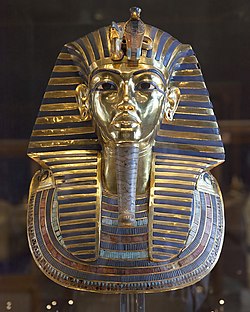
Death mask of Tutankhamun, Egyptian Museum, Cairo (c. 1323 BCE) — the most famous object in Egyptian archaeology; beaten gold inlaid with lapis lazuli, quartz, obsidian, carnelian, and colored glass; Tutankhamun's face rendered in idealized permanent form — the mask was placed over the mummy's face so that the spirit could recognize its body upon returning

The Opening of the Mouth ceremony — the most important funerary ritual, depicted in the Book of the Dead and on tomb walls; a priest, wearing the mask of Anubis, touches the mummy's mouth with a sacred implement to restore the ability to eat, drink, and speak in the afterlife; the ritual reanimated the dead body as surely as birth had animated the living one

Egyptian mourners — professional female mourners (dryt) depicted in a tomb painting, their hair loosened and arms raised in lamentation; the public expression of grief was a ritual requirement, not merely an emotional response; hired mourners amplified the deceased's importance and helped the soul navigate the transition between worlds

Sarcophagus of Ken-Hor, 26th Dynasty (c. 600 BCE), Neues Museum Berlin — the elaborate painted program covering the coffin's inner and outer surfaces provides the deceased with a complete ritual environment; even if the tomb's wall paintings were lost or inaccessible, the coffin itself contained all the spells, prayers, and divine images the soul needed to navigate the afterlife

Mummy mask, Middle Kingdom (c. 2000-1700 BCE) — cartonnage (layers of linen glued with plaster) shaped to fit over the mummy's head; the gilding of the face reflects the Egyptian belief that the flesh of the gods was gold; the deceased, in death, becomes divine — the mummy mask is the visual statement of that transformation

Fayum mummy portrait of a Roman soldier (c. 130 CE), Altes Museum — the Greco-Roman period saw Egyptian mummification combined with realistic encaustic portrait painting; these extraordinary faces — the most lifelike portraits to survive from the ancient world — were placed over the mummy's face, giving the dead a permanent, individualized presence; they are the direct ancestors of panel painting and icon tradition

Falcon mummy (2000-1001 BCE) — millions of animals were mummified in ancient Egypt as votive offerings: cats (sacred to Bastet), ibises (sacred to Thoth), falcons (sacred to Horus), crocodiles (sacred to Sobek), bulls (sacred to Apis); the animal mummy industry was one of the largest commercial enterprises of the late period, employing thousands and consuming vast quantities of linen

Heart scarab of Bak-en-Djehuti, Walters Art Museum — placed over the mummy's heart, inscribed with Spell 30B from the Book of the Dead: 'O my heart of my mother, do not stand against me as a witness, do not speak against me before the tribunal'; the heart might testify against its owner in the Hall of Two Truths — the heart scarab was the insurance against self-betrayal

Shabti of King Pinudjem I (c. 1025-1007 BCE) — the shabti (or ushabti) figurines placed in the tomb were magical workers who would answer the call when the deceased was required to perform labor in the afterlife; a wealthy burial might contain 365 shabtis (one for each day of the year) plus 36 overseers — an entire magical workforce waiting to serve their master in the Field of Reeds


Comentarios