Elves: The Luminous Ones of Norse Myth and Ancient Memory

Elves by Arthur Rackham — the great illustrator's vision of the fairy folk, combining naturalistic detail with otherworldly strangeness, from his 1908 illustrations for *A Midsummer Night's Dream*.
In the mythological landscape of the Germanic and Norse world, few beings have captured the imagination as powerfully as the elves — the álfar of Old Norse, the ylfe of Old English, the elbe of Old High German. They are among the oldest supernatural beings in the Germanic traditions, predating the written mythology by centuries, embedded in place names, personal names, and folk belief across the entire Germanic linguistic world from Iceland to the Alps. They are not merely the pointed-eared helpers of Santa Claus or the magical craftsmen of Tolkien's fiction; they are something far stranger and more powerful — beings of light and darkness, of health and illness, of beauty and terror, that occupied a central place in the religious imagination of northern Europe for a thousand years.
To encounter the elves in their original mythological context is to encounter a vision of the supernatural that is neither wholly benevolent nor wholly malevolent, neither fully divine nor fully monstrous — a vision of an intermediate order of existence, more powerful than human beings, connected to the forces of the natural world, demanding proper acknowledgment and offering both gifts and dangers to those who enter into relationship with them.
Álfar in the Norse Cosmos: Light, Dark, and the Space Between
The Prose Edda of Snorri Sturluson (c. 1220) — our primary systematic source for Norse mythology — gives the elves a defined place in the cosmological structure of the nine worlds. Álfheim (Elf-Home) is described as one of the nine worlds arranged around Yggdrasil, the World Tree, placed in the upper regions of the cosmos, close to the realm of the Æsir gods. The god Freyr — the Vanir god of fertility, sunlight, and prosperity — is said to rule Álfheim, given to him as a tooth-gift in infancy.
Snorri distinguishes between ljósálfar (light elves) and dökkálfar (dark elves), describing the light elves as "fairer than the sun to look at" and the dark elves as "blacker than pitch." The dark elves he appears to associate with the dvergar (dwarves) — the master craftsmen of the Norse cosmos who live underground and forge the most powerful magical objects in existence. This distinction between light and dark elves may represent Snorri's attempt to systematize earlier, less clearly differentiated traditions, but it established a polarity that has been enormously influential on subsequent literary and esoteric elf-lore.
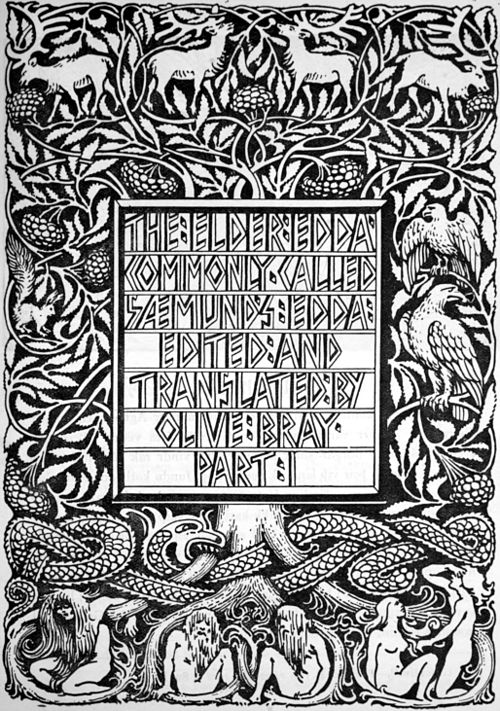
Yggdrasil, the World Tree, by Friedrich Wilhelm Heine (1886) — in the Norse cosmos, Álfheim (Elf-Home) is one of the nine worlds arranged around the World Tree, ruled by the god Freyr.
The connection between the elves and Freyr is deeply significant. Freyr is the Norse god most associated with fertility, natural abundance, sunlight, and the life-giving powers of the earth; his sister Freyja is the goddess of love, beauty, and seiðr (the shamanic magic of the Norse tradition). The Vanir gods to which both belong were originally a separate divine race — the gods of nature, fertility, and the chthonic powers of the earth — who fought and then made peace with the Æsir (the warrior gods headed by Odin). The elves, in Freyr's domain, partake of the Vanir nature: they are beings of natural fecundity, of the abundant energies of the living world, connected to the divine powers of growth, light, and the turning of the seasons.
The Old English Elf: Between Health and Illness
In Old English literature and medical texts, the elves appear in a very different context from the idealized creatures of Norse cosmology. In the Leechbooks — the medical compilations of Anglo-Saxon England — elves are consistently associated with illness: ælfsogoða (elf-sickness), ælfadl (elf-disease), ylfig (elf-struck) are terms for various conditions attributed to elf interference. The elves were believed to shoot invisible arrows (elf-shot) at human beings and livestock, causing sudden sharp pains, illness, and wasting.
This Anglo-Saxon elf is simultaneously luminous (the word ælf is cognate with Latin albus, white) and dangerous — a being of light whose attention is not necessarily welcome. The charms written against elf-shot in the Leechbooks invoke Christian saints against the elves, suggesting that the Anglo-Saxon church was engaged in a sustained effort to demonize and displace an older tradition of elf-propitiation.

The word *ylfe* (elves) in the Old English *Beowulf* manuscript — elves are listed alongside giants and evil spirits among the monstrous descendants of Cain, reflecting the Christianization of older elf-lore.
In Beowulf, elves are listed among the descendants of Cain — alongside giants and monsters — suggesting that by the time of that poem's composition, the church had largely succeeded in repositioning the elves from supernatural neighbors (requiring respect and propitiation) to enemies of the Christian order (requiring exorcism and avoidance). This repositioning is a consistent pattern in the Christianization of Germanic culture: the old supernatural beings are not simply dismissed as nonexistent but redefined as fallen, demonic, or inimical to human spiritual health.
The Erlking: Germanic Elf-King
One of the most powerful poetic treatments of the elf tradition in German Romanticism is Goethe's ballad Der Erlkönig (The Erlking, 1782) — a poem of extraordinary psychological and atmospheric power that gave the Germanic elf-king a definitive literary form. In the poem, a father rides through the night carrying his sick child; the child sees and hears the Erlking — a supernatural figure offering beautiful, seductive visions — while the father sees only fog and hears only the wind. By the time the father arrives at his destination, the child is dead.
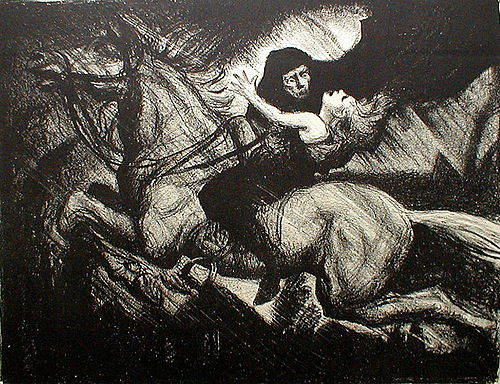
The Erlking by Albert Sterner — Goethe's supernatural elf-king who lures the dying child with beautiful visions, one of the most powerful poems of the German Romantic tradition.
The Erlking is not a simple villain; he offers beauty, warmth, and play — the child sees something genuinely alluring, not merely frightening. The horror of Goethe's poem lies precisely in this ambivalence: the supernatural being offers something real, something that the ordinary world cannot provide, and it is the child's sensitivity (illness, openness to other dimensions of experience) that makes the encounter possible. The Erlking is the Germanic elf tradition at its most dangerous and most illuminating: a being whose nature is neither good nor evil but fundamentally other, and whose otherness can be fatal to those who encounter it without proper preparation.
The name Erlking comes from the Danish ellerkonge (elf-king), though it has sometimes been interpreted as Erlenking (alder-king, from the tree). In either case, it connects the elf-king to the liminal, boundary places of the northern landscape — the alder groves beside streams, the misty thresholds where the human world and the wild world press against each other.
The Elves of Folklore: Domestic Spirits and Wild Beings
Beyond the literary and mythological treatments, a rich tradition of domestic elf-lore persisted in Scandinavia through the medieval and early modern period. The tomte (Swedish) or nisse (Norwegian/Danish) — small, usually invisible beings that attached themselves to specific farms and households — combined the dangerous potential of the elf with a more domestic, manageable presence.
The tomte was understood as something between a spirit and a very old ancestor — the first settler of the farm, who had died and remained to watch over the land and livestock he had worked. He required respect: his own place at the table, a bowl of porridge on Thursday evenings, proper acknowledgment of his presence. A satisfied tomte would protect the farm, care for the animals, and ensure prosperity. An offended tomte would cause havoc — souring the milk, tangling the horses' manes, making the cows sick, and in extreme cases leaving the farm entirely, taking the luck of the house with him.
This domestic elf tradition — which persisted in the Swedish and Norwegian countryside in its most conservative forms into the nineteenth century — represents the elf at his most specifically local and relational: not a cosmic being of Álfheim but the genius loci of a particular farm, a being whose welfare and the farm's welfare were bound together in a relationship of mutual obligation. The tomte who appears in modern Scandinavian Christmas imagery as a cheerful gnome-like figure is the heavily domesticated descendant of this more ambivalent and demanding tradition.
Thomas the Rhymer and the Elven Abduction
In Scottish tradition, the encounter with the Elf Queen and the journey to Elfland was a central theme, given its most famous literary expression in the ballad of Thomas the Rhymer (also called True Thomas). In the ballad, Thomas meets the Elf Queen on the Eildon Hills in the Scottish Borders, rides with her to Elfland, and spends seven years there — experiencing them as a much shorter time — before being returned to the human world with the gift of prophecy and the inability to tell a lie.
Thomas the Rhymer was a historical figure — Thomas of Erceldoune (c. 1220–1298) — who was famous in his lifetime as a prophet, and whose legendary journey to Elfland was understood in the tradition as the source of his prophetic gift. The story follows a consistent pattern in Celtic and Germanic elf-lore: the person taken to the elf-realm is transformed by the experience, returned with gifts (usually of second sight, music, or poetry), but also permanently marked by the encounter — belonging to two worlds simultaneously, fully at home in neither.
This pattern — elf abduction as transformative initiation, the return from the Otherworld with supernatural gifts — connects the elf tradition to shamanic experience across many cultures. The journey to the spirit-world, the encounter with non-human intelligences, the return with gifts of healing or prophecy: this is the structural pattern of shamanic initiation in Siberian, Central Asian, and many other traditions. In the Celtic and Germanic world, the elves and fairies are among the beings who conduct this initiation.
Tolkien's Elves: The Literary Transformation
No discussion of elves in the modern cultural imagination can avoid J.R.R. Tolkien, whose treatment of the Quendi (Elves) in The Lord of the Rings (1954–55) and the posthumous Silmarillion (1977) transformed the elf from a small, mischievous or dangerous folk being into a race of tall, immortal, supremely gifted beings — the Firstborn of Ilúvatar, the children of the stars, whose light-filled civilization represents the highest achievement of the pre-human world.
Tolkien's Elves were a deliberate attempt to recover and amplify what he saw as the deepest content of the Norse and Anglo-Saxon elf tradition — the connection to light, to beauty, to an order of existence more ancient and more luminous than the merely human. He was a professional scholar of Old and Middle English literature, and his Elves draw specifically on the etymology of ælf (light, white), on the cosmological role of the álfar in relation to the Vanir gods, and on the tradition of elf-beings as the oldest and most gifted of the created intelligences.
At the same time, Tolkien's Elves are mortal in their own way — subject to a different kind of mortality than humans, unable to die of disease or age but capable of being killed in battle or wasting away from grief, eventually doomed to sail to the Blessed Realm in the West and leave Middle-earth. This elven mortality — the fading, the sailing West, the gradual withdrawal of the elder world as human civilization rises — is one of Tolkien's most beautiful mythological inventions, and it resonates with the genuine folk tradition of the elves as beings who do not live fully in the human world but are withdrawing from it, or have withdrawn into its hidden interior.
Elves and the Light of Ancient Memory
In the esoteric tradition, the elves have been read as memory-beings — as presences that carry within themselves the memory of the world's earlier states, the time before human dominance when the non-human orders of existence were fully present and active in the visible world. Their light — the álfheim of Norse cosmology, close to the solar world of the gods — is the light of the primordial world before the fog of materiality thickened around it.
Rudolf Steiner's Anthroposophical tradition distinguished between various classes of elemental beings — gnomes, sylphs, undines, fire beings — and understood the elves and fairy beings as corresponding to a specific dimension of the life-world, the etheric realm in which the formative forces of nature operate just below the threshold of physical visibility. In this reading, the elf-tradition is not mere folklore but a genuine folk perception of a real dimension of existence — the etheric intelligence that governs the growth of plants, the patterns of the landscape, the invisible formative forces that give the visible world its characteristic shapes.
This reading connects the elf tradition to a broader esoteric understanding: that the folk traditions of supernatural beings are not inventions but imperfect perceptions, seen through the fog of cultural bias and theological re-interpretation, of real dimensions of existence that human beings have always, at some level, sensed. The elves who left disease in the Anglo-Saxon world, who danced on the Eildon Hills and abducted prophets, who guarded the Norse farms as tomtar and filled the cosmic realm of Álfheim with their light — all of these are perceptions, from different angles and cultural contexts, of the same underlying reality: a world that is more than the merely physical, inhabited by intelligences that are more than human, and that require of us something we rarely manage to give them — genuine attention and appropriate respect.
Conclusion: The Luminous Other
The elves endure in the human imagination because they represent what the ordinary world consistently fails to fully account for: the luminous, the other, the dimension of existence that is more beautiful and more dangerous than the daily round of human life allows. From the elf-shot of the Anglo-Saxon Leechbooks to the light of Tolkien's Elbereth, from the tomte of the Scandinavian farmstead to the Erlking riding through the winter forest, the elf tradition has given form to the human intuition that the world is inhabited by more than the merely human — and that this more is simultaneously a source of beauty and of danger, demanding of those who encounter it a quality of awareness and respect that ordinary consciousness rarely achieves.
The luminous ones are still there — in the old places, at the old times, at the thresholds where the ordinary world thins enough for something else to show through. Whether we call them elves, or nature spirits, or the numinous dimension of the living world, the tradition insists that they are real, that they matter, and that the relationship between the human and the more-than-human is one that the survival of both depends on maintaining.
— Lux Esoterica


Comentarios