Etruscan Art: The Mysterious Civilization Before Rome
Between approximately 900 and 100 BCE, the Etruscan civilization flourished in central Italy — in the region still called Tuscany, from Etruria. They were the dominant power in Italy before Rome, their cities (Tarquinia, Veii, Vulci, Caere, Arezzo) wealthy from trade in copper, iron, and wine. They gave Rome much of what Rome would later claim as its own: the arch, the toga, the gladiatorial games, the religious practice of reading the future in the entrails of sacrificed animals (haruspicy), and three of Rome's early kings. And then they disappeared — absorbed, conquered, and gradually assimilated into the Roman world until their language ceased to be spoken and their identity was subsumed. What survives of them is primarily funerary: the extraordinary painted tombs of Tarquinia, whose frescoes show a people of remarkable vitality and joy; the bronzes of astonishing quality; the terracotta sarcophagi whose reclining figures display the same easy intimacy with death that their art displays with life. The Etruscans remain, in many respects, genuinely mysterious: their language is partly understood but not fully, their religion imperfectly reconstructed, their ultimate origin debated since antiquity. What is not mysterious is the quality of what they made.

Tomb of the Leopards, Tarquinia (c. 480-450 BCE) — the most celebrated Etruscan tomb painting; banqueters recline on couches in a scene of festive abundance, musicians play, servants bring wine; two leopards watch from the gable above; the Etruscans decorated their tombs not with images of death but of living pleasure, the afterlife conceived as an eternal continuation of the banquet

Sarcophagus of the Spouses, Cerveteri (c. 520 BCE), Louvre — a husband and wife reclining together on a banquet couch, her hand on his shoulder, his arm around her; the intimacy of the pose — equal partners, physically comfortable together — is extraordinary in the ancient world; Greek and Roman art rarely depicted married couples with this quality of mutual tenderness
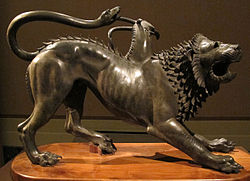
Chimera of Arezzo (c. 400 BCE), National Archaeological Museum, Florence — one of the supreme achievements of ancient bronze casting; the mythological fire-breathing monster (lion's body, goat's head rising from the back, serpent's tail) shown wounded and at bay; the inscription on the foreleg reads 'Tinscvil' — a votive offering to the Etruscan god Tin (equivalent to Jupiter); the quality of the casting was not surpassed until the Renaissance

Mars of Todi (c. 400-375 BCE), Vatican Gregorian Etruscan Museum — a life-size bronze warrior in the act of making an offering; the figure combines Greek formal conventions (the contrapposto stance, the anatomical detail) with Etruscan spiritual sensibility; the eyes were once inlaid with a different material, giving the figure the quality of presence that characterizes the finest Etruscan bronzes
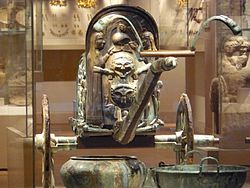
Monteleone Chariot (c. 530 BCE), Metropolitan Museum — a parade or ritual chariot with bronze panels inlaid with ivory and decorated with scenes from the life of Achilles; the three panels show Thetis giving Achilles his divine armor, Achilles fighting, and Achilles in his chariot; the quality of the narrative relief rivals contemporary Greek work; the chariot was buried with its aristocratic Etruscan owner as a mark of status and divine connection

Sleep and Death carrying Sarpedon, cista handle (400-380 BCE), Cleveland Museum — the cylindrical toilet boxes (cistae) that Etruscan women used to store jewelry and cosmetics were decorated with mythological scenes of extraordinary quality; this handle shows the winged figures of Hypnos and Thanatos carrying the dead Trojan hero Sarpedon from the battlefield — Greek mythology rendered in Etruscan bronze with a grace that transcends its origins

Cista with Dionysian revel and Perseus with Medusa's head, Walters Art Museum (4th-3rd century BCE) — the cylindrical surface engraved with a continuous scene of satyrs and maenads in Dionysiac ecstasy, with Perseus holding the severed head of Medusa; the engraving technique used on Etruscan cistae achieved a linear expressiveness impossible in relief sculpture

Sarcophagus of Seianti Hanunia Tlesnasa (c. 150-130 BCE), British Museum — a woman reclining on her funeral couch with an expression of absolute composure; the inscription names her in the Etruscan language; she holds a mirror, the attribute of feminine self-knowledge; the portrait realism of late Etruscan sarcophagi — the specific face of a specific person — anticipates the Roman portrait tradition that would dominate the next five centuries

François Tomb fresco — Liberation of Celio Vibenna (4th century BCE) — a scene from Etruscan legendary history showing the hero Macstrna (identified with the Roman king Servius Tullius) freeing the Etruscan hero Caele Vibenna; the François Tomb at Vulci is the only Etruscan tomb to depict historical events; it provides unique evidence of an Etruscan historical mythology entirely lost in the Roman assimilation

Cinerary urn, Chiusi or Volterra (mid-2nd century BCE), Worcester Art Museum — the reclining figure of the deceased on the lid, the relief panel on the body showing mythological scenes of the underworld journey; the Etruscan cinerary urn tradition, concentrated in the cities of Chiusi and Volterra, produced thousands of such urns across several centuries — a complete visual theology of death and afterlife encoded in terracotta


Comentarios