Fra Angelico: The Painter of Paradise
Fra Giovanni da Fiesole (c. 1395–1455) — known as Fra Angelico ("the Angelic Friar"), beatified by Pope John Paul II in 1982 — was a Dominican monk who painted as an act of prayer. His work occupies a singular position in the history of Western sacred art: chronologically at the beginning of the Florentine Renaissance (he was a contemporary and colleague of Brunelleschi, Donatello, and Masaccio), formally fluent in the new language of perspective and anatomical naturalism, yet spiritually rooted in a medieval understanding of the painted image as a threshold — a place where the divine becomes present through the artist's devotion rather than merely represented through his skill. The 44 frescoes he painted in the cells and corridors of the Convent of San Marco in Florence (c. 1438-1450) — one fresco per monk's cell, as a subject for daily meditation — are among the most concentrated expressions of Christian mysticism in any visual medium. He was reportedly unable to paint a crucifixion without weeping. Pope John Paul II, at his beatification, said he had achieved "a synthesis of prayer and art." Whatever one's theological commitments, the experience of standing before Fra Angelico's Annunciation in the corridor of San Marco confirms that something of unusual quality happened in that painter's attention.

The Annunciation, Convent of San Marco, Florence (c. 1440-1445) — the archangel Gabriel and the Virgin Mary in a loggia of pure Brunelleschian architecture; no gold leaf, no elaborate throne, no court of angels — only the two figures in the moment of divine communication, the architecture opening onto a garden from which Eve was expelled; Fra Angelico understood that the Annunciation reverses the Fall

San Marco Altarpiece (c. 1438-1440) — the Virgin enthroned with saints in a unified space, the figures gathered as if in actual conversation; this was the first sacra conversazione in Florentine painting — the formula that would dominate Renaissance altarpiece composition for a century; Fra Angelico invented it from his reading of the Dominican meditation tradition

The Last Judgment (c. 1432-1435), Museo di San Marco — the saved (left) dance in the golden meadow of paradise with an unselfconscious joy that no other painter of the Last Judgment has achieved; the damned (right) are consumed in darkness; Fra Angelico's heaven is not serene but actively joyful, the theological claim that the beatific vision produces not peace but delight

The Crucified Christ with saints — one of the many crucifixion paintings Fra Angelico made throughout his career; Vasari reports that he could not paint a crucifixion without tears; whether or not the story is literally true, it points toward the quality of attention in these paintings — a painter who was praying with the brush, not merely representing a theological proposition
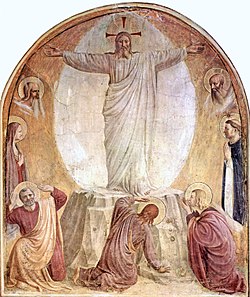
The Transfiguration, Cell 6, Convent of San Marco (c. 1442) — Christ blazing with divine light on Mount Tabor, Moses and Elijah flanking him, the disciples fallen to the ground; one of the 44 cell frescoes at San Marco, each one designed as a meditation support for the Dominican brother who occupied that cell; Fra Angelico knew which mystery corresponded to which soul's need

Coronation of the Virgin (c. 1432), Uffizi Gallery — Christ placing the crown on the Virgin's head in the presence of saints and angels; the gold ground (medieval in convention) meets the new spatial clarity of Renaissance perspective; Fra Angelico inhabited both worlds simultaneously, the theological certainty of the medieval and the visual revolution of the Renaissance, without experiencing them as contradiction

Adoration of the Magi, painted with Fra Filippo Lippi (c. 1440-1460), National Gallery of Art, Washington — the Epiphany as a scene of cosmic convergence: the distant kings representing the whole world, the specific stable representing the particular point where the divine entered the human; the circular tondo format mirrors the cosmic roundness of the event

La Thebaide (c. 1420), Uffizi — a landscape of hermits and monks in their cells, the Egyptian desert tradition of the Desert Fathers translated to Tuscan hills; this early work shows Fra Angelico's roots in the medieval devotional tradition before his engagement with Renaissance spatial revolution; the gold sky is still Byzantine, the setting already humanist

Saint Lawrence Distributing Alms, Niccoline Chapel, Vatican (1447-1450) — the frescoes Fra Angelico painted in the private chapel of Pope Nicholas V are among the most sophisticated narrative paintings of the early Renaissance; Saint Lawrence's gesture of distribution — the deacon standing between the pope's wealth and the poor of Rome — encodes the theological function of the Church as intermediary

Fiesole Altarpiece (c. 1424-1430) — an early work showing Fra Angelico's formation in the International Gothic tradition before his encounter with the new Brunelleschian Renaissance; the gold ground, the hierarchical scale, the decorative elaboration — all medieval; the quality of attention in the faces already entirely his own


Comentarios