Gandhara: Where Greek Gods Became Buddhas
In the 4th century BCE, Alexander the Great crossed the Hindu Kush and reached the valley of the Indus. His armies withdrew, but the Greek settlers did not — the Indo-Greek kingdoms they founded persisted for centuries in what is now northern Pakistan and eastern Afghanistan, governing a frontier territory where the traditions of the Mediterranean world encountered the world of India for the first time in sustained contact. The result, fully flowering between the 1st and 5th centuries CE under the patronage of the Kushan dynasty, was one of the most extraordinary artistic syntheses in human history: Gandharan art, in which the sculptural vocabulary of Greece was placed at the service of the Buddhist dharma. The Buddha was first given a human face in Gandhara — before this tradition emerged, he was represented symbolically (by a footprint, a wheel, an empty throne). The face the sculptors gave him was Greek: the wavy hair of Apollo, the straight nose, the flowing drapery of a toga. Hercules (Heracles) became Vajrapani, the diamond-thunderbolt bearer who guards the Buddha. Atlas, the Titan condemned to hold up the sky, was put to work supporting Buddhist stupas. The wind god Boreas, his cheeks puffed with the divine breath, crossed the Silk Road and arrived in Japan as Fūjin, the wind deity still depicted in the same billowing pose in Japanese temples today. Gandharan art is the bridge between the Mediterranean and Asian worlds — the conduit through which the visual language of Greece flowed into the iconographic traditions of Tibet, China, and Japan.
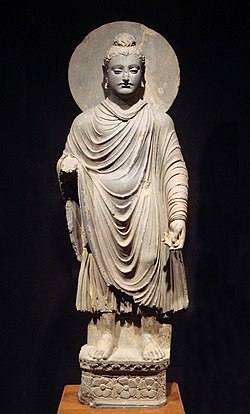
Standing Buddha from Gandhara (1st–2nd century CE) — the canonical Gandharan Buddha figure: the wavy hair arranged in the Greek fashion (ushnisha at the crown), the straight Greek nose, the thin drapery of the robe revealing the body beneath as in Hellenistic sculpture, the right hand raised in abhaya (fear-not) mudra; this is the first fully realized anthropomorphic image of the Buddha in the history of art, and it is Greek in form even as it is Buddhist in meaning
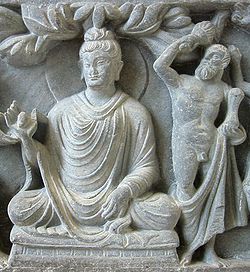
Vajrapani as Herakles protecting the Buddha (2nd century CE), Gandhara — the most extraordinary syncretism of the Gandharan tradition: Herakles, the Greek hero identified by the lion skin on his shoulder and the club in his hand, has been recruited as Vajrapani, the Buddhist guardian deity; the identification was possible because both figures shared the attribute of overwhelming power deployed in the service of cosmic order; Herakles slays monsters, Vajrapani destroys obstacles to enlightenment

Buddha flanked by Herakles/Vajrapani and Tyche/Hariti — the full complexity of the Gandharan synthesis in one image; on the Buddha's right, Herakles with his lion skin has become Vajrapani; on the left, Tyche (the Greek goddess of fortune, recognizable by her turreted crown) has become Hariti, the Buddhist goddess of children and abundance; the Buddha at the center is unchanged — the Greek figures have migrated into his entourage, bringing their visual identities with them
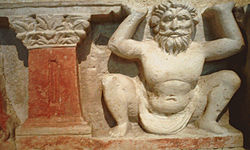
Atlas supporting a Buddhist stupa, Hadda, Afghanistan — in Greek mythology, the Titan Atlas was condemned by Zeus to hold up the vault of heaven on his shoulders for eternity; in Gandharan Buddhist art, the figure of Atlas (identifiable by his characteristic posture — crouching, arms raised to bear a weight above) was repurposed to support the architectural elements of Buddhist stupas and shrine bases; the Titan's eternal burden became an act of devotion
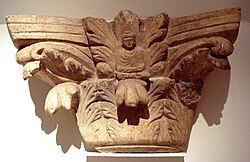
Indo-Corinthian capital with seated Buddha (3rd–4th century), Gandhara — the Corinthian capital, with its acanthus-leaf decoration invented by Greek architects of the 5th century BCE, had spread across the Mediterranean and West Asia as the preferred ornamental form of Hellenistic architecture; in Gandhara, the Buddhist sculptors placed figures of the Buddha and Bodhisattvas within the acanthus leaves, creating hybrid capitals in which the Greek decorative system became a setting for Buddhist devotional imagery

Head of a Bodhisattva, Gandhara (ca. 4th century CE) — in the Gandharan tradition, Bodhisattvas (enlightened beings who postpone their own nirvana to assist others) were depicted as young men of aristocratic beauty in the Greek manner; the curled hair, the straight features, the quality of idealized individual presence — all derive from the Greek tradition of depicting divine and heroic youth; the spiritual aspiration of the Buddhist Bodhisattva was expressed in the physical form of a Greek kouros
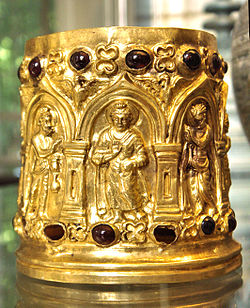
The Bimaran Casket (c. 30–10 BCE), British Museum — one of the earliest dated representations of the Buddha in human form; a gold reliquary found at Bimarān, Afghanistan, with the Buddha in a niche flanked by Brahma and Indra, surrounded by figures in arched niches separated by stylized columns; the architectural form derives from Hellenistic architecture; the casket was found inside a stupa containing coins of the Indo-Scythian king Azes II, giving a precise terminus post quem for the earliest anthropomorphic Buddha imagery
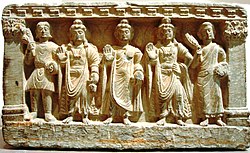
Gandharan Buddhist Triad — Maitreya (the future Buddha), Gautama Buddha (the historical Buddha), and Avalokiteśvara (the Bodhisattva of compassion) in a composition derived from Hellenistic triadic groups; the three figures are individualized by their attributes and postures while sharing the same Greco-Buddhist stylistic vocabulary; this triad type, transmitted via the Silk Road, would become the template for Buddhist devotional sculpture across Central Asia, China, Korea, and Japan

The wind god's journey: from Greek Boreas to Japanese Fūjin — the iconographic evolution across 1,500 years and the breadth of Asia; the Greek wind god Boreas, depicted with puffed cheeks and a billowing cloak full of wind, traveled the Silk Road through Gandhara, where he became the Buddhist wind deity, and continued east through Central Asia and China to arrive in Japan as Fūjin, still recognizable by the same billowing bag of wind; Gandharan art was the transmission point for this iconographic migration

The evolution of Herakles into the Niō temple guardians of Japan — in Greece, Herakles; in Gandhara, Vajrapani; in China, the wrathful guardians of Buddhist temples; in Japan, the Niō (benevolent kings) who stand at the gates of Buddhist temples in fierce protective postures, their muscled bodies contorted in warrior stances; the Greek hero's visual identity — the muscular body, the dynamic tension, the attribute of overwhelming power — traveled across Asia without losing its essential character, transfigured into each culture's own idiom


Comentarios