Geometry of the Living World: Diatoms, Snowflakes, and Sacred Natural Patterns
Before there were human artists, geometry was already being practiced by the living world. The diatom — a single-celled alga enclosed in a silica shell — constructs a structure of such symmetrical perfection that microscopists have spent two centuries studying the mechanisms by which something without eyes, without intention, without any organ of measurement produces a form whose precision rivals the finest human craftsmanship. The snowflake — water crystallizing in the cold air — generates the six-fold symmetry of the hexagon in an infinite variety of unique configurations, each one applying the same structural rules to a different microscopic history. The nautilus shell, the sunflower's seed arrangement, the spiral of a galaxy — all express the same mathematical principles that sacred geometry identifies as the language in which the universe is written. What the contemplative traditions have called the divine proportion, the living world has been practicing for three billion years. The geometry is not a human imposition on nature. It is nature's own vocabulary, noticed and named and celebrated by beings who recognized in it something they recognized also in themselves.

Diatoms through the microscope — the silica shells (frustules) of multiple diatom species; each species constructs its own specific geometric pattern with extraordinary consistency; the diatom frustule is built from the inside out by the living cell, which deposits silicon dioxide in precise three-dimensional patterns according to a genetic blueprint refined over hundreds of millions of years

Diatoms by Ernst Haeckel, 'Kunstformen der Natur' (1904) — the German biologist's famous plates presenting natural microscopic forms as aesthetic objects; Haeckel's argument was explicit: natural forms are beautiful because beauty is the expression of order, and order is the expression of underlying mathematical law; the sacred geometry of the natural world is not metaphor but biological fact

Coscinodiscus diatom — the circular symmetry of the disc diatom, viewed from above; the hexagonal patterning of the silica frustule is a direct expression of the hexagonal close-packing that silicon dioxide molecules adopt when they crystallize; the same geometry that appears in snowflakes, honeycombs, and basalt columns is the geometry of the diatom's house

Diatom frustule detail, scanning electron microscope — the regular array of pores (areolae) in the silica wall; the spacing of the pores, the branching patterns of the connecting ribs, the hierarchical scaling of the geometric pattern — all of these are produced by a cell without a brain, without any apparent intention, through chemical self-organization

Pennate diatom — the bilateral symmetry of the elongated diatom forms; where circular diatoms express the six-fold symmetry of crystallization, pennate (feather-shaped) diatoms express bilateral symmetry — the same left-right mirroring that organizes most animal bodies, including the human one
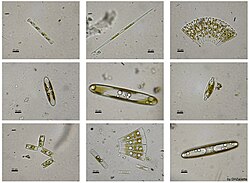
Mixed diatom assemblage — a community of different species, each with its own specific geometry, sharing the same water column; the diversity of diatom forms (circles, triangles, crescents, rectangles, stars) is a natural demonstration that the same mathematical principles generate an infinite variety of specific solutions

Snowflake — the hexagonal symmetry of ice crystallization; a single water molecule is chemically asymmetric, but when billions of them lock into the ice lattice, the hexagonal patterning of hydrogen bonds generates the six-fold symmetry visible in every snowflake; the geometry emerges from the molecule's shape the way a symphony emerges from a single note's overtones

Snow crystals — the variety within unity; every snowflake expresses the same hexagonal symmetry, but no two snowflakes are identical because each one's specific branching pattern is determined by the unique sequence of temperature and humidity conditions through which it fell; the universal law expressed in an infinite variety of individual instances

Diatom chain — some diatom species link their frustules in chains by extending spines that lock together; the resulting structure is a fractal: the geometry of the individual cell is replicated at the scale of the chain; fractal self-similarity across scales is one of the most common structural principles in the living world, and one of the most visually striking
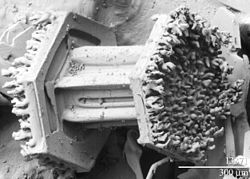
Snowflake under scanning electron microscope — the three-dimensional structure of an ice crystal, revealed by the SEM's ability to image surfaces without destroying delicate structures; what appears as a flat pattern of hexagonal symmetry under an optical microscope is revealed as a three-dimensional branching structure of extraordinary delicacy


Comentarios