Islamic Calligraphy: The Sacred Art of the Word
In Islam, the prohibition of figural representation in sacred contexts — contested, historically variable, but influential — redirected the creative energy of Islamic civilization's finest artists toward an art form that Christianity and Buddhism had never elevated to comparable supremacy: calligraphy. The written word is sacred in Islam in a direct and non-metaphorical sense: the Quran is not a text about the divine word; it is the divine word, the speech of God transmitted through the Prophet Muhammad, perfectly preserved in Arabic. To write it beautifully is therefore an act of devotion of the highest order — the human artist's finest capacity placed entirely at the service of the divine message. The great calligraphers of the Islamic tradition — Ibn Muqla (who systematized the proportional system of Arabic letterforms in the 10th century), Ibn al-Bawwab, Yaqut al-Musta'simi — are saints of their art, and their finest works are theological objects as much as aesthetic ones: the divine speech made visible in a form worthy of its content.

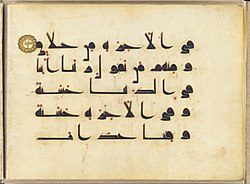
Quran by Yaqut al-Musta'simi, Baghdad (1282-1283 CE) — the last great Abbasid calligrapher, whose innovations in the six classical scripts defined the tradition for centuries; Yaqut's bihari-style letters, with their sweeping horizontals and decisive terminals, were copied by calligraphers across the Islamic world for three hundred years after the Mongols destroyed Baghdad in 1258
Quran folio — the illuminated Quran represents the highest aspiration of Islamic book arts: the sacred text adorned with geometric borders, gold leaf, and lapis lazuli in patterns as mathematically precise as the tile work of the great mosques; the ornamentation does not compete with the text but frames it, indicating its status as the utterance of the Infinite
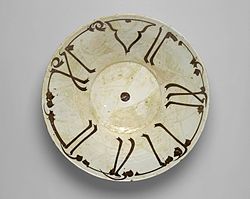
Bowl with Kufic calligraphy (10th century CE) — Kufic, the earliest formal script of Arabic, characterized by angular, rectilinear letterforms; the Quran was first written in Kufic; the transfer of sacred text to ceramics, textiles, and metalwork democratized the presence of the divine word throughout the material culture of Islamic civilization
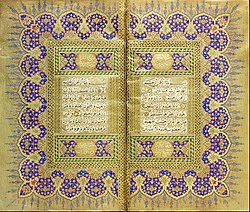
Quran by Mehmed Şevki Efendi — the Ottoman master calligrapher (1829-1887) whose naskh script is considered the finest of the 19th century; Şevki's letters achieve a clarity and elegance that his students memorized letter by letter; the Ottoman calligraphic tradition, centered in Istanbul, sustained the classical Islamic scripts through centuries when other art forms were changing under Western influence

Quran folio, Mamluk dynasty (13th-15th century CE) — the Mamluk sultans of Egypt were among the most lavish patrons of Quranic calligraphy; the large-format Mamluk Qurans, intended for use in mosques and mausoleums, were written in muhaqqaq script — a grand, stately script with sweeping horizontals — on a scale commensurate with the spaces they were meant to inhabit

Bismillah (Basmala) — 'In the name of God, the Compassionate, the Merciful' — the opening words of every chapter of the Quran except one; the most frequently written Arabic phrase in the world; its calligraphic rendering is an art form in itself, the four words twisted, elongated, mirrored, and interlaced into forms ranging from the elegant to the extraordinary

Calligraphy by Mir Emad al-Hasani (c. 1610) — the master Safavid calligrapher of Isfahan, whose nastaliq script defined the Persian calligraphic tradition; Mir Emad was murdered in 1615 by court rivals who resented his favor with Shah Abbas; his letters, fluid as water and precise as mathematics, were copied by Iranian calligraphers for two centuries after his death

Calligraphic ceiling, Frere Hall, Karachi — the integration of Arabic calligraphy into architectural decoration; in Islamic architecture, the written word covers surfaces that in other traditions are left plain or adorned with figural imagery; the mosque is a building whose walls speak, whose every surface proclaims the divine word in the art form that Islamic civilization elevated to the highest expression of the human creative capacity


Comentarios