Islamic Geometric Art: The Mathematics of the Infinite
Islamic geometric art is perhaps the most mathematically sophisticated visual tradition in human history — and its sophistication is inseparable from its theology. In Islam, the depiction of the human figure in sacred contexts is problematic: no human form should compete with the divine. What took its place was geometry — the abstract language of mathematical pattern, understood as the closest available approximation to the infinite, self-replicating order of God's creation. The tile patterns of the Alhambra in Granada, the carved plaster of the Moroccan madrasas, the mosaic domes of Isfahan's Friday Mosque contain, in visual form, the same mathematical structures that Western science discovered analytically centuries later: quasi-crystalline symmetry, non-periodic tiling, the seventeen plane symmetry groups. The artists who made these patterns did not have algebra in the modern sense. They had something that may have been more powerful: an intuitive, practiced, devotional relationship with the mathematics of the divine.

Alhambra Palace, Granada, Spain (14th century) — muqarnas (stalactite vaulting) detail; the muqarnas system transforms the architectural transition between wall and ceiling into an intricate three-dimensional geometry that has no structural function — it exists purely to enact the mathematical beauty of infinite subdivision

Alhambra tile pattern close-up — one of the 17 mathematically distinct plane symmetry groups, all of which appear somewhere in the Alhambra's tile work; the Moorish artists achieved, through direct geometric construction, what Western mathematicians would not formally classify until the 19th century

Darb-i Imam Shrine, Isfahan, Iran (1453) — girih tile pattern in the spandrel; Peter Lu and Paul Steinhardt's 2007 analysis of this pattern demonstrated that it encodes quasi-crystalline geometry (specifically Penrose tiling) 500 years before Roger Penrose described it mathematically

Bou Inania Madrasa, Fez, Morocco (14th century) — the layered program of geometric tile, carved plaster arabesque, and calligraphic frieze; each material and each height registers a different level of symbolic meaning — earth, garden, heaven — in a vertical hierarchy of the divine

Ben Youssef Madrasa doorway, Marrakech (16th century) — the threshold as cosmic portal; Islamic sacred architecture consistently treats doorways as the most elaborate surfaces, marking the transition between the outer world and the sacred interior as the most important architectural event
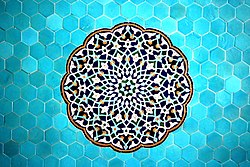
Jame Mosque of Yazd, Iran — the deep blues of the Persian mosaic tilework; the color blue in Islamic architecture carries the same theological weight that it does in Chartres Cathedral: the color of the infinite, the color of the sky, the color that recedes toward the divine horizon

Shah Nematollah Vali Shrine dome, Mahan, Iran — the interior of the dome as image of heaven; the geometric pattern that covers every surface from floor to dome is designed to be read from any position in any direction, an infinite pattern that has no privileged viewpoint — as the divine itself has no privileged perspective

Bibi-Khanym Mosque minaret detail, Samarkand (15th century) — the Timurid tradition of Central Asia developed some of the most intricate geometric surface decoration in the Islamic world; the minaret as vertical axis connecting earth and heaven, its surface covered in the visual language of cosmic order
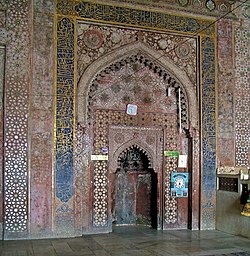
Mihrab, Jama Masjid, Fatehpur Sikri, India (16th century) — the prayer niche that indicates the direction of Mecca; the mihrab is the most sacred surface in any mosque, the point toward which all bodies in the congregation orient themselves in prayer; its elaboration is accordingly among the most intensive in Islamic art

Palace of the Shaki Khans, Azerbaijan (18th century) — shabaka stained glass windows; Islamic architecture adapted the Gothic insight that colored light transforms space, creating in the shabaka tradition a geometric stained glass that achieves its effects through pattern rather than pictorial narrative

Great Mosque of Kairouan luster tiles, Tunisia (9th century) — among the oldest surviving examples of luster-ware tilework in Islamic architecture; the metallic sheen of luster tiles was understood as catching and transforming light in the same way that the sacred text transforms the mundane into the divine


Comentarios