Izanagi and Izanami: The Creator Couple of Japanese Myth, the Birth of Death, and the First Descent into the Underworld
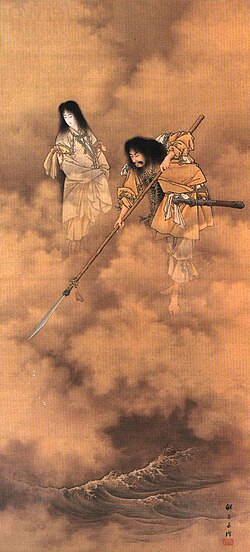
Izanagi wielding the jeweled spear Ame-no-Nuboko, with Izanami — Kobayashi Eitaku, 1880–1890, Museum of Fine Arts, Boston. The founding act of Japanese creation: the divine couple standing on the Floating Bridge of Heaven, stirring the primordial waters with the celestial spear until the first land emerges from the sea.
In the beginning, before the islands of Japan existed, the heavens and the earth were still combined — an undifferentiated mass like an egg, the clear and light element rising to form the sky and the heavy and dark element sinking to form what would become the earth. From this separation emerged the first gods, one after another, until the divine pair was appointed: Izanagi-no-Mikoto ("the Male-Who-Invites") and Izanami-no-Mikoto ("the Female-Who-Invites").
The older gods of heaven gave them a jeweled spear — the Ame-no-Nuboko, the "Heavenly Jeweled Spear" — and instructed them to stand on the Floating Bridge of Heaven and stir the primordial waters below. They stirred, and when they lifted the spear, the brine that dripped from its tip coagulated and fell, and the drops piled up until they formed the first island: Onogoroshima — the island that formed itself, the primordial land from which the rest of the Japanese archipelago would be born.
They descended to this island. They built a great pillar and walked around it in opposite directions, and when they met, they spoke words of courtship. And from their union, the islands of Japan were born.
This is the opening of the Kojiki (Records of Ancient Matters, 712 CE), Japan's oldest surviving text — the account of how the world came to be, how the Japanese islands emerged from the primordial waters, and how the divine couple who made the world together were then divided by the first death.
The Kojiki and the Nihon Shoki: The Two Tellings
The story of Izanagi and Izanami is preserved in two primary ancient sources: the Kojiki (712 CE), compiled by Ō no Yasumaro under imperial command as a record of Japan's sacred history, and the Nihon Shoki (720 CE), Japan's second oldest chronicle. The two texts tell the same mythological narrative with significant variations in detail, suggesting that multiple regional traditions were compiled and harmonized in the early 8th century into something approaching a standard account.

The Japanese primordial deities — chart showing the Kotoamatsukami (the five divine entities that spontaneously emerged at creation) and the seven generations of kami that followed, culminating in Izanagi and Izanami as the last divine couple charged with completing the creation of the earthly world.
The Kojiki's version of the Izanagi-Izanami narrative is richly detailed and emotionally powerful — one of the great myth-cycles of world literature, combining cosmic creation with a love story, a death, and a descent into the underworld that sets the fundamental conditions of human existence. Its combination of cosmological grandeur and intimate human emotion — the grief of separation, the horror of decomposition, the rage at betrayal — places it in the same category as the Sumerian Descent of Inanna, the Greek myth of Orpheus and Eurydice, and the Norse account of Hermóðr's journey to retrieve Baldr.
Creating the Islands: The Sexual Geography of Japan
The birth of the Japanese islands from the union of Izanagi and Izanami is one of the most distinctive creation narratives in world mythology: the land itself is the child of the divine couple, not the product of labor or craft or speech, but of the same generative process that produces biological offspring. The islands of Japan are, in this mythological framework, divine children — entities of sacred origin, born from sacred parents, possessed of kami-nature themselves.
The first birth — in the Kojiki version — produced a malformed child, the Hiruko ("the Leech Child"), who lacked bones and could not stand. The heavenly gods, consulted about this failure, diagnosed the problem: when Izanami and Izanagi had walked around the pillar and met, it was Izanami (the female) who spoke first — "Oh, what a fair and lovely youth!" — before Izanagi could speak. The improper order of speech had corrupted the birth. They must do the ritual again, correctly, with the male speaking first.
They did. And from the second, properly conducted union, the islands of Japan emerged in sequence: Awaji, Shikoku, Oki, Kyushu, Iki, Tsushima, Sado, and finally the great central island Honshu — the Great Yamato Island — giving Japan its mythological name of Ōyashima, "the Eight Great Islands" (a term for the archipelago as a whole, rather than a literal count of eight).
After the islands, Izanagi and Izanami generated the gods: kami of the sea, of the mountains, of the rivers, of the trees, of the plains, of the winds — the entire divine infrastructure of the natural world generated by this one creative couple working together.
The Death of Izanami: How Death Entered the World
The narrative turns on the birth of Kagu-tsuchi — the kami of fire. Izanami, giving birth to the fire-god, was burned by her own child's divine heat. She fell ill and died.
This is the moment that Kojiki identifies as the origin of death — not an abstract theological explanation but a story of causal logic: the world needed fire to be complete, and the creation of fire cost the life of the one who brought it into being. Death enters the world as the price of fire. The universe gains one of its most necessary elements and loses, for the first time, a divine being.
Izanagi's grief is devastating. The text of the Kojiki describes him weeping at her head, at her feet, moving around her body in lamentation. Even as he grieves, the divine functions of the world continue — other kami emerge from Izanami's body and from Izanagi's tears. But the world is no longer the same. The creator couple is separated. The male principle remains in the living world; the female principle has passed to Yomi — the underworld.
The Descent to Yomi: The First Encounter with Death
What follows is the core of the Izanagi-Izanami myth: Izanagi's descent into Yomi-no-Kuni — "The Land of Darkness," the Japanese underworld — to retrieve his dead wife.

Yomotsu Hirasaka — the traditional location of the entrance to Yomi, the Japanese underworld, in Higashiizumo, Shimane Prefecture. This slope is identified in the Kojiki as the place where Izanagi blocked the passage between the worlds after his flight from the underworld, establishing the permanent boundary between life and death.
He descends to the entrance of the underworld and calls out to Izanami from the threshold. She answers him from within the darkness. She would like to return, she says — but she has already eaten the food of Yomi, and that changes her status. She asks him to wait while she consults with the gods of the underworld. She asks him, specifically, not to look at her.
He waits. He waits a long time. He grows impatient. He breaks off a tooth from the comb in his hair and lights it as a torch. And he looks.
What he sees is the decomposed body of his wife — crawling with maggots, her body in advanced putrefaction, the eight thunder-gods born from the different regions of her rotting flesh. The text of the Kojiki is unflinching in its specificity: the body that Izanagi sees is not a symbolic death but biological decay in exact anatomical detail.
Izanami, discovering that she has been seen in her corruption — that the prohibition has been broken, that the bargain of darkness has been violated by light — is furious. She sends the Shikome (hideous women of the underworld) to pursue him. She sends armies of underworld soldiers. She releases the eight thunder-gods.
Izanagi flees. In his flight, he uses the objects he carries to slow his pursuers: he throws down his black headdress, which becomes a cluster of grapes; he throws down his comb, which becomes bamboo shoots. (Food appears from ceremonial objects — the underworld creatures stop to eat.) When he reaches the slope that marks the boundary between Yomi and the living world — the Yomotsu Hirasaka — he picks up three peaches and throws them at his pursuers, driving them back.
Then Izanami herself comes. And Izanagi rolls an enormous boulder across the entrance to the underworld, blocking her.
On one side of the boulder, Izanami — the goddess who is also now the ruler of death — speaks: "My beloved husband, if you do this, I will kill a thousand of your people every day."
And Izanagi responds: "My beloved wife, if you do that, I will cause fifteen hundred births every day."
This exchange, in the Kojiki's account, establishes the fundamental condition of human existence: the ratio of death to birth. One thousand die each day; fifteen hundred are born. The world continues, and grows, despite the toll that death takes — because the creative principle, properly invoked, always slightly exceeds the destructive one. The boulder between the worlds is the permanent structure of mortality: irreversible, blocking return, but also defining what is on the other side as worth returning to.
The Purification of Izanagi: The Birth of the Three Great Deities
Emerging from the underworld contaminated by contact with death and corruption, Izanagi performs misogi — the great ritual purification by water that is one of the central practices of Shinto to this day. He strips off his garments at the entrance to the underworld (from which more kami emerge) and goes to a river mouth to bathe.

Izanagi performing misogi (ritual purification) at the river mouth after returning from Yomi — Natori Shunsen, woodblock print. The ritual bathing that purifies the pollution of the underworld generates, in the mythological account, some of the most important kami in the Shinto pantheon, including the three great deities Amaterasu, Tsukuyomi, and Susanoo.
As he bathes, the pollution of the underworld washing away generates kami. And when he washes his left eye, Amaterasu-Ōmikami ("the Great Divinity Illuminating Heaven") is born — the sun goddess, who becomes the most important deity in the entire Shinto pantheon and the divine ancestor of the Japanese imperial family. When he washes his right eye, Tsukuyomi-no-Mikoto ("the Moon-Reader") is born — the moon god. When he washes his nose, Susanoo-no-Mikoto ("the Impetuous Male") is born — the storm god.
These three — the Three Great Deities (Mihashira no Uzu no Miko) — are the central figures of subsequent Japanese mythology. Amaterasu rules the heavens; Tsukuyomi rules the night; Susanoo is assigned the seas but refuses his duty, weeping for his dead mother (Izanami) and eventually sent away, initiating the great narrative of his earthly adventures. The entire subsequent structure of Shinto myth unfolds from the moment of Izanagi's purification in the river.
Izanami as Queen of the Dead
After the rupture at the Yomotsu Hirasaka boulder, Izanami does not disappear from the tradition. She becomes Yomotsu-Ōkami — the Great Deity of Yomi — the ruler of the land of the dead. She is the goddess who receives the dead and governs the underworld, her initial role as life-giver transformed by death and decomposition into its opposite.
The mythological logic is precise: Izanami began as the one who bears life into the world (through the union with Izanagi that produced the islands and the gods). She ends as the one who holds the dead. The creative principle and the destructive principle are assigned to the same being in two sequential phases: the same goddess who gave birth to Japan became the goddess who threatens to kill a thousand of its inhabitants every day. Creation and destruction are not opposite forces held by different beings — they are sequential aspects of the same divine nature.
This is the Japanese mythological insight that corresponds to what the Hindu tradition expresses in the figure of Shiva (who both creates and destroys) and what the Greek tradition expresses through Demeter and Persephone (the goddess of grain whose daughter's absence is the cause of winter and death). The divine feminine, in these traditions, encompasses both the capacity for life-giving and the capacity for death — because both are aspects of the same fundamental reality of change.
The Esoteric Izanagi-Izanami: Light from the Look
The pivotal moment of the Izanagi-Izanami myth — the forbidden look — contains one of the most structurally important insights in any mythological tradition about the relationship between consciousness and death.
Izanagi cannot retrieve Izanami from death because to retrieve her would require keeping her in darkness — in the state of not-being-seen that she herself requests. The moment consciousness is brought to bear on death (the tooth-comb torch, the act of looking), death becomes visible in its true form — putrefaction, dissolution, the radical otherness of the no-longer-living — and the attempt at retrieval fails. Death cannot be brought into the light without becoming what it actually is.
The Orpheus myth tells the same story: you cannot look at what you are trying to rescue from the underworld, because looking changes both the observer and the observed. The act of looking establishes the viewer as alive (consciousness, light, the capacity for attention) and the viewed as dead (the object of attention rather than its source). To look at the dead is to confirm the boundary between them.
Izanagi's misogi — the purification by water after the contamination of the underworld — is the mythological encoding of the renewal that contact with death makes possible. He returns from Yomi polluted, contaminated by what he has seen and by the world he has entered. The purification washes this away and in doing so generates the greatest of his divine children: the sun, the moon, the storm. Contact with the ultimate darkness, properly processed through the ritual of purification, produces the light that illuminates the world.
The boulder stands at the Yomotsu Hirasaka. Fifteen hundred are born today. A thousand will die. And the ratio that Izanagi established — slightly more life than death, always, in perpetuity — holds the world in its careful, imperfect, beautiful balance.
— Lux Esoterica


Comentarios