Khajuraho: Sacred Architecture and the Union of Opposites
The Khajuraho Group of Monuments — 85 temples built between 950 and 1150 CE by the Chandela dynasty in central India, of which 22 survive — is one of the most extraordinary achievements of medieval Indian religious architecture, and one of the most consistently misunderstood. The erotic sculptures (mithuna) that cover a portion of the temples' exteriors have attracted Western fascination out of proportion to their actual extent: they constitute perhaps 10% of the total sculptural program, whose majority depicts celestial beings, divine figures, epic scenes, and geometric ornamentation of extraordinary refinement. The theological meaning of the erotic sculpture is debated — some scholars see it as Tantric instruction, others as apotropaic protection against lightning (associated with Indra, who was believed to be deterred by erotic display), others as the representation of sacred union in the Shaiva tradition. All agree that it is not pornographic in any modern sense: it is sacred art, depicting the union of divine principles in the same spirit that other traditions depict the divine through other means.

Khajuraho temple architecture — the characteristic shikhara (tower) of the Nagara style rises in a curvilinear form meant to represent Mount Meru, the cosmic axis; the temple is not a building but a mountain — the abode of the deity, the point where heaven and earth meet

Lakshmana Temple, Khajuraho (c. 954 CE) — one of the earliest and most complete temples; the triple spire system, in which smaller subsidiary shrines surround and echo the main tower, creates a visual crescendo from ground to summit that maps the soul's ascent from material to divine

Dulhadeo Temple detail — the surfaces of Khajuraho temples are covered in continuous bands of sculpture; celestial nymphs (apsaras), divine couples, mythological scenes, and geometric patterns create an encyclopedia of sacred imagery that takes hours to read; the temple as text, the wall as scripture

Ruined temple columns, Khajuraho — of the original 85 temples, only 22 survive; the rest were destroyed, most likely by the Delhi Sultanate in the 13th century; the surviving temples escaped because Khajuraho had been abandoned and reclaimed by jungle, hidden from those who destroyed other temples

Mithuna (sacred couple) sculpture — the erotic sculptures of Khajuraho depict the union of male and female as a sacred act; in the non-dual Shaiva tradition, the union of Shiva and Shakti is the fundamental creative act of the cosmos; the human erotic embrace, properly understood, mirrors the divine creative union
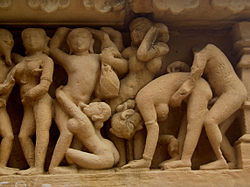
Erotic detail, Lakshmana Temple — positioned on the exterior walls, the mithuna sculptures are crossed on the threshold of the sacred interior; to enter the temple, the devotee passes through the world of erotic attachment and leaves it behind, moving from the outer world of desire into the inner world of the divine

Kama sculptures, Lakshmana Temple — Kama, the Hindu god of desire, whose arrows cause love; the Khajuraho temples honor the full range of human experience as sacred, including the desires that other traditions ask the devotee to renounce; the Tantric path uses those desires as fuel for spiritual transformation rather than obstacles to be suppressed

Map of the Khajuraho temple complex — the temples are arranged in three groups (Western, Eastern, and Southern); the Western group, most complete, includes the largest and most elaborately decorated temples; the complex was a royal sacred city, its temples the devotional expression of Chandela dynastic power


Comentarios