Kumbh Mela: The World's Largest Sacred Gathering
The Kumbh Mela — held on a rotating cycle at four sacred river sites in India (Prayagraj, Haridwar, Nashik, and Ujjain) — is the largest peaceful gathering of human beings on Earth. The 2019 Prayagraj Maha Kumbh Mela attracted an estimated 240 million pilgrims over 49 days — a number that exceeds the population of most countries. It has been described as the only human event visible from space. Its origin lies in one of the central myths of Hindu cosmology: the Samudra Manthan (Churning of the Ocean of Milk), in which gods and demons cooperated to churn the cosmic ocean and produce the amrita (nectar of immortality); during the subsequent battle for possession of the amrita, drops fell at the four sacred sites — making these places, for pilgrims, literally the locations where divine nectar touched the earth. To bathe in the river during the most auspicious astronomical alignments of the Kumbh is to participate in the myth — to enter the water that received the nectar of immortality and to carry that contact back into ordinary life.

Samudra Manthan (Churning of the Ocean of Milk) — the mythological origin of the Kumbh Mela; gods (on the right) and demons (on the left) use the serpent Vasuki as a rope and Mount Mandara as a churning staff to agitate the cosmic ocean; the amrita drops that fell during the subsequent battle for possession of the nectar sanctified the four Kumbh Mela sites
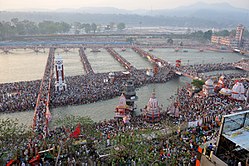
Shahi Snan (Royal Bath), Hari Ki Pauri Ghat, Haridwar — the main bathing ghat at Haridwar on one of the auspicious bathing dates (Shahi Snan); millions bathe simultaneously at specific astronomical moments (planetary alignments involving Jupiter, the Sun, and the Moon) believed to charge the river water with maximum sacred energy; the timing is calculated to the minute by astrologers

Pilgrims at the Kumbh Mela — the diversity of Indian spiritual life made visible: householders and renunciants, devotees of Vishnu and Shiva and the Goddess, practitioners of yoga and tantra and devotional bhakti; the Kumbh Mela is one of the few occasions when the full spectrum of Hindu practice coexists in a single visible space

Prayagraj Kumbh Mela, 2001 — the Maha Kumbh Mela (Great Kumbh, held every 12 years at Prayagraj at the confluence of the Ganges, Yamuna, and mythological Saraswati rivers) is the largest of the four; the Prayag Sangam (confluence) is considered the most sacred bathing site in Hinduism — three rivers meeting at a single point, the visible dual merging into the invisible third
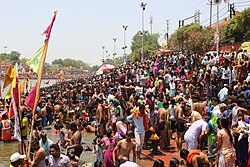
Simhastha Kumbh Mela, Ujjain, 2016 — the Kumbh Mela at Ujjain (the Simhastha) is held when Jupiter enters Leo; Ujjain, the ancient city of Avanti, was the prime meridian of Indian astronomy; the sacred river Shipra here joins the symbolic geography of the Kumbh: all rivers are the Ganges when they host the event

Kumbh Mela at Haridwar, 1850s steel engraving — the event as witnessed by British colonial observers who struggled to comprehend a religious gathering on this scale; the 1820 Haridwar Kumbh Mela saw an estimated 3 million pilgrims — at a time when London had a population of 1 million; the Kumbh Mela has always been, and always will be, beyond ordinary scales of reference

Prayag Snana Vidhi manuscript (1674 CE) — the Sanskrit text prescribing the rituals of bathing at Prayagraj; the pilgrimage procedures, the auspicious timings, the prayers to be recited — all transmitted in an unbroken textual tradition; the manuscript tradition and the living practice have reinforced each other for millennia, the text preserving the practice and the practice giving the text its meaning

Evening Ganga Aarti, Hari Ki Pauri Ghat, Haridwar — the nightly river ceremony in which lamps are offered to the Ganges as the living embodiment of the goddess Ganga; the river is not a body of water that happens to be sacred — it is the goddess herself, flowing through the landscape; to bathe in it is to be touched by a divine being; to offer light to it is to reciprocate the grace it continuously bestows

Cultural performance, Kumbh Mela 2019 — the contemporary Kumbh Mela is not only a bathing pilgrimage but a complete festival of Indian culture: music, dance, spiritual discourse, yoga demonstrations, and the camps of the various akharas (orders of sadhus) where advanced practitioners share teaching with ordinary pilgrims; the sacred and the festive are not distinguished


Comentarios