Mercury Retrograde: The Cosmic Pause That Asks You to Look Back

The planet Mercury photographed by the MESSENGER spacecraft — the closest planet to the Sun, it completes its orbit in just 88 days and appears to reverse course three or four times a year from Earth's perspective, giving rise to one of astrology's most discussed cycles
Few phrases have migrated from the esoteric subculture to mainstream consciousness as completely as "Mercury is in retrograde." It explains missed emails and delayed flights, derailed negotiations and technological meltdowns, the sudden resurfacing of exes and unfinished conversations. It is invoked in memes, morning news segments, and corporate presentations. Millions of people who would not call themselves astrologers know that when Mercury goes retrograde, something is different.
The question worth asking is not whether they are right in any strict causal sense, but what this ancient cycle is actually pointing at — what it has meant across two thousand years of astrological tradition, what the god behind the planet stands for in the esoteric framework, and what genuine wisdom lies embedded in this most viral of celestial events.
What Retrograde Actually Means
Mercury retrograde is a real astronomical phenomenon, not an astrological invention. It is a consequence of the geometry of orbits.
Mercury orbits the Sun in approximately 88 days — far faster than Earth's 365 days. Because Mercury's orbit is smaller and faster, there are periods when it appears, from Earth's point of view, to move backward against the background of the stars. This is an optical illusion produced by the relative speeds of the two planets: as Mercury "overtakes" and then "laps" Earth, its apparent motion as seen from Earth reverses direction for approximately three weeks, then reverses again, returning to its normal forward motion.
The technical term is apparent retrograde motion. Mercury is not actually moving backward. But the appearance is real — it is observable from Earth with the naked eye if you track the planet's position against fixed stars over several weeks. And in astrology, it is the appearance from Earth — what the sky looks like from the perspective of human observers — that carries meaning. Astrology is, among other things, a system of meaning-making based on the sky as experienced from the surface of this particular planet, at this particular time in human history.
Mercury goes retrograde three or four times per year, for roughly three weeks each time, covering about sixty to eighty degrees of the zodiac before resuming direct motion. There are also shadow periods — the two to three weeks before retrograde begins (when Mercury slows before reversing) and after it ends (when it re-traverses the degrees it covered during retrograde) — which many astrologers treat as extensions of the retrograde's influence.

Apparent retrograde motion: as a faster inner planet overtakes Earth, it appears to reverse direction against the background of fixed stars — an optical illusion with genuine observational reality and centuries of astrological interpretation
Mercury the Planet, Mercury the God
The interpretive framework of Mercury retrograde begins not with the planet but with the deity after whom it was named — the Roman Mercury, identified with the Greek Hermes, one of the most complex and multifaceted figures in the ancient world.
Hermes in the Greek tradition is the messenger of the gods: the divine intermediary who moves between Olympus, Earth, and the underworld, carrying communications between realms. He is the patron of language, eloquence, writing, commerce, travel, and boundaries. He is the only god who can cross between the world of the living and the world of the dead at will — a function that made him the psychopomp, the guide of souls in their transit after death.
He is also the patron of thieves, liars, and tricksters. This is not a contradiction. The same faculty that makes communication possible — the capacity to represent one thing in terms of another, to translate, to mediate — also makes deception possible. Language is the medium of both truth and falsehood. The same intelligence that builds bridges between minds can also construct illusions. Hermes presides over all of it: the sophist and the poet, the merchant and the pickpocket, the diplomat and the double agent.
In astrology, Mercury the planet governs all of these Hermetic domains: communication, commerce, intellect, information, transportation, contracts, siblings, the local environment, short-distance travel. When Mercury moves forward, these areas of life tend to flow. When Mercury moves backward — retrograde — the Hermetic principle inverts.
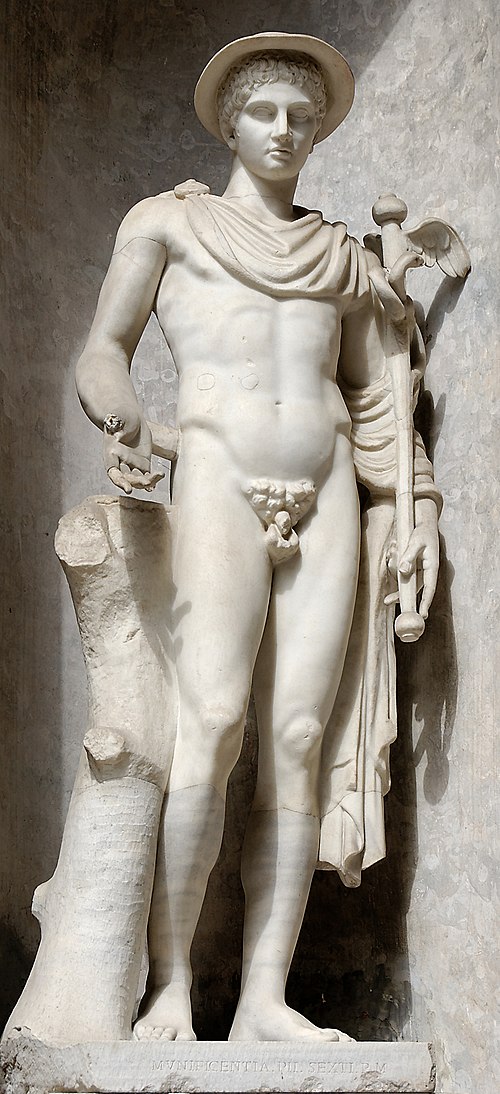
Hermes Ingenui, Roman marble copy of a 5th-century BCE Greek original, Vatican Museums — the god of communication, commerce, and boundaries was also the guide of souls between worlds: the same figure who moves messages between the living presides over the retrograde's invitation to revisit the past
The Retrograde Signature: Re-, Re-, Re-
The most consistent practical advice around Mercury retrograde is the list of re- words: review, revise, revisit, reconnect, reconsider, reassess, return, rest. The prefix is the key: retrograde is a time for backward motion — not in the pejorative sense of regression, but in the literal sense of returning to territory already traversed.
This is the basic astrological logic: as Mercury retraces its degrees, the areas of life it governs are opened for review. Contracts signed under retrograde may contain errors or misunderstandings that only become apparent later. Communications launched during retrograde may fail to arrive, be misinterpreted, or carry unintended implications. Decisions made in haste during this period often need revision when Mercury turns direct.
This is not fatalistic. The retrograde is not a period during which all action is cursed. It is a period that naturally favors inward movement over outward expansion: review over initiation, revision over creation, reconnection over new beginnings. The person who treats it as a signal to slow down, double-check, and revisit what has been left unfinished typically finds the period productive. The person who ignores the signal and launches major initiatives tends to find them riddled with complications that would have been avoidable.
The technology dimension of Mercury retrograde — the collapsed servers, the failed backups, the garbled messages — has become its most culturally legible face. Whether or not Mercury's apparent position affects electronic infrastructure (which the physics of the situation renders implausible), there is something useful in the cultural practice of treating technological failures as prompts for patience and preparation rather than occasions for panic. "Mercury is retrograde" functions as a collective permission to pause, troubleshoot carefully, and not take communication breakdowns personally.
The Shadow Periods and the Three Passes
Understanding the full Mercury retrograde cycle requires looking at all three passes over the degrees involved.
When Mercury stations retrograde (the moment it stops and reverses), it begins moving backward over degrees it has already covered. When it stations direct (the moment it stops again and resumes forward motion), it then passes forward over those same degrees for a third time. This triple traversal is significant in traditional astrology: topics, themes, and conversations activated during the first pass (pre-shadow) are developed during retrograde and resolved — or at least clarified — during the third pass (post-shadow).
This three-act structure is worth taking seriously as a practical framework for introspection. The first pass raises questions. The retrograde period is for sitting with them, revisiting their background, resisting the urge to force conclusions. The third pass is for integrating what emerged and acting from a more informed position.
This maps onto a rhythm of consciousness that contemplative traditions across cultures have recognized: the necessary alternation between engagement and withdrawal, action and reflection, movement forward and return to what has been seeded. Mercury retrograde, in this reading, is not an obstacle but an opportunity — a rhythmic invitation, built into the structure of the solar system and repeating three or four times per year, to do the work of genuine reconsideration.
Retrograde and the Zodiac Sign
Mercury retrograde does not occur in the same part of the sky each time. Where it happens — which zodiac sign or signs it traverses — colors the experience and suggests which areas of life and psyche are most available for review.
A retrograde through fire signs (Aries, Leo, Sagittarius) tends to resurface questions of identity, passion, direction, and vision — the stories we tell about who we are and where we are going. Earth sign retrogrades (Taurus, Virgo, Capricorn) bring practical matters forward: financial arrangements, bodily health, work structures, and the material conditions of daily life. Air sign retrogrades (Gemini, Libra, Aquarius) emphasize relationships, social dynamics, ideas, and the quality of communication itself. Water sign retrogrades (Cancer, Scorpio, Pisces) go deepest: into emotional patterns, family history, unconscious material, and the feelings that have not found words.
This is why experienced astrologers pay attention to the full context of each retrograde rather than treating all of them identically. A Mercury retrograde in Scorpio is a very different experience from one in Gemini — even though both will share the general themes of review and revision, the content that surfaces will be shaped by the archetype of the sign.
The Synchronicity Dimension
Carl Jung's concept of synchronicity — meaningful coincidence, the occurrence of events that are causally unrelated but meaningfully connected — provides a framework that is genuinely useful for understanding what is happening during Mercury retrograde, without requiring literal causal claims about the planet's position affecting electronics or postal services.
The retrograde creates a coherent attentional field: millions of people, simultaneously, with the shared expectation that communication will be more complex, the past more present, and the need for patience and review more pressing. This collective orientation is itself a kind of synchronizing force. When you expect to hear from old contacts, you are more likely to respond warmly when they reach out. When you expect communication to be complex, you are more likely to read carefully before sending. When you are prepared for technological friction, you are less likely to be derailed by it.
In the language of esoteric philosophy, consciousness shapes experience. Not through magical causation, but through the genuine mechanisms of attention, expectation, and meaning-making. The retrograde functions as a collective frame of attention — and what it frames, it illuminates.
The conversations that resurface during retrograde are often ones that needed to resurface. The technical failures that create delays often prevent worse outcomes. The misunderstandings that come to light are ones that were present before the retrograde made them visible. The period's reputation for chaos is partly a reputation for revelation — for the uncovering of what was already there but not yet acknowledged.
Living with Mercury Retrograde: A Practical Esoteric Guide
The traditional practical advice has a consistent core:
Before Mercury stations retrograde: back up devices, finalize contracts if possible, resolve outstanding communications. This is not superstition — it is the sensible preparation of someone who knows a period of complexity is approaching.
During retrograde: slow down deliberate action, favor review over initiation, avoid signing major contracts or making irreversible decisions unless you have verified every detail multiple times. Expect to be patient with yourself and others in communication.
For the past that resurfaces: treat it as material for genuine examination rather than simple regression. The ex who texts during Mercury retrograde is not necessarily a sign of destiny — but the feelings their reappearance provokes may contain information worth attending to. The unfinished project that suddenly demands attention may genuinely need to be completed.
For the technology failures: use them as prompts for patience and self-examination rather than occasions for anxiety. What would you lose if you couldn't access your communications for three weeks? What does that tell you about your relationship to information and connectivity?
For the inner work: the retrograde is particularly well-suited to journaling, meditation, dreamwork, and any practice that turns attention inward. This is the trickster god going underground, and what he carries back from the underworld — like Hermes returning from Hades with the souls of the dead — is not death but information: what the ordinary daylight world cannot see.
The Return of the Messenger
When Mercury stations direct, there is often a palpable sense of movement returning — of clarity that had been elusive suddenly coming into focus, of communications that had been stuck releasing, of plans that had stalled beginning to move forward again.
This is the messenger returning from his journey below. He has been in the underworld, in the past, in the territory of revision and return — and he brings back what he found there: the adjustments that make the forward movement sounder, the conversations that needed to be had before new ones could begin, the understanding that only comes from sitting with incompleteness long enough to let it teach you something.
The esoteric significance of Mercury retrograde is not that the planet is punishing you. It is that the universe, periodically and rhythmically, offers a structured invitation to review: to look at where you have been, to reassess what you are carrying forward, and to make the thousand small corrections that keep the trajectory of a life aligned with its genuine direction.
The messenger goes backward so that the message, when it finally arrives, will be true.
— Lux Esoterica


Comentarios