Mughal Miniature Painting: The Divine Court of the Great Mughals
The Mughal school of miniature painting — which flourished in northern India between approximately 1550 and 1750 CE under the patronage of the Mughal emperors — represents one of the most extraordinary syntheses in the history of world art: the meeting of Persian miniature tradition, Hindu artistic practice, and European Renaissance painting (introduced through Jesuit missionaries who brought illustrated books to the Mughal court) in a visual language of unprecedented sophistication. The Mughal emperors were not merely patrons but participants: Akbar (r. 1556-1605) established the imperial atelier and supervised its production closely despite being unable to read; Jahangir (r. 1605-1627) was one of the most discerning connoisseurs in the history of any art tradition, able to identify the individual hand of different artists within a single collaborative painting; Shah Jahan (r. 1628-1658) brought the style to its most refined and jewel-like perfection. What they collectively produced in the imperial karkhana (workshop) was an art of the court that was simultaneously a theology of kingship: the emperor depicted as the center of a divine order, the living embodiment of justice, wisdom, and cosmic equilibrium.

Jahangir Preferring a Sufi Shaikh to Kings, Bichitr (c. 1615-1618) — the emperor seated on an hourglass throne offers a book to a Sufi mystic while European kings (including James I of England, holding a portrait) and the Ottoman sultan wait below; the image encodes Jahangir's self-understanding as a spiritual sovereign whose authority transcends the merely political
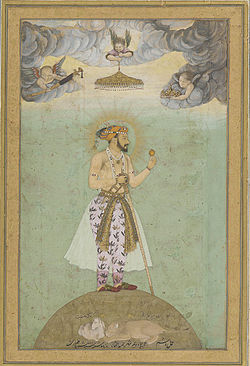
Shah Jahan on the Globe (c. 1640) — the emperor stands on the terrestrial globe, a halo behind him, holding a scepter; the composition draws directly on European allegorical imagery (probably transmitted through Jesuit gifts) while placing the Mughal emperor at the literal center of the world; the synthesis of Persian, Hindu, and European visual traditions is complete

Princes of the House of Timur (c. 1550-1555) — a dynastic portrait showing the Timurid ancestors of the Mughals gathered in a garden; the painting establishes the legitimacy of Mughal rule through genealogical connection to Timur (Tamerlane) and Genghis Khan; the garden setting references the Quranic paradise (jannat) and the ideal of enlightened royal power

Jahangir Visiting the Ascetic Jadrup, Govardhan (c. 1616-1620), Musée Guimet — Jahangir meets a Hindu holy man in his cave hermitage; Jahangir's memoirs (Tuzuk-i-Jahangiri) describe his genuine interest in Hindu and Jain ascetics, whom he respected as exemplars of a different form of spiritual authority; the painting records an actual encounter, the imperial court descending to meet the cave

Jahangir at the Jharoka Window of Agra Fort, Abu'l Hasan (c. 1620), Aga Khan Museum — the daily public appearance (jharoka darshan) at which the emperor showed himself to his subjects was a sacred ritual as much as a political performance; the emperor's visibility was the guarantee of cosmic order; Abu'l Hasan was Jahangir's favorite court painter, described by the emperor as 'unrivalled in his age'

Jahangir Weighs Prince Khurram (the future Shah Jahan), Manohar (1610-1615), British Museum — the prince is weighed against gold, silver, and other precious commodities on his birthday, which are then distributed to the poor; the weighing ceremony (tula dan) was borrowed from Hindu practice and adapted into Mughal imperial ritual; generosity as theology, the king's weight as the measure of his gift to the world

Study of a Nilgai (Blue Bull), Ustad Mansur (c. 1620), Metropolitan Museum — Jahangir employed the painter Ustad Mansur specifically to document the natural world; the emperor's memoirs record his intense interest in natural history, and the animal studies commissioned under his reign are among the finest natural history illustrations produced before the scientific revolution; Jahangir called Mansur 'the wonder of the age'

Elephant with Mahout (c. 1660), Metropolitan Museum — the elephant held a central place in Mughal royal symbolism: strength, memory, auspiciousness, and the power of the state made animal; emperors rode elephants in state processions, elephants were given royal names and kept meticulous genealogies, and the finest painters of the court were assigned to document exceptional animals

Prince Aurangzeb Facing the Maddened Elephant Sudhakar (1633) — the young prince alone on horseback before a charging war elephant, composed and unafraid; the image records an actual event described in Mughal chronicles; Shah Jahan had it painted to honor his son's courage; the moment of supreme danger rendered with the same jewel-like precision as a court reception, terror given the same visual value as ceremony

Asvatthama Fires the Narayana Weapon, from the Razmnama (c. 1616-17), Metropolitan Museum — the Razmnama ('Book of Wars') was Akbar's Persian translation of the Sanskrit Mahabharata, commissioned to make the Hindu epic accessible to Muslim courtiers; Akbar's policy of religious synthesis (Din-i-Ilahi) found its artistic expression in these collaborative translations, where Hindu epic and Mughal miniature tradition merged


Comentarios