Osiris: Lord of the Dead, God of Resurrection, and the King Who Made Death Survivable

Osiris in his classic standing form: green-skinned, mummiform, wearing the atef crown with its twin ostrich feathers, holding the crook and flail - the regalia of divine kingship that he carries not into life but through death, as the eternal king of the dead. The green skin is not decoration; it is theology, the color of that which has passed through death and returned transformed.
There is a paradox embedded in the figure of Osiris that the ancient Egyptians held without resolution for more than three thousand years: he is both the lord of death and the god of resurrection; both the murdered king and the one who makes death something other than a final catastrophe. He is not the god who prevents death - he is the god who is death, and who from inside death's own darkness demonstrates that death is not the end of the story.
Osiris (Egyptian Wsir; Greek Osiris; also Wennefer, "He Who is Permanently Benign and Youthful"; Khenty-amentiu, "Foremost of the Westerners," i.e., the dead) is the Egyptian god of the underworld, the afterlife, death, resurrection, and the cycles of agricultural fertility. He is one of the most ancient, most widely worshipped, and most theologically sophisticated deities in the Egyptian pantheon - a god whose myth encodes the central theological question of Egyptian civilization: what survives when the body dies, and what conditions determine whether that survival is toward blessing or toward annihilation?
His story - murdered by his brother, reassembled by his wife, resurrected long enough to father the son who will avenge him, then permanently enthroned as king of the dead - is one of the most emotionally resonant myths in the ancient world. It was told and retold across three thousand years of Egyptian history, elaborated in the Pyramid Texts (the oldest religious texts in the world, c. 2400 BCE), in the Coffin Texts, in the Book of the Dead, and in Plutarch's philosophical retelling in the 2nd century CE. The myth endures because what it addresses - the reality of loss, the question of what remains after devastating destruction, the possibility of a justice that operates beyond the reach of ordinary power - addresses the deepest anxieties of every human civilization.
The Appearance: Green King of the Dead
Osiris's most immediately striking attribute is his green skin - or in some traditions, black skin. Both colors carry precise theological content. Green (wadj) is the color of new vegetation, of the papyrus plant and the growing grain, of everything that emerges from death and makes life continue. Black (kem) is the color of the fertile Nile silt deposited by the annual flood - the mud from which everything grows. Both point to the same truth: Osiris's domain is not death in isolation but the cycle of death-and-renewal, the darkness from which life perpetually emerges.

Head of Osiris, Late Period Egypt, c. 595-525 BCE, Brooklyn Museum. The atef crown - the white hedjet crown of Upper Egypt flanked by twin ostrich feathers - is Osiris's most distinctive headgear, distinguishing him from the other kings of both the living and the dead. Even in this fragmentary form, the face carries the characteristic stillness of the divine king who rules beyond time rather than within it.
He is depicted mummiform: wrapped in white linen with only his hands and face exposed, in the posture of a wrapped corpse. This is not a limitation - it is a statement of his nature. He is the mummified dead king, the one who has undergone the transformation of death and retained his identity through it. His hands hold the crook (heqa) and flail (nekhakha) - the twin symbols of royal power - which he carries into the underworld as the king who rules there.
His crown is the atef: the tall white hedjet of Upper Egypt flanked by twin ostrich feathers and, in later traditions, by ram's horns. The atef is specifically his crown; it identifies him across all variations of his depiction. And his wife Isis - one of the most powerful magical beings in Egyptian theology - stands behind him with her wings outspread, as she stood when she searched for him, reassembled him, and breathed him back to life.
The Murder of a God: Set and the Coffin
The central myth of Osiris begins with him as the first king of Egypt - the divine ruler who taught humanity civilization: agriculture, law, the arts of life. His brother Set (Seth), god of the desert, storms, and chaos, wanted the throne. The fullest version of the myth comes from Plutarch's On Isis and Osiris (c. 100 CE), which preserves a Hellenized but recognizable version of Egyptian tradition.
Set conspired with seventy-two associates. He had a beautiful chest constructed, exactly fitted to Osiris's measurements, and offered it as a gift to whoever could fit inside it perfectly. Each guest tried; none fit. When Osiris lay down in the chest, it fit him precisely - because it had been made for him. Set and his conspirators slammed the lid shut, sealed it with molten lead, and threw it into the Nile. The coffin floated out to sea and came to rest at Byblos on the Phoenician coast, where a tamarisk tree grew around it, enclosing it in its trunk. The king of Byblos had the tree cut down and used it as a pillar in his palace - the murdered god enclosed inside a column of wood, holding up a foreign king's roof.
Isis - who had been searching - tracked down the chest. She retrieved it from the palace at Byblos through her famous intelligence and magical power, brought it back to Egypt, and hid it in the marshes of the delta. But Set found it. And he did what murderers do when they realize the body has been found: he dismembered it. He cut Osiris into fourteen pieces (some sources say sixteen, others forty-two, one for each nome of Egypt) and scattered them across the land.

The Osiris family - Louvre, E 6204. The divine family in miniature: Osiris enthroned, Isis and Nephthys flanking him, Horus before him. The family structure encodes the theological narrative: the murdered father, the devoted sister-wives who reassemble him, and the son whose birth from the dead father makes the resurrection mythologically complete and whose life is the ongoing consequence of the murder and the reassembly.
Reassembly and the Permanent Resurrection
Isis and her sister Nephthys - who, despite being Set's wife, was devoted to Osiris - searched Egypt for the pieces. They found them all except one: the phallus, which had been thrown into the Nile and swallowed by an oxyrhynchus fish (or, in some versions, by three different fish). Isis fashioned a replacement from gold.
Then she worked the greatest magic in the Egyptian tradition. Using her knowledge of the divine names and the spells she had extracted from Ra himself, she reassembled the body, performed the Opening of the Mouth ritual to restore Osiris's senses, and in the form of a kite (a hawk-like bird) hovered over the body and breathed life back into it - long enough for Osiris to impregnate her with the child who would become Horus.
Then Osiris died again. Not because the resurrection failed - but because he chose to rule the dead. He did not return to the living world; he descended permanently to the Duat, the underworld, to become its king. The resurrection was not a reversal of the death. It was the death's transformation: what had been murdered became the king of the murdered, and in doing so gave death a ruler who understood it from the inside.
Horus was born, raised in secret in the marshes by Isis, and eventually - after a long series of legal disputes and battles with Set before the tribunal of the gods - was awarded his father's throne. Osiris was avenged. The divine order (called ma'at - truth, justice, cosmic balance) was restored. And in the Duat, Osiris sat on his throne with Isis and Nephthys behind him, and the dead came before him.
The Duat: Kingdom of the Transformed Dead
The Duat (also Tuat) is the Egyptian afterlife realm - not simply a place of the dead but a complex cosmological space through which the sun itself traveled during the night hours, encountering the dead and renewing the world in the process. Osiris is its permanent king, presiding over the tribunal that determines the fate of each soul.
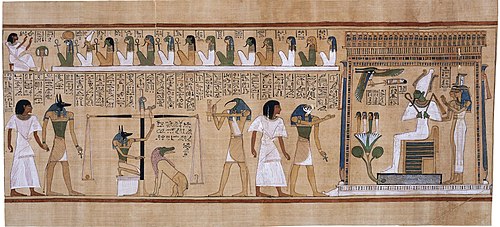
The Judgement of the Dead in the Presence of Osiris - from the Book of the Dead of Hunefer, c. 1275 BCE, British Museum. The most complete surviving image of the Egyptian afterlife judgment: on the left, Anubis leads the soul forward; in the center, the heart is weighed against Ma'at's feather while Thoth records the result and Ammit waits below; on the right, the soul is presented to the enthroned Osiris surrounded by Isis, Nephthys, and the forty-two Assessors. The entire procedure is a single dramatic moment where what has been lived becomes the measure of what will be.
The central ritual of the afterlife was the Weighing of the Heart (Psychostasia): the deceased's heart was placed on a scale against the feather of Ma'at - the feather of truth, justice, and cosmic order. If the heart was lighter than the feather - if the life had been lived in alignment with ma'at - the soul passed into the Field of Reeds (Aaru), the paradise of eternal plenty that awaited the worthy. If the heart was heavier - if it was burdened with wrongdoing, with violations of the forty-two precepts of Ma'at - Ammit, the Devourer (lion, hippopotamus, and crocodile in one) consumed it, and the soul ceased to exist in any form.
Osiris presides over this judgment not as an executioner but as a guarantor of justice. His own experience - murdered by the powerful, reassembled by the devoted, vindicated by the tribunal of the gods - makes him the most qualified judge: he knows what unjust power does, and he knows that ma'at ultimately prevails. The dead person appearing before his court was addressed as "Osiris [Name]" - a formula that identified the individual soul with the god himself, acknowledging that every human being who faces death is, in some sense, Osiris: murdered, in need of reassembly, awaiting judgment.
The Djed Pillar: Osiris's Spine and the Stability of the World
The djed (ded) is one of the oldest and most widely used symbols in Egyptian iconography: a column-like pillar with horizontal bands at the top, interpreted variously as a tree trunk, a bundle of grain stalks, or a stylized depiction of a spine. In the Osiris theology, the djed represents Osiris's spine - and more broadly, the stability that his resurrection establishes in the cosmos.
The annual ceremony of Raising the Djed was one of the most important rituals of the Egyptian religious calendar: the djed pillar was lifted upright by the pharaoh and priests in a symbolic re-enactment of Osiris's resurrection. When the djed stood upright, the world was stable; when it was horizontal, the world was in the disordered state of Osiris's death. The tamarisk tree at Byblos that had enclosed Osiris's body was understood by some traditions as the original djed - the pillar of a foreign king's palace was, in this reading, the spine of the murdered god of Egypt, and Isis's recovery of it was the recovery of the world's stability.
Osiris and Grain: The God Who Is the Harvest
Osiris's green skin connects him directly to his other great domain: grain and agricultural fertility. The grain dies each year - the stalks are cut, the earth lies bare - and returns. Osiris's myth is this cycle made into narrative: the god who is killed, who is buried (like a seed), and from whom life returns.

Osiris-Nepra - Osiris as the grain god, his body covered with ears of grain emerging from the mummiform wrappings. Nepra (or Neper) was an independent grain deity who became merged with Osiris in the Middle Kingdom. The image of the grain growing from the mummified body is the most direct visual statement of the Osirian agricultural theology: death and fertility are not opposites but successive stages of the same cycle.
Osiris-beds - molds in the shape of the god, filled with fertile Nile mud and seeded with grain - were placed in tombs and in temples. The grain that sprouted from the Osiris-bed represented the god's resurrection and, by extension, the resurrection of the soul interred with it. The image of grain growing from a mummified human form is the clearest and most concrete statement of the Egyptian theology of death: the body is the soil, and what was buried in it is the seed of what will grow.
Abydos: The Navel of the Osirian World
The cult center of Osiris was Abydos (Abdju), a city in Upper Egypt that claimed to possess Osiris's head - the sacred head of the god, buried in the earth, making Abydos the most sacred site in Egypt after the great temples of Thebes. Every Egyptian who could afford it wanted to be buried at Abydos, or at least to have a cenotaph there, or to have their mummy transported to Abydos for rituals before final burial elsewhere.
The Osireion - a mysterious underground sanctuary at Abydos, connected to the temple of Seti I - was understood as Osiris's actual tomb: the place where the god's body lay in the underworld, surrounded by water, in the darkness of the earth. It is one of the most architecturally remarkable structures in Egypt, built of massive granite blocks in a style that evokes much earlier periods, as though deliberately reaching back toward the origins of the civilization.
Each year, Abydos hosted a mystery play that dramatized the myth of Osiris: his death, the search of Isis and Nephthys, the battles of Horus and Set, the resurrection, the enthronement. Participants did not merely watch; they were understood to participate in the events - to be part of the reassembly, part of the lamentation, part of the final vindication.
Serapis: The God Who Conquered the Mediterranean
With the conquest of Egypt by Alexander the Great (332 BCE) and the subsequent Ptolemaic dynasty, Osiris was repackaged for a Greek and eventually Roman audience. Serapis - a syncretic deity combining Osiris with Zeus, Helios, Hades, and the bull-god Apis - became one of the most widely worshipped deities in the Mediterranean world.
The Serapic image is emphatically non-Egyptian: a bearded, curly-haired man holding a scepter, wearing a modius (a grain basket) on his head - recognizably a Greek/Roman divine form. The modius on his head encoded Osiris's grain connection; the Apis bull that he incorporated was the sacred bull of Memphis, understood as Osiris's ba (soul) in animal form. Serapis temples were built across the Mediterranean, from Alexandria to Rome; the Isis and Serapis cult became one of the mystery religions of the Roman Empire, with initiations, sacred meals, and a theology of death and resurrection that competed directly with early Christianity.
The Esoteric Osiris: The Self That Survives Dismemberment
The deepest significance of Osiris in the esoteric tradition is the claim that identity survives total destruction. Set doesn't simply kill Osiris - he dismembers him, scatters the pieces across fourteen different locations, makes the body irretrievable as a body. And yet Isis reassembles it. And yet Osiris remains Osiris. The identity that makes him him - the divine name, the ka and ba that constitute the self - cannot be destroyed by physical annihilation.
In this reading, Set represents the principle of division: the force that breaks the unified self into fragments, scatters the pieces, and hopes that what is scattered will be forgotten. Isis represents intelligence in the service of love: the tireless, geographically unlimited search for what has been scattered, the knowledge of how to make whole what has been broken. And Osiris himself represents the principle of identity that persists through transformation - the self that is not identical with its physical instantiation and therefore cannot be finally destroyed by the destruction of that instantiation.
The formula "Osiris [Name]" - used for every dead Egyptian from the Middle Kingdom onward - is not merely a ritual courtesy. It is the claim that every human being carries within themselves the same structure: the divine self that can be murdered by the Setian forces of envy, chaos, and division, can be reassembled by the Isiac forces of devoted intelligence, and can survive its own dismemberment to rule in the kingdom that exists beyond the reach of those forces.
The green skin is the last word on this. Green is the color of what grows back. It is not the color of the undead, of something that refused to die - it is the color of something that died completely, went into the earth, and came up changed. The resurrection of Osiris is not the restoration of what was. It is the emergence of what was always there, having passed through what seemed like its annihilation.
The Nile rises every year. The grain sprouts every year. The dead king sits on his throne in the Duat, and every soul that comes before him is, in the moment of judgment, Osiris itself: looking at its own heart, weighing it against the feather, knowing that what it finds there is the final measure of what it was.
-
- Lux Esoterica*


Comentarios