Persian Miniature Painting: Paradise Gardens and Sacred Narrative
Persian miniature painting — the tradition of illustrated manuscript art that flourished in the courts of Persia (Iran) from approximately the 13th through the 17th centuries — is one of the supreme achievements of Islamic civilization and one of the most sophisticated visual traditions in the history of world art. Where European manuscript illustration tended toward narrative clarity and theological instruction, Persian miniature painting pursued a different ideal: the creation of an image so dense with beauty, so perfectly organized in its color relationships and spatial arrangements, that the viewer's ordinary perception was suspended and replaced by something closer to the contemplative state that the poems it illustrated described. The great Shahnameh (Book of Kings) of Ferdowsi — the Persian national epic — and the mystical poems of Rumi, Hafez, Attar, and Nizami provided the primary narrative content; the painters of Herat, Tabriz, Shiraz, and Isfahan provided visual interpretations that were not illustrations in the Western sense but parallel creations, the painter's intelligence engaging the poet's with equal authority. The result is a body of work in which every color relationship is calculated, every spatial arrangement meaningful, every flower and tree a participant in the image's spiritual argument.

Conference of the Birds (Mantiq al-Tayr), c. 1600 — illustrating Farid ud-Din Attar's 12th-century Sufi poem in which the birds of the world journey to find the mythical Simorgh (the divine bird-king) and discover, upon arrival, that the Simorgh is themselves; the painting encodes the central Sufi teaching that the seeker and the divine are not separate — the journey is the discovery of what was always already the case

Yusef and Zuleykha, Kamal ud-Din Behzad (c. 1488) — the master of Herat school's depiction of the Quranic story of Joseph and Potiphar's wife, reinterpreted in Sufi tradition as the soul's (Zuleykha's) passionate pursuit of the divine beauty (Yusef/Joseph); Behzad is the acknowledged master of the Persian miniature tradition, his figures combining individual character with formal perfection

Khosraw Discovers Shirin Bathing (1548), from Nizami's Khamsa — the Sasanian king encounters the Armenian princess Shirin at her bath; Nizami's romance is simultaneously a love story, a political poem, and (in Sufi reading) an allegory of the soul's discovery of the divine beauty; the miniature's garden setting — every flower named, every tree specific — encodes the paradise garden (pairidaēza) that gave the word 'paradise' to Western languages

Nighttime in a City, Tabriz (c. 1540), Freer-Sackler Museum — a scene of nocturnal life in a Persian city, every window of the multi-story building occupied by a different drama; the Persian miniature tradition's treatment of architecture (buildings cut away to reveal their interiors simultaneously with their exteriors) creates a visual form of omniscience — the painting shows what no single human viewer could see

Juvaynī manuscript frontispiece (1290), Bibliothèque nationale de France — among the earliest surviving Persian illustrated manuscripts, from the period when the tradition was still developing its characteristic visual language; the frontispiece as gateway to the sacred text encodes the manuscript's status as a precious object whose outer beauty reflects the inner beauty of the poetry it contains

Varka and Golshah — battle scene, Seljuk Anatolia (mid-13th century) — from the oldest surviving illustrated Persian romantic manuscript; the stiff, confrontational figure style of this early period retains echoes of Byzantine and Central Asian influence; over the next century, the tradition would develop the fluid naturalism and spatial sophistication of the Mongol and Timurid periods

Jackals, lions and cubs — Kalila and Dimna, Jalayirid (1370-74) — from the Persian translation of the Sanskrit Panchatantra; the animal fable tradition, transmitted from India through Persia to the Arab world and eventually to Europe, carried philosophical and political wisdom in the form of narratives accessible to all; the Persian miniaturists made the animals specific, their expressions readable, their environments lush

Divan of Khvaju Kirmani, Junayd (1396), British Library — by the Jalayirid court painter Junayd, this manuscript marks a decisive moment in the tradition; the spatial depth, the sophisticated landscape, the integration of architecture and figures — all show the influence of Chinese painting (brought by the Mongol Ilkhanate) absorbed and transformed into something distinctively Persian

Baysonghor Shahnameh — Faramarz mourning Rostam (1430), Golestan Palace — the Shahnameh (Book of Kings) of Ferdowsi was the pre-eminent text of the Persian miniature tradition; the copy commissioned by Prince Baysonghor at Herat in 1430 represents the peak of the Timurid school; the mourning scene — the hero's son weeping over his father's body — achieves an emotional directness rare in the decorative perfection of the tradition

The 'Id Festival begins — Diwan of Hafiz, Safavid (c. 1531) — the Safavid court at Tabriz brought the miniature tradition to its final peak; the feast scene shows the complete integration of landscape, architecture, figures, and decorative border that characterizes the Safavid achievement; every element of the image participates in its visual argument; nothing is merely background
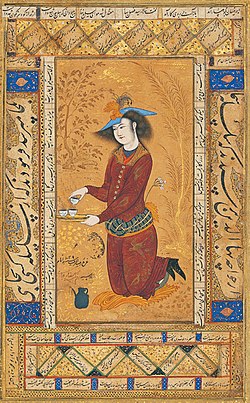
Saki (Wine Bearer), Reza Abbasi (1609), Golestan Palace — the last great master of the Persian miniature tradition; Abbasi's single-figure studies abandoned the complex multi-figure compositions of the earlier tradition for an intimate focus on individual character; the wine bearer, a figure with both literal and Sufi allegorical meaning (the divine intoxication), is depicted with a psychological specificity that anticipates portraiture


Comentarios