Pompeii Frescoes: The Sacred Paintings Preserved by Fire
On the morning of August 24, 79 CE, Mount Vesuvius began its catastrophic eruption. By the following day, the Roman city of Pompeii — prosperous, sophisticated, populated by approximately 11,000 people — was buried under 4 to 6 meters of volcanic ash and pumice. The disaster was complete and instantaneous. And because of it, the paintings on the walls of Pompeii's houses, temples, and villas were preserved with a fidelity impossible in any other ancient context: the colors still vivid after 1,900 years, the plaster still smooth, the subjects — mythological scenes, still lifes, portraits, sacred ceremonies — still legible. The frescoes of Pompeii are the primary source of knowledge about Roman domestic painting, a tradition almost entirely lost elsewhere. Among them, the cycle of frescoes in the Villa of the Mysteries — 29 life-size figures moving through a continuous Dionysiac ritual narrative on the walls of a single room — constitutes the most complete surviving depiction of an ancient mystery religion's initiation rites in existence. We do not know what the rites meant; the mysteries, as their name suggests, were secret. But we can see the faces of the initiates as they passed through the stages of the ritual, and in those faces we can see something genuine: people undergoing a real transformation, their expressions caught between terror and revelation.

Villa of the Mysteries, Pompeii (c. 60-50 BCE) — the full frieze showing multiple stages of the Dionysiac initiation; the figures move at life-size through a continuous narrative space painted on the blood-red background characteristic of the Second Pompeian Style; the room may have served as an actual initiation chamber, or as a depiction of the ceremony for a patroness of the cult

Villa of the Mysteries — the reading of the ritual: a young boy reads from a scroll while an older woman supervises and a third figure prepares offerings; the scroll may contain the sacred text of the mystery; the initiation process began with instruction in the ritual's meaning before its enactment, the intellectual preparation for the experiential encounter

Villa of the Mysteries — the terrified initiate and the winged daemon; a young woman recoils in terror from something not shown (perhaps the unveiled Dionysiac phallus) while a winged figure raises a whip behind her; the terror of initiation — the confrontation with the divine that the ordinary self cannot bear — is depicted with an honesty that scholarly interpretations have not fully absorbed

Villa of the Mysteries — the third scene showing stages of initiation; Dionysus reclines in the lap of the seated figure of Ariadne while another figure unveils the sacred object; the integration of the mythological narrative (Dionysus and Ariadne) with the ritual narrative (the initiate's transformation) suggests that the mystery re-enacted the myth — the initiate became Ariadne, the divine presence becoming tangible through the ceremony

Villa of the Mysteries — the Bacchic rite; a maenad dancer whirls in ecstasy, her hair loose, her body abandoned to the divine possession that Dionysus bestows on his devotees; the Dionysiac tradition understood ecstasy (ek-stasis — standing outside oneself) as the highest human experience: the moment when the individual self dissolves into the divine current

Villa of the Mysteries — initiation scene; the completion of the rite, the initiate having passed through terror to a new state of being; the figure's composure after the preceding scenes of fear and violence suggests not peace but transformation — a different quality of presence acquired through the experience of the divine at its most overwhelming
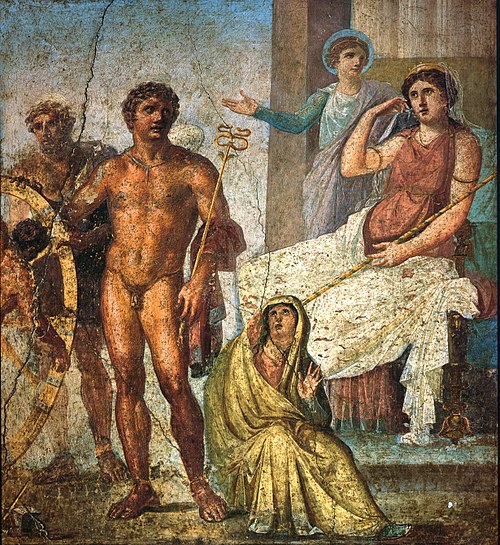
Ixion's punishment, Casa dei Vettii, Pompeii (c. 62-79 CE) — the mythological king bound to a spinning wheel in Tartarus for his attempt to seduce Hera; the House of the Vettii, owned by two freedmen of extraordinary wealth, contains some of the finest preserved Pompeian paintings; the mythological cycle in the triclinium functioned as both decoration and moral instruction for dinner guests

Mars and Venus, Casa di Marte e Venere, Pompeii — the divine lovers depicted in the intimate moment that preceded the Trojan War in mythological time; the pairing of Mars (war, masculine force) and Venus (love, feminine beauty) was the most popular mythological subject in Pompeian domestic painting, its erotic charge inseparable from its cosmological statement about the fundamental forces governing the world

First Style Pompeian painting (c. 200-80 BCE) — the earliest decorative system, imitating marble panels in painted plaster; the First Style is the foundation of all subsequent Pompeian decoration; in its imitation of luxury materials it encodes the Roman understanding that the proper dwelling should aspire to the grandeur of the divine, the domestic space elevated through art toward the sacred

Pompeian fresco (c. 10-20 CE), Third or Fourth Style — a mythological figure in an architectural framework; the later Pompeian styles increasingly used architectural illusion to create the impression of space extending beyond the actual walls, the room opening onto painted colonnades, gardens, and sacred landscapes; the domestic interior transformed into a vision of the divine

Necropolis of the Esquiline, Rome — a funerary fresco depicting a battle narrative; while Pompeii provides the most complete surviving Roman domestic painting program, funerary frescoes from Rome itself give evidence of the broader tradition; the Roman painter's art was a continuous practice from the most intimate domestic setting to the grandest public commission


Comentarios