Prehistoric Cave Art: The First Sacred Images
Between 45,000 and 10,000 years ago, human beings entered the deepest, darkest, most inaccessible chambers of limestone caves in Europe, Africa, and Southeast Asia, and created images on the walls that have survived to the present day. They painted with pigments ground from ochre, charcoal, and manganese. They used animal fat lamps for light. They sometimes crawled through passages barely wide enough for a human body to reach chambers where no natural light had ever penetrated. What they made there — the bison and horses of Lascaux, the lions and woolly rhinoceroses of Chauvet, the hand stencils of Sulawesi and Patagonia, the geometric signs that recur across sites separated by tens of thousands of miles and years — is not decoration. It is something else. Something we have no adequate modern word for, because it comes from a time before the categories through which we interpret art and religion had yet been separated.
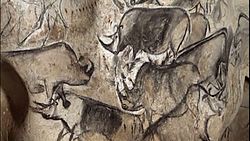
Woolly rhinoceroses, Chauvet Cave, France (c. 32,000 BCE) — the oldest figurative cave art in Europe, three times older than the Lascaux paintings; the Chauvet artists used shading and perspective to create images of extraordinary sophistication; they were fully modern human beings with fully modern minds
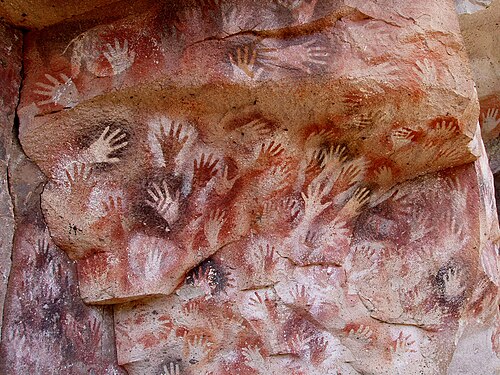
Cave of Hands (Cueva de las Manos), Santa Cruz, Argentina (c. 9,000–13,000 BCE) — hundreds of hand stencils in negative (the hand placed on the wall, paint blown around it); the earliest form of self-portrait, the claim of presence, the assertion: I was here, I existed, I touched this rock
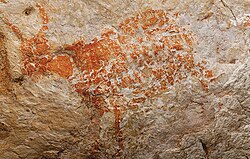
Cave painting of a bull, Lubang Jeriji Saléh Cave, Borneo (c. 40,000 BCE) — one of the oldest known figurative paintings on Earth, predating European cave art; the simultaneous appearance of figurative painting on multiple continents suggests either a shared cognitive revolution or parallel independent developments

Hand stencils, Pettakere Cave, Sulawesi, Indonesia (c. 40,000 BCE) — discovered in 2014, these hand stencils are among the oldest in the world; the global distribution of the hand stencil tradition across cultures with no known contact suggests it expresses something universal in the human relationship with sacred space

Cave of El Castillo, Cantabria, Spain (c. 40,000-22,000 BCE) — one of the longest continuously used prehistoric sanctuaries known, with layers of art spanning nearly 20,000 years; the cave was not used once and abandoned but returned to across generations as a sacred site

Rock art bull, Tassili n'Ajjer, Algeria (c. 8,000 BCE) — the Saharan rock art tradition documents a North Africa that was green, lake-filled, and populated with hippos and cattle; the paintings are both a zoological record and a sacred image-making tradition spanning millennia

Spotted hyena, Chauvet Cave (c. 20,000 BCE) — the Chauvet artists depicted not only the prestigious megafauna (lions, mammoths) but the full range of their world; the hyena, associated in later cultures with death and transformation, appears in the deepest chambers of the sanctuary
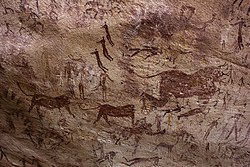
Panel of animals, Altamira Cave, Spain (c. 15,000-17,000 BCE) — bison rendered with such naturalistic power that when they were first discovered in 1879, professional archaeologists refused to believe Paleolithic humans had made them; the rejection lasted twenty years before the evidence became undeniable
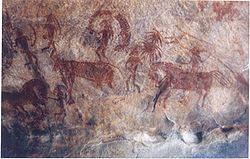
Bhimbetka rock shelters, Madhya Pradesh, India (c. 30,000 BCE) — the longest continuously inhabited site in Asia, with rock paintings spanning from the Paleolithic to the medieval period; 700 shelters across a sandstone outcrop used as canvas by people over a span of 30,000 years

San Bushman rock art, South Africa (c. 1,000-3,000 years old) — the San people's rock art tradition, one of the best-documented living connections between shamanic practice and image-making; San shamans entered trance states during ritual dances and painted what they saw in the spirit world — a direct visual record of altered states of consciousness

Jabiru Dreaming, Kakadu National Park, Australia — contemporary Aboriginal rock art in the continuous tradition of the world's oldest ongoing artistic practice; in Aboriginal understanding, the paintings maintain the connection between the present and the Dreamtime — they are not historical records but living acts of cosmic maintenance


Comentarios