Romanesque Tympana: The Last Judgment Carved in Stone
The tympanum — the carved semicircular space above the central portal of a Romanesque church — was the medieval church's most theologically charged surface. Every person who entered the church passed beneath it; every pilgrim who arrived after a journey of weeks or months encountered it before crossing the threshold into sacred space. The Romanesque master sculptors who filled these semicircles with stone images of the Last Judgment, the Pentecost, the Christ in Majesty — working in the compressed, expressive, anatomically unconventional style that characterizes the great Romanesque portals — were not decorating a doorway. They were creating a statement about what lies beyond death, who enters paradise and who does not, and what the stakes of a human life actually are. The violence and tenderness of these carvings — the saved ascending in joy, the damned consumed in hell's demons, Christ presiding over both with equal calm — encode a theology that takes human moral choice completely seriously.

Tympanum, Vézelay Abbey (c. 1120-1135 CE) — Christ in Majesty with rays of divine light extending from his hands to the surrounding apostles; uniquely, Vézelay depicts not the Last Judgment but the Pentecost — the moment when the Holy Spirit was sent to empower the Church's mission; around the outer archivolt appear the peoples of the earth, including the mythical Panotii (people with enormous ears) and dog-headed Cynocephali
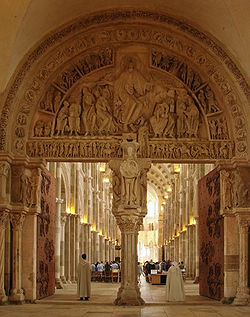
Vézelay tympanum full view — Christ at the center, the apostles receiving the Holy Spirit, the outer archivolt with its strange peoples; the Vézelay master's Christ is of extraordinary formal power — the elongated, stylized body radiating divine energy in all directions, the face expressing a calm that transcends the drama surrounding it

Vézelay tympanum right detail — the apostles receiving the rays of divine light; the Romanesque figure style, with its elongated proportions, decorative drapery, and intense expressive faces, was not a failure of naturalism but a different aesthetic priority: the spiritual truth of the figures mattered more than their physical accuracy

Last Judgment tympanum, Conques Abbey (c. 1107-1125 CE) — the most complete Romanesque Last Judgment portal; Christ enthroned at the center; to his right, the saved ascending in orderly calm; to his left, the damned being consumed by demons with a specificity of horror that suggests first-hand observation of nightmares; among the damned, a bishop and a monk

Vézelay narthex portal — the inner portal of the narthex (entrance hall), through which pilgrims passed before reaching the main tympanum; the narthex itself was a transitional space between the secular world and the sacred — the architectural embodiment of the theological concept of preparation and purification before encountering the divine

Santiago de Compostela Cathedral — the destination of the great medieval pilgrimage route (the Camino de Santiago); pilgrims who had walked from France, Germany, or Italy arrived here after weeks or months of journey; the cathedral's portal (the Pórtico de la Gloria, 1168-1211 CE) was the culmination of their journey and the supreme achievement of Romanesque portal sculpture in the Iberian Peninsula

Vézelay tympanum left detail — the apostles on Christ's left side; the lintel below the tympanum shows scenes of the healing of lepers and other miracles; the Romanesque portal program reads from bottom to top, from historical time (the miracles of history) to eschatological time (the eternal judgment above), the pilgrim's eye drawn upward by the compositional hierarchy

Vézelay narthex detail — the carved capitals within the narthex narrate biblical and hagiographic stories; the Vézelay capitals are among the masterworks of Romanesque narrative sculpture, combining theological seriousness with a visual wit and inventiveness that make the biblical stories fresh in each telling


Comentarios