Runestones of Scandinavia: The Viking Alphabet in Stone
Between approximately 400 and 1100 CE, the Norse and Germanic peoples of Scandinavia carved thousands of inscriptions into standing stones using the runic alphabet — a writing system whose origins are still debated but whose function was never merely practical. The runes (from the Proto-Germanic rūnō, meaning "secret" or "mystery") were understood as a sacred technology: letters that carried inherent power, that could bind and loose, curse and heal, commemorate the dead and invoke the divine. The runestones that survive — over 6,000 in Sweden alone — are simultaneously memorials, legal documents, territorial markers, religious declarations, and magical objects. Their intricate serpentine and interlace patterns, their images of ships and warriors and mythological scenes, their proud statements of lineage and loss, constitute the most extensive outdoor museum of early medieval art in the world.
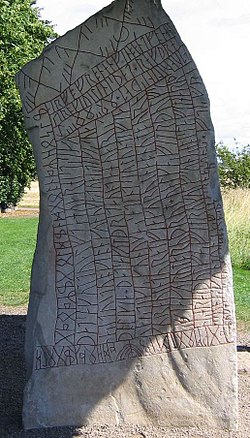
The Rök Runestone, Östergötland, Sweden (c. 800 CE) — bearing the longest runic inscription ever found (approximately 760 characters); it references Theodoric the Great, poses mythological riddles, and has been interpreted as encoding cosmic anxiety about the approach of Ragnarök

Lingsberg Runestone U 240, Uppland, Sweden — one of the late Viking Age memorial stones whose serpentine ribbon bears the runic text; the pattern of intertwined serpents or dragons surrounding the inscription is characteristic of the Urnes style of late Viking art

Möjebro Runestone, Uppland, Sweden (c. 400-600 CE) — an early runic inscription written right to left; the earliest runes were written without consistent direction, reflecting their origin in an oral culture that had not yet standardized its visual expression

The Snoldelev Stone, Denmark (c. 800-900 CE) — inscribed with a triskelion and drinking horn; the triskelion (three-armed spiral) is associated with the sacred mead of poetry and the skaldic tradition; this stone may mark the burial of a court poet

Stenkvista Runestone Sö 111, Södermanland, Sweden — the Thor's hammer (Mjolnir) symbol carved at the center of the serpentine inscription; runestones from the transitional Viking Age often bear both Christian crosses and pagan symbols, reflecting a society navigating between worldviews
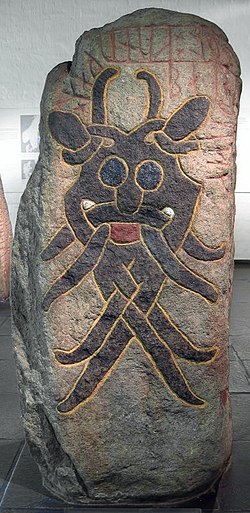
The Mask Stone, Moesgård, Denmark — a face carved in relief, one of the rare examples of figurative art on a runestone; the mask tradition connects Norse runestone art to the broader Germanic and Celtic tradition of apotropaic face imagery
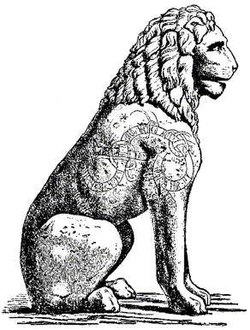
The Piraeus Lion, Venice — a marble lion removed from the harbor of Piraeus, Greece, by Venetian forces in 1688; its flanks bear runic inscriptions carved by Varangian (Norse) mercenaries in Byzantine service around 1000 CE; the farthest-traveled runestone in existence

Västra Steninge Runestone Ög 8, Östergötland, Sweden — the serpentine ribbon characteristic of 11th-century Swedish runestones; the serpent or dragon whose body forms the text band is typically identified as the World Serpent Jörmungandr, framing the inscription in cosmological significance

Djulefors Runestone Sö 65, Södermanland, Sweden — memorial stone for a man who died on a Viking journey; the runestones are frequently memorials for men who died abroad in trade, warfare, or Crusade; they are the Viking Age's monuments to mobility and loss

The Vallberga Stone, Scania, Sweden — a Christian cross incorporated into the runestone design, typical of the transitional period when Norse communities were adopting Christianity while preserving the runic tradition; the rune masters served both religions simultaneously


Comentarios