Salamanders: The Fire Elementals, Keepers of the Sacred Flame

Fire — the most alive of the four classical elements, the one element that visibly consumes and transforms, that cannot exist without burning. Within its heart, the esoteric tradition placed beings of pure will and creative force: the salamanders.
Of the four classical elements, fire is the most dramatic and the most dangerous. It transforms everything it touches, consuming the old to release energy for the new. It is the one element that cannot be held, that exists only in the act of burning, that always moves upward — a perpetual reaching toward the sky. Fire is the symbol of life itself: metabolism, body heat, the electrical activity of the brain, the nuclear fire at the heart of every star. And within fire, according to the Western esoteric tradition, dwell the salamanders — elemental beings of pure will and transforming power, the spirits of the flame that the ancients recognized as something more than chemistry.
The salamander's story moves from the zoological curiosity of ancient Greece through the alchemical furnaces of medieval Europe, touches the sacred fires of Zoroastrian temples, echoes in the myth of Prometheus, and arrives in modern spiritual practice as a symbol of will, passion, and the courage to transform. It is a story about the intelligence hidden in fire itself.
Paracelsus and the Fire Elemental
Paracelsus (1493–1541) placed the Salamandrae — fire elementals — at the apex of his elemental hierarchy in terms of power and transforming force. In his system of four elementals corresponding to the four classical elements, the salamander was the spirit of fire: a being that lived within flames as naturally as a fish lives in water, that was made of concentrated fire-force, that moved with the speed and unpredictability of flame itself.
Paracelsus described the salamanders as the most powerful and volatile of all the elementals. Where gnomes moved slowly and deliberately through solid earth, and undines flowed and yielded, the salamanders burned with relentless energy, always in motion, always consuming and transforming. They were associated in Paracelsus's temperament theory with the choleric humor — fiery, passionate, quick to anger, quick to enthusiasm, driven by will and initiative.
The alchemist's furnace — the athanor — was the salamander's domain. The sustained heat necessary to reduce metals to their essences, to drive the alchemical processes of calcination and sublimation, was understood not as a mechanical phenomenon but as a living one: the salamanders within the flames were active participants in the transformation being sought. To tend the alchemical furnace properly was to work in conscious cooperation with fire elementals, maintaining the precise heat required without angering or dissipating them.
The Historical Salamander — From Aristotle to the Middle Ages
The association between the actual salamander — the small, moist, black-and-yellow amphibian — and fire is one of the great paradoxes of natural history. Aristotle recorded the belief that salamanders could walk through fire unharmed. Pliny the Elder in his Natural History elaborated on this, describing the salamander as so cold by nature that it could extinguish any flame it entered, just as ice extinguishes a burning coal.
The actual biological basis for this belief is surprisingly plausible. Salamanders habitually shelter in decaying logs. When such logs were thrown onto fires, the creatures would emerge, fleeing the heat, and appear to contemporaries as if they were being born from the flames themselves. The mucus that covers their skin provided brief but real protection from heat. Medieval observers, lacking modern understanding, interpreted what they saw through a mythological lens and concluded that the salamander was a creature of fire.
This idea was enthusiastically adopted by medieval bestiaries — the encyclopedic collections of real and legendary animals that served as moral textbooks for medieval Europe. The salamander was always included, always described as living in fire, always interpreted allegorically. For Christian writers, the salamander's supposed immunity to fire symbolized the Christian's immunity to the flames of temptation — the soul purified by faith could pass through any trial unscorched.
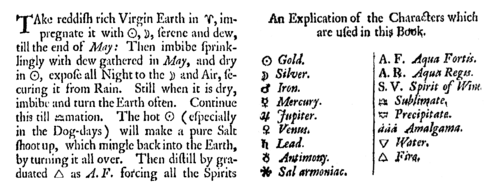
Alchemical manuscript illustration — fire as the agent of transformation, the medium in which base matter becomes gold, the domain of the salamander.
The great 16th-century goldsmith and sculptor Benvenuto Cellini claimed in his autobiography to have seen, as a child, a tiny lizard-like creature playing in his father's fire. His father told him it was a salamander — an omen of great fortune — and struck the young Benvenuto to make sure he would remember the moment. Whether real or legendary, the story captures the place of the salamander in Renaissance consciousness: a being of fire seen as a sign of exceptional destiny.
Salamanders and the Alchemical Tradition
In alchemy, fire served four distinct functions: calcination (burning to ash), sublimation (turning solid into vapor), distillation (separating components by their volatility), and fixation (capturing the volatile in a stable form). Each required a different quality of heat, a different relationship with the fire. The accomplished alchemist was one who had mastered fire — who could maintain precise temperatures, who understood the difference between the fire that destroys and the fire that transforms.
The salamander, in this context, was not merely a symbol. It was understood as the actual intelligent agent within the fire, the being whose cooperation made alchemical transformation possible. Texts like the Mutus Liber (the wordless book of alchemy) show the alchemist working at the furnace with what can only be described as a devotional attitude — tending the fire as one tends a living relationship, attentive to its moods and needs, neither dominating it nor neglecting it.
The alchemical motto Ignis mutat res — "fire changes things" — points to the salamander's fundamental teaching. Fire is the agent of transformation, the force that makes the impossible possible, that reduces complexity to essence, that releases the hidden from the encrusted. The salamander is the intelligent will within this process.
Sacred Fire in Zoroastrianism
No tradition honored sacred fire more consistently and profoundly than Zoroastrianism, the ancient Persian religion founded by the prophet Zarathustra (Zoroaster). For Zoroastrians, fire was not merely a symbol of the divine but the most direct presence of Ahura Mazda — the Wise Lord, the supreme deity — accessible to human beings in physical form.

A Zoroastrian fire temple (Atash Behram) — where the sacred flame is kept burning continuously, tended by priests who are careful not to pollute it with their breath.
The Zoroastrian Atash Behram (Victory Fire) was the highest grade of sacred fire, constructed from sixteen different fires including those from a lightning strike, a cremation fire, and fires used by various craftsmen. Once established, it was maintained continuously — never allowed to go out — and tended by priests who wore masks to prevent their breath from polluting the flame. Some Zoroastrian sacred fires have burned continuously for more than a thousand years.
The fire in Zoroastrian theology was specifically associated with Asha — truth, righteousness, cosmic order. To tend the fire was to participate in the maintenance of cosmic order itself, to add one's intention and devotion to the great project of truth-keeping that Ahura Mazda had initiated at the beginning of creation. The salamander, in this context, is not merely a nature spirit but an aspect of divine truth made tangibly present in the physical world.
Prometheus and the Myth of Stolen Fire
The Greek myth of Prometheus gives the fire elemental its most dramatic mythological expression. Prometheus — whose name means "Forethought" — stole fire from the gods and gave it to humanity. For this act of cosmic rebellion, Zeus chained him to a rock where an eagle tore out his liver each day, only for it to regrow by night, the punishment renewed eternally.
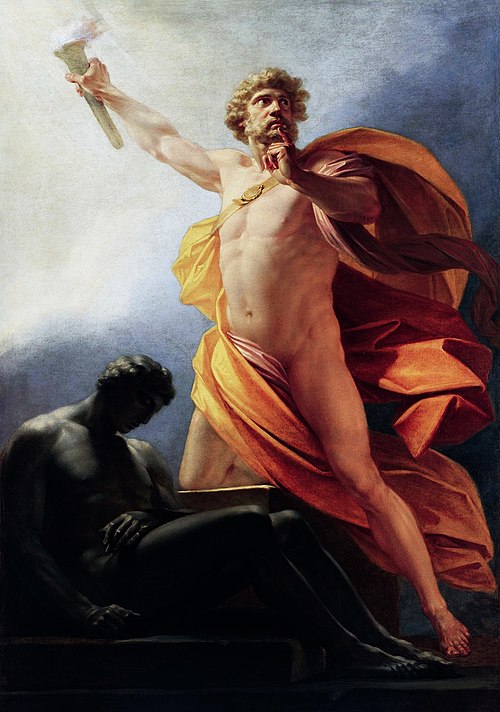
Heinrich Füger's Prometheus Brings Fire to Mankind (1817) — the Titan descends from Olympus with the stolen fire cupped in a fennel stalk, the act that defined human civilization and cost him eternal suffering.
The fire Prometheus gave was not ordinary warmth — it was techne, the principle of craft and civilization, the capacity to transform raw nature into culture, to use tools, to cook, to smelt metals, to think abstractly and make things. Fire, in Greek thought, was synonymous with human consciousness itself: the Promethean spark that distinguished humans from animals and made them like gods.
The Vedic tradition has its own version: Agni, the fire god who mediates between humans and the divine, who carries sacrificial offerings upward through flame to reach the gods. Agni is the one god who is always present — in every hearth, every sacrifice, every bolt of lightning. He is the first and last of the gods, invoked at the opening and closing of every ritual.
Seen through the lens of elemental mythology, Prometheus and Agni are human-facing aspects of the salamander — the fire elemental encountered not in its own domain but in its relationship with humanity, as the dangerous gift that elevates us and burns us simultaneously.
Salamanders in Theosophical and Occult Thought
Geoffrey Hodson described fire elementals as intense, rapid, brilliant beings — perhaps the most purely energetic of all the elementals, existing in a state of perpetual activity. He observed them most clearly in large fires and in lightning, appearing as streaks of concentrated fire-force moving with extraordinary speed. Unlike undines, which could be relatively still, salamanders were never motionless; their consciousness flickered with the same rhythm as the flames they inhabited.
Rudolf Steiner attributed to fire elementals the function of mediating cosmic warmth — not physical heat alone but the spiritual warmth that expresses itself as will, enthusiasm, and creative initiative. The salamanders worked with the warmth dimension of the plant kingdom, supporting the metabolic processes of flowering and fruiting. Without the fire elemental's contribution, Steiner suggested, plants could grow but could not flower — the upward striving that produces blossoms and seeds required the salamander's active presence.
In Anthroposophical cosmology, fire was associated with the ego-body — the "I" — the principle of individual identity and will. The salamander was thus connected to selfhood itself, to the fire of consciousness that allows a being to say "I am" and mean something distinct by it.
Working with Salamander Energy
In contemporary elemental practice, working with salamanders means working with the fire qualities: will, passion, creativity, transformation, courage, and the power to initiate change.
Practices associated with salamanders include:
- Candle meditation — staring into a flame with soft focus, attending to it as a living being, practicing fire-gazing (pyromancy)
- Ritual fire — bonfires, hearth fires, and sacred flame as points of elemental contact and intentional transformation
- Burning release ceremonies — writing what needs to be released and burning it as a transformative act
- Physical warmth practices — intense exercise, sun gazing, sauna — accessing the salamander's energy through the body's own heat
- Invocations of will — calling on fire energy before any act requiring courage, decisive action, or creative initiative
The traditional elemental direction for fire is South — the direction of the sun at its height, of noon, of summer, of maximum energy and vitality. South-facing sacred spaces and midday practices are natural salamander territory.
The Teaching of the Salamander
The salamander's deepest teaching is about transformation through will. Fire is the element that makes things into other things — irreversibly. Once burned, a thing cannot be unburned. The salamander teaches that genuine transformation requires this irreversibility: the willingness to let the old form be consumed entirely, to trust that what emerges from the fire is more true than what went in.
This applies to the spiritual path as much as to alchemy. The mystical traditions speak of a "dark night of the soul" — a period of apparent destruction, of the burning away of false certainties and comfortable identities. The salamander is the guide through this fire, the reminder that what is being burned is not the self but the encrustation around the self, the dross that obscures the gold.
The salamander also teaches the difference between destructive fire and purifying fire. Rage and fear are fire out of control — destructive, consuming without purpose. Passion and will aligned with truth are fire in service — purifying, illuminating, transforming with intention. The art of working with fire elementals is the art of distinguishing these two, of learning to direct the flame rather than being consumed by it.
— Lux Esoterica


Comentarios