Shamanism: The World's Oldest Spiritual Technology and the Art of Walking Between Worlds

A Buryat shaman in ceremonial regalia, Siberia — keepers of a tradition stretching back tens of thousands of years, the shamans of Central Asia are among the oldest continuous shamanic lineages on Earth.
Before there were priests, before there were temples, before there were scriptures — there were shamans. In the cave paintings of Lascaux (17,000 BCE), researchers have identified figures that appear to be humans in altered states, half-animal, communing with beings invisible to ordinary perception. In the burial sites of Siberia, archaeologists have found 30,000-year-old graves containing the tools of shamanic practice: drums, animal bones, red ochre, carved figurines. Across every inhabited continent, in cultures that never made contact with one another, the same core figure appears: the specialist in consciousness, the one who travels to the other worlds, the healer who works in the invisible.
Shamanism is not a religion in the conventional sense — it has no founder, no scripture, no creed, no central institution. It is a technology: a set of techniques for intentionally altering consciousness in order to interact with the spirit world on behalf of the community. Its practitioners — shamans — are the world's oldest spiritual specialists, and the tradition they carry may be the mother of all the mystical and religious innovations that followed.
The Word and Its Origins
The word shaman comes from the Tungusic language of the Evenki people of Siberia — šaman, possibly related to the Sanskrit śramaṇa (an ascetic or religious practitioner) through ancient migrations across the Eurasian steppe. It entered Western scholarly vocabulary in the 17th century through Russian explorers and traders who encountered the religious specialists of Siberia and used the Evenki term to describe them.
In its original context, the shaman (šaman) was specifically the Evenki term for their own practitioners. The anthropological extension of the word to similar figures across cultures — the Korean mudang, the Amazon ayahuascero, the Mongolian böö, the Lakota wičháša wakȟáŋ (holy man), the African sangoma — is an academic convenience that some indigenous scholars contest, preferring to use the specific terms of their own traditions. The extension is nonetheless useful as a comparative framework, as long as we remember that each tradition has its own specific character, history, and context.
The Shamanic Worldview: Three Worlds and the Axis
Across the vast majority of shamanic traditions worldwide, a consistent cosmological structure appears. The universe is understood as consisting of three realms:
- The Upper World: the domain of celestial beings, ancestors, teacher spirits, and cosmic forces. Accessed by traveling upward along the World Tree or Cosmic Mountain.
- The Middle World: the ordinary physical world, but also the invisible dimension that overlaps with it — the realm of nature spirits, place spirits, and the spiritual dimensions of everyday phenomena.
- The Lower World: the underworld, not understood as hell (a moral category) but as the realm of animal spirits, deep ancestral wisdom, and the powers of the earth. Accessed by traveling downward through the roots of the World Tree.
Connecting all three realms is the Axis Mundi — the World Tree, the Cosmic Mountain, the World Pillar. In Siberian shamanism this is the great tree (often a birch) whose roots reach the underworld and whose crown pierces the sky. In Norse mythology it is Yggdrasil. In the Amazon it is the vine that connects earth and sky. In Hindu cosmology it is Mount Meru. The structural identity of these images across unconnected traditions is one of the most remarkable features of comparative religion — a testimony, perhaps, to the consistency of the human psyche when encountering the cosmos in deep states of consciousness.
The shaman's fundamental skill is the ability to travel deliberately between these worlds — to enter the upper or lower world in full consciousness, interact with its inhabitants, gather information or power, and return to the middle world with what the community needs: healing, guidance, knowledge of weather, location of game, or the resolution of a spiritual crisis.
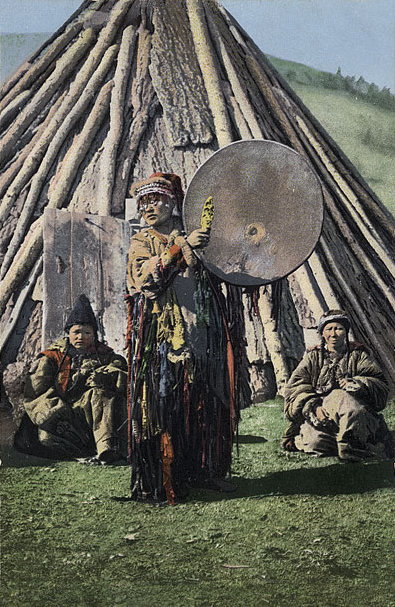
An Altai shaman with drum — the drum is the shaman's primary instrument for inducing the trance state necessary for journeying between worlds, its rhythmic beat described as "the horse" that carries the shaman across the threshold.
The Drum: Vehicle of the Journey
The drum is the shaman's most universal and defining tool. Across Siberia, Central Asia, the Arctic, and the Americas, the shamanic drum appears as the primary instrument for inducing the altered state of consciousness needed for journeying. In Siberian traditions, the drum is described as the shaman's horse — the vehicle that carries them between worlds. The drumhead is the steed's skin, and the beating is the gallop.
Modern neuroscience has partially confirmed what shamans have always known: steady rhythmic drumming at frequencies between 4 and 7 beats per second (in the theta brain wave range) reliably induces shifts in consciousness associated with heightened visual imagery, reduced critical thinking, and increased access to what researchers call the "default mode network" — the brain's internal processing systems that generate imagination, memory, and self-narrative. This is not the full explanation of shamanic experience, but it helps explain why the drum works consistently across cultures and individual differences.
Other techniques for inducing the shamanic state include: fasting and sleep deprivation, rhythmic breathing, exposure to extreme cold or heat (sweat lodge), isolation in darkness, and — in traditions such as Amazonian shamanism — the ingestion of plant medicines (ayahuasca, peyote, psilocybin mushrooms). The plant medicines are not considered recreational or even merely therapeutic: they are understood as teachers, as plant spirits with their own intelligence and intentions, who agree to work with the shaman on behalf of the community.
Initiation: The Wounded Healer
The path to becoming a shaman is universally described as a crisis, not a curriculum. The shaman does not choose the vocation — it chooses them. The classical shamanic initiation begins with an unsought, often terrifying experience: a life-threatening illness, a series of visions that cannot be controlled or stopped, a dramatic encounter with the spirit world that the uninitiated person is ill-equipped to handle.
In Siberian traditions, the initiatory experience is often described as dismemberment: the spirits take apart the initiate's body — tear it apart to its bones, boil the flesh, count and examine each piece — and then reassemble it with enhanced spiritual organs. The initiand "dies" as an ordinary person and is reborn as one who can move between worlds.
This mythological grammar is remarkably consistent across cultures. The shaman's power comes from having already died and returned — from having traversed the most terrifying territories of existence and found a way through. Carl Jung recognized in this the same pattern he called the "wounded healer": the physician who can heal others precisely because they have experienced and integrated their own wound. The shaman's authority is not institutional (granted by a hierarchy) but experiential — earned through personal encounter with the forces they will work with on others' behalf.
In many traditions, an experienced elder shaman is involved in the initiation — recognizing the signs of a genuine calling, guiding the initiate through the crisis, transmitting technical knowledge about how to navigate the spirit world safely. But the core experience remains between the initiate and the spirits themselves.
Spirit Allies and Animal Helpers
A central feature of shamanic practice across cultures is the relationship with spirit allies — non-human beings who work with the shaman over time, providing power, guidance, and specific healing abilities. These may appear in many forms:
Power animals (also called totem animals or animal helpers) are among the most universal shamanic spirit allies. Each shaman typically has one or more power animals that accompany them on journeys, provide protection, and embody specific qualities or capabilities. The bear brings healing and strength. The eagle brings vision and celestial connection. The serpent carries transformative and underworld knowledge. The wolf brings hunting ability and pack intelligence. These are not symbols in the literary sense — in shamanic understanding, they are actual non-physical intelligences with whom a genuine relationship is cultivated over years of practice.
Teacher spirits (often appearing in human form) serve as guides and instructors in the upper and lower worlds. In some traditions these are ancestors; in others they are spirits who have never been human; in others they are the spirits of specific landscapes or natural features.
Plant spirits — particularly relevant in Amazonian traditions — are understood as conscious beings with their own intelligence, who can be asked to teach, heal, or reveal hidden knowledge. The ayahuascero or curandero works primarily in relationship with plant spirits, learning their songs (icaros), their properties, and their healing protocols through years of dedicated contact under the guidance of the plants themselves.

A shaman in Kyzyl, Republic of Tuva — one of the heartlands of living Siberian shamanism, where the tradition survived Soviet suppression and has experienced a powerful revival since the 1990s.
Healing: Soul Retrieval and Extraction
The shaman's healing work operates within a specific diagnostic framework that differs fundamentally from biomedical approaches. In the shamanic worldview, illness typically has one of three spiritual causes:
Soul loss: In shamanic understanding, the soul is not monolithic — it can fragment under the impact of trauma, shock, grief, or abuse. The lost fragment wanders in the spirit world, leaving the person feeling incomplete, depressed, chronically fatigued, or unable to move forward in life. The shaman's task is to journey to wherever the soul fragment has gone, negotiate its return, and reintegrate it into the patient's energetic body. This technique — soul retrieval — is one of the most widely documented and reported shamanic practices, with modern practitioners reporting remarkable outcomes even in clinical settings.
Spiritual intrusion: Foreign energies, thought forms, or spirit entities that have entered the person's energetic field and are causing disturbance. The shaman's task is to identify and remove these intrusions — a process requiring the shaman's own power animals to assist, as direct engagement with harmful spirits requires spiritual protection.
Power loss: The depletion of a person's fundamental vitality and spiritual resources — often resulting from chronic stress, grief, or the gradual erosion of connection to one's own nature. The shaman restores power by returning the person's power animal, by bringing back spiritual resources from the journey, or by performing ceremonies that reconnect the person to the living world.
It is important to note that shamanic healing does not preclude or replace biomedical care — the two operate on different levels, and skilled traditional healers have always understood this. The shaman addresses the spiritual dimension of illness; what happens in the body is a separate but related question.
A Global Tradition
Shamanism in its various forms is found on every inhabited continent:
Siberia and Central Asia: The classical shamanic heartland, home to the Evenki, Buryat, Yakut, Tuvan, and Mongolian shamanic traditions. The Tuva Republic and Mongolia have seen remarkable shamanic revivals since the end of Soviet suppression in the 1990s.
The Amazon Basin: The most diverse surviving shamanic ecosystem on Earth, with hundreds of distinct traditions, plant medicine practices, and healing systems. Figures such as the Shipibo curanderos, the Peruvian vegetalistas, and the Brazilian União do Vegetal preserve some of the deepest surviving shamanic knowledge.
Korea: The mudang — typically women — maintain one of Asia's most vibrant shamanic traditions, performing gut ceremonies that involve ecstatic dance, spirit possession, and divination. Korean shamanism has survived Confucian suppression, Japanese colonization, and decades of modernization.
West Africa and the African diaspora: The sangoma of the Zulu and Xhosa traditions, the balian of Bali, and the initiated priests of Yoruba-derived traditions (Candomblé, Santería, Vodou) all share structural features with shamanic practice: initiation through crisis, spirit communication, healing through altered states, and community ceremony.
Indigenous North America: The wičháša wakȟáŋ (holy man) of the Lakota, the medicine people of the Navajo and Hopi, the Inuit angakkuq — each tradition is distinct and embedded in specific cultural contexts, but all share the core shamanic structure of mediation between the human community and the spirit world.
Modern Core Shamanism
In the late 20th century, Michael Harner — an anthropologist who had trained with several Amazonian traditions and undergone his own initiatory experience with ayahuasca — distilled the cross-cultural techniques of shamanic journeying into what he called Core Shamanism: a practice stripped of specific cultural context and focused on the universal techniques (drumming, journeying, power animal retrieval, soul retrieval) that appear across traditions.
Harner's Foundation for Shamanic Studies, founded in 1979, has trained tens of thousands of practitioners worldwide and sparked a significant revival of shamanic practice in Western cultures. Core Shamanism is controversial — indigenous scholars rightly point out the problems of extracting sacred practices from their cultural context — but it has also introduced millions of people to a mode of consciousness and healing that they would not otherwise have encountered.
The tension between authentic cultural transmission and cross-cultural accessibility is real and important. What seems clear is that the shamanic experience — the journey, the spirit allies, the healing work — is not the exclusive property of any single culture. It appears to be a human capacity, one that specific cultures have developed into sophisticated arts over millennia, and one that continues to find its way into receptive individuals regardless of their background.
Shamanism and the Esoteric Traditions
The relationship between shamanism and the broader Western esoteric tradition is deep and underappreciated. The Greek figure of Hermes — psychopomp, guide of souls, traveler between worlds — is structurally shamanic. The Orphic initiates who journeyed through the underworld to retrieve the memory of their divine origin were performing a shamanic operation. The Neoplatonic theurgist who ascended through the planetary spheres to encounter the divine intellect was using a technique structurally identical to the shaman's upper world journey.
Alchemy's imaginal work — the interior encounter with the prima materia, the nigredo, the lapis — can be understood as a shamanic journey into the deep psyche. Carl Jung explicitly recognized this: his Red Book, composed during what he called his "confrontation with the unconscious," describes a series of shamanic journeys into imaginal realms where he encountered spirit figures, underwent symbolic death and rebirth, and emerged with a transformed understanding of the psyche.
The animism at the heart of shamanic worldview — the understanding that everything is alive, that the natural world is populated with intelligence and intentionality, that relationship is the fundamental structure of reality — is also the deepest teaching of mystical traditions worldwide. When Meister Eckhart writes that God is in every grass-blade, when the Zen master sees the Buddha-nature in a frog, when the Kabbalist encounters the divine sparks (nitzotzot) scattered through all of creation — they are touching the same reality that the shaman navigates every time they enter the drum's rhythm and open to the living world.
Shamanism is not primitive religion — it is the original empirical investigation of consciousness, conducted without instruments other than the disciplined human nervous system, in relationship with a living world that was always more than it appeared.
— Lux Esoterica


Comentarios