The Aztec Sun Stone: Decoding the Calendar of the Five Suns
The Aztec Sun Stone (Piedra del Sol) — carved from basalt, 3.6 meters in diameter and weighing 24 tons, completed in 1479 CE under the reign of the tlatoani Axayacatl — is one of the most complex and information-dense sacred objects ever created. It is not, as popularly believed, a calendar in the modern sense; it does not track days or months in the way a wall calendar does. It is a cosmological statement: a compressed image of the Aztec universe's temporal structure, its creation history, and its precarious present situation. At its center is the face of Tonatiuh, the Fifth Sun — the current age of the world, the sun that must be nourished with human blood or it will be destroyed. Around him are the four previous suns (each destroyed by a different catastrophe), the twenty day-signs of the 260-day sacred calendar, the symbols of the solar year, and the cosmic serpents who bear the whole structure through time. The stone was not a timekeeper. It was a reminder of what the Aztecs believed with terrible urgency: that the cosmos is fragile, that it requires maintenance, and that the maintenance is the responsibility of human beings.
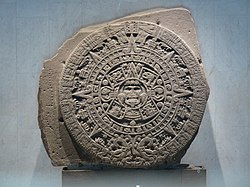
The Aztec Sun Stone, National Museum of Anthropology, Mexico City (carved 1479 CE) — discovered in 1790 beneath the Zócalo (main plaza) of Mexico City, buried during the Spanish colonial period; for centuries it was believed to be a sacrificial altar; modern scholarship has established it as a cosmological and theological monument

The center of the Sun Stone — the face of Tonatiuh, the Fifth Sun, with his tongue extended in the form of a sacrificial knife (tecpatl); the obsidian knife-tongue demands blood; his clawed hands grip human hearts in each claw; the central image encodes the fundamental Aztec theological claim: life requires sacrifice to continue

The Sun Stone diagram showing its concentric rings — from center outward: Tonatiuh's face; the four previous suns (Nahui Ocelotl, Nahui Ehecatl, Nahui Quiahuitl, Nahui Atl — each destroyed by a different catastrophe); the twenty day-signs of the tonalpohualli; the solar year ring; the jade ring; the turquoise sky ring; the solar rays; the fire serpents (Xiuhcoatl)

Annotated Sun Stone — the scholarly decoding of the stone's concentric registers; the four previous suns read like a geological record of catastrophic epochs: the First Sun destroyed by jaguars, the Second by wind, the Third by rain of fire, the Fourth by flood; the Fifth Sun (the current one) will be destroyed by earthquake — perhaps at any moment

Sun Stone detail — the outer ring of solar rays and fire serpents (Xiuhcoatl) that enclose the entire cosmological diagram; the two great serpents framing the bottom of the stone carry the sun through the sky and through the underworld at night; the universe is not a stable structure but a dynamic process requiring constant ritual support

Aztec calendar on amate paper — the sacred calendar (tonalpohualli) and solar calendar (xiuhpohualli) rendered in the traditional amate bark paper medium; the two calendars interlocked: the 260-day ritual cycle and the 365-day solar cycle met at the same starting point only once every 52 years — the New Fire ceremony, when the world's continuation was not guaranteed


Comentarios