The Pre-Raphaelite Brotherhood: Beauty, Truth, and the Medieval Dream
In 1848, seven young English artists — the oldest twenty-one, the youngest sixteen — formed a secret society in defiance of everything the Royal Academy of Arts represented. They called themselves the Pre-Raphaelite Brotherhood, and their program was simple and radical: to paint with the directness and sincerity that European art had possessed before Raphael taught everyone to paint beautifully instead of truthfully. Their targets were the smooth academic painting they called "Sir Sloshua" (after Sir Joshua Reynolds), the mannered studio compositions, the trained lighting, the polished surfaces that concealed the world rather than revealing it. Their method was equally radical: paint outdoors, from life, on a white ground, in brilliant pigments, with every leaf and grass-blade and hair individually rendered. The results scandalized the critics and electrified the public. Dickens called Millais's Christ in the House of His Parents "mean, repulsive, and revolting." Ruskin, who would become their most powerful defender, called Millais's Ophelia the most perfect painted landscape since the Flemish masters. The Brotherhood dissolved as a formal group within a few years, but the aesthetic it created — the intense color, the medieval literary subjects, the female figures painted with obsessive sensory attention, the fusion of beauty and symbolic meaning — persisted through the second generation (Burne-Jones, Morris, the Aesthetic Movement) and seeded the Symbolism that would transform European art at the century's end. At the center of the Brotherhood's imagery is a vision of womanhood — Ophelia, Beatrice, Proserpine, Lilith — in which female beauty becomes the primary vehicle for spiritual truth, a tradition as troubling as it is beautiful.
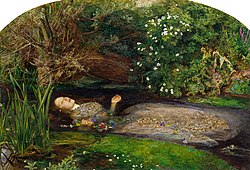
Ophelia, John Everett Millais (1851-52), Tate Britain — the most iconic Pre-Raphaelite painting; Elizabeth Siddal, Rossetti's model and later wife, posed for months in a bathtub of water kept warm by lamps beneath it (the lamps went out; she developed pneumonia); every plant in the scene is botanically correct and symbolically charged — willow for forsaken love, nettle for pain, poppies for death, forget-me-nots for remembrance; the Pre-Raphaelite method demanded this completeness of observation

Christ in the House of His Parents, Millais (1850), Tate Britain — the painting that ignited the first great Pre-Raphaelite scandal; Dickens attacked it as a depiction of Christ as a 'hideous, wry-necked, blubbering, red-haired boy'; the Brotherhood's crime was depicting the Holy Family as working-class people in an actual carpenter's shop, with sawdust on the floor and hands roughened by labor — realism applied to sacred subject was considered blasphemy
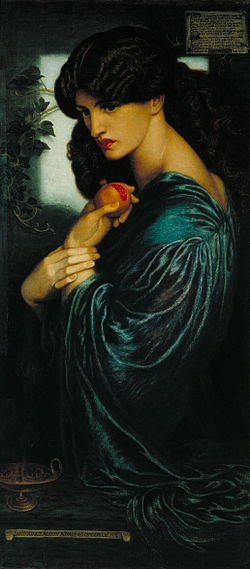
Proserpine, Dante Gabriel Rossetti (1874), Tate Britain — one of eight versions Rossetti painted; the model is Jane Morris, William Morris's wife, with whom Rossetti was conducting a passionate and impossible love affair; Proserpine (Persephone), queen of the underworld who longs for the upper world she can never fully re-enter, is Rossetti's emblem for the condition of impossible desire; the pomegranate she holds has sealed her in the underworld — each seed is a sentence of return

Beata Beatrix, Rossetti (1864-1870), Tate Britain — painted as a memorial to Elizabeth Siddal, who died of a laudanum overdose in 1862; the image fuses Dante's Beatrice at the moment of her death with Siddal herself, the model who had embodied the Pre-Raphaelite female ideal for a decade; the red dove (messenger of death) brings a poppy (opium, the substance of her death); Rossetti's grief and guilt permeate the painting's mystical sweetness

Lady Lilith, Rossetti (1868), Delaware Art Museum — the model is Fanny Cornforth, Rossetti's mistress; Lilith, Adam's first wife in Jewish mystical tradition, who refused submission and was cast out, is depicted as the type of dangerous, self-absorbed feminine beauty; Rossetti's Lilith combs her golden hair and gazes into a mirror, surrounded by white roses and poppies, indifferent to the power she exercises — the Pre-Raphaelite femme fatale, as opposed to the submissive Beatrice

The Hireling Shepherd, William Holman Hunt (1851), Manchester Art Gallery — painted entirely outdoors in the Surrey countryside, the saturated color and botanical detail are the purest expression of the PRB's naturalist program; the theological allegory (the shepherd neglects his flock for flirtation, as clergymen neglect their congregations for worldly distraction) is secondary to the painting's visual achievement: English summer light rendered with an intensity no studio painting could match

Ecce Ancilla Domini! (The Annunciation), Rossetti (1850), Tate Britain — the model for the Virgin is Rossetti's sister, the poet Christina Rossetti; the Annunciation depicted not as majestic encounter but as a frightening intrusion — Mary recoils in bed from the angel, her fear palpable; the white-on-white palette, the bare room, the angel's hovering feet, all create an image of vulnerability rather than glory; Rossetti shows the human cost of divine election

The Day Dream, Rossetti (1880), Victoria and Albert Museum — one of Rossetti's last great paintings; the model again is Jane Morris, her distinctive features — heavy brows, full lips, long neck — the face of the late Rossetti period; the honeysuckle she holds symbolizes devoted affection; the painting captures the Pre-Raphaelite ideal at its most distilled: a beautiful woman in a state of reverie, half in this world and half in another, the boundary between the sensory and the spiritual dissolved

Medea, Evelyn De Morgan (1889) — De Morgan was one of the most gifted painters associated with the later Pre-Raphaelite and Aesthetic movements; where the male Pre-Raphaelites painted women as objects of contemplation, De Morgan painted women as agents — Medea here is not the abandoned wife but the sorceress in full command of her power; De Morgan's spiritualism and theosophy gave her imagery a different metaphysical charge than Rossetti's erotic mysticism

Fair Rosamund, Arthur Hughes (1854) — Hughes was among the most tender of the Pre-Raphaelite associates; his Rosamund (mistress of Henry II, hidden in a labyrinthine bower to protect her from the queen) is depicted in the enclosed garden that is one of the tradition's persistent spaces — the hortus conclusus, the enclosed garden of medieval sacred iconography transformed into a space of romantic imprisonment; beauty and captivity, in the Pre-Raphaelite world, are rarely far apart


Comentarios