The Sphinx: Guardian of Sacred Thresholds and Hidden Wisdom

The Great Sphinx of Giza with the Pyramid of Khafre behind — the most ancient and iconic guardian of sacred thresholds in human history.
Across thousands of years and dozens of cultures, one figure has stood at the thresholds of the sacred — at the gates of temples, at the entrances of tombs, at the passages between the human world and the divine. The Sphinx — part human, part lion, sometimes winged, always formidable — is one of the most geographically and temporally distributed symbolic figures in the history of human civilization. From Egypt to Greece, from Mesopotamia to South Asia, from the banks of the Nile to the classical temples of Delphi and Corinth, the Sphinx has guarded the passage between the known and the unknown, the mortal and the immortal, the question and the answer.
She is, fundamentally, a guardian of thresholds — but she is also much more. In the Greek tradition, she is the questioner: the terrible creature who poses the riddle that must be answered before the passage can be made. In the Egyptian tradition, she is the silent keeper of cosmic secrets, sitting in eternal stillness between the pyramids and the rising sun, her face turned toward the east. In the esoteric tradition, she is the image of the mystery itself — the face of what cannot be known except through the transformation that the encounter brings about.
The Egyptian Sphinx: Keeper of the Solar Mystery
The most ancient and most imposing sphinx in human history sits at Giza, carved from the living bedrock of the Giza Plateau, facing due east toward the rising sun. The Great Sphinx of Giza — known in Arabic as Abu al-Hol, "Father of Terror" — is approximately 73 meters long and 20 meters high, the largest monolithic statue in the world and one of the oldest. While its precise date of construction remains debated, mainstream Egyptology attributes it to the reign of Pharaoh Khafre (c. 2558–2532 BCE), whose pyramid rises immediately behind it.
The Egyptian sphinx is a male figure — combining the human head (representing intelligence, royalty, and the divine) with the body of a lion (representing power, protection, and solar energy). The lion was one of the most powerful solar animals in Egyptian symbolism, associated with the sun god Ra and with the pharaoh as Ra's earthly embodiment. The sphinx thus represents the synthesis of human wisdom and leonine power in the person of the divine king — the pharaoh as living sphinx, as the guardian-at-the-threshold between human and divine orders.
The Sphinx at Giza faces east — toward the rising sun, toward the spring equinox sunrise (which, at the time of its construction, rose exactly between the Giza pyramids as seen from the Sphinx). This orientation is not incidental: it places the Sphinx at the cosmic threshold between darkness and light, between the night of death and the morning of resurrection, between the underworld through which the sun-god Ra traveled each night and the horizon from which he emerged reborn each dawn.

The Sphinx of Naxos (c. 570–560 BCE), dedicated at Delphi — a Greek winged sphinx seated on an Ionic column, guarding the oracle's sanctuary.
In the Dream Stele erected between the paws of the Great Sphinx by Pharaoh Thutmose IV (c. 1401 BCE), the Sphinx itself speaks: it appears to the young prince Thutmose in a dream and promises him the crown of Egypt if he will clear away the desert sand that has buried it up to its neck. This narrative is extraordinary in several respects: the Sphinx has a voice, a desire, a relationship of mutual obligation with the pharaoh. It is not merely a monument but a presence — a divine entity that communicates, that makes promises, that exists in a relationship with humanity. The sphinx-as-presence, not merely sphinx-as-symbol, is the deeper Egyptian understanding.
The Greek Sphinx: The Riddle That Must Be Answered
The Greek tradition gave the Sphinx a radically different character — and a female one. The Greek Sphinx (Σφίγξ — Sphinx, related to the verb sphingein, "to strangle" or "to bind tight") is a monstrous hybrid: woman's head, lion's body, eagle's wings, and sometimes a serpent's tail. She was sent — by Hera, or by Ares, or was simply born of the monster-couple Echidna and Typhon, or possibly Orthrus — to plague the city of Thebes, sitting on a rock outside the city gate and posing a riddle to every traveler who wished to pass.
Those who could not answer the riddle were devoured.
The riddle she posed is one of the most famous in history: What goes on four legs in the morning, two legs at noon, and three legs in the evening? The answer, famously provided by Oedipus, was: the human being — who crawls as an infant, walks upright as an adult, and uses a staff in old age. When Oedipus answered correctly, the Sphinx — according to most versions of the myth — threw herself from her rock and died.

*Oedipus and the Sphinx* by Jean-Auguste-Dominique Ingres (1808) — the hero calmly confronting the monster's riddle, his answer poised to destroy her.
The riddle is philosophically extraordinary in its answer. The Greek Sphinx does not ask about the cosmos, the gods, the nature of reality — she asks about the human being. And the answer that defeats her is self-knowledge — the very thing that the Delphic Oracle demanded of every visitor with its famous injunction: γνῶθι σεαυτόν (gnothi seauton), "Know thyself." The Sphinx's riddle is the riddle of what are you? — and the answer that saves you from being devoured is the honest, unflinching answer to that question.
There is a tragic irony in the myth that commentators have noted from antiquity: Oedipus answered the riddle correctly — he knew what a human being is — but he did not know what he himself was. He did not know he had killed his father and married his mother. The Sphinx who demanded self-knowledge was defeated by a man who lacked it in the most fundamental way. The oracle's demand was fulfilled in form but evaded in substance. This irony drives the entire tragic arc of the Oedipus cycle, and it suggests that the riddle of the Sphinx does not end with the correct verbal answer; the real answer is a life lived in genuine self-awareness, which Oedipus spent the rest of his life learning the hard way.
The Sphinx as Threshold Guardian Across Cultures
The sphinx archetype appears independently, or through cultural diffusion, in multiple ancient traditions, suggesting that the figure of the winged human-lion guardian at the passage between worlds touches something deep in the human symbolic imagination.
In Mesopotamia, the lamassu — colossal human-headed winged bulls and lions placed at the gates of Assyrian palaces and cities — served an analogous function to the sphinx. They were explicitly protective: their hybrid nature (combining human intelligence, bull strength or lion ferocity, and eagle flight) made them embodiments of comprehensive power capable of warding off any evil. The royal palaces of Ashurnasirpal II and Sargon II at Nimrud and Khorsabad were guarded by pairs of lamassu whose inscriptions describe their function as guardians against hostile forces.
In Persia, the sphinx appears in Achaemenid court art at Persepolis and in smaller luxury objects, where it combines the Egyptian and Mesopotamian traditions with distinctively Iranian elements. The Persian sphinx served similar guardian functions, positioned at the passages between rooms in the royal court.
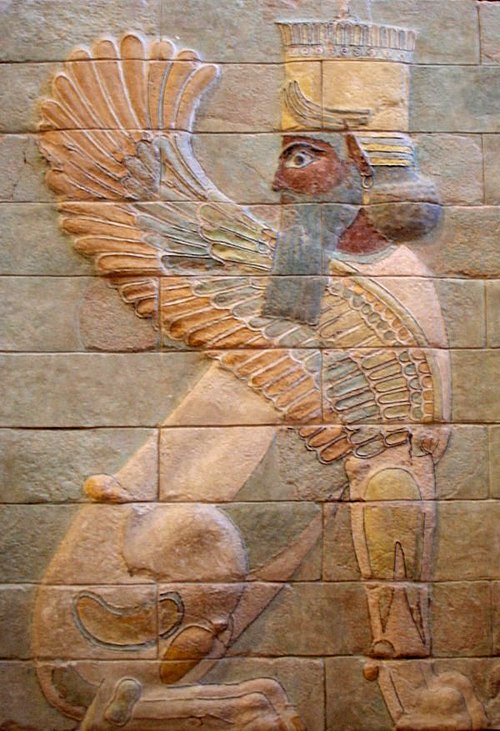
A sphinx from the palace of Darius I at Susa (6th–5th century BCE), now in the Louvre — the Achaemenid Persian sphinx combining Egyptian and Mesopotamian influences.
In South Asia, the vyala or sharabha — composite beasts combining human, lion, and other animal elements — appear in Hindu temple architecture as guardian figures at doorways and staircases, serving a function directly parallel to the sphinx in other traditions. The purusha-mriga (human-animal) figures of South Asian temple art are among the richest examples of the sphinx archetype's global spread.
In medieval Europe, the sphinx appears in the bestiary tradition — the illustrated encyclopedias of real and imaginary animals that served as both natural history and moral allegory — where it is typically interpreted as a symbol of the dual nature of Christ (human and divine) or of the deadly power of carnal temptation. The sphinx's female form and her devouring of those who fail her riddle made her an easy symbol of the dangers of sensuality in the Christian moral imagination. But even in this context, the sphinx remained at the threshold — now as a warning at the threshold of sin rather than a guardian at the threshold of the sacred.
The Sphinx in Esoteric and Occult Tradition
In the esoteric tradition of the nineteenth and twentieth centuries, the Sphinx became one of the central symbols of the occult mystery — the face of the divine secret that cannot be approached without the proper preparation of consciousness. The Hermetic Order of the Golden Dawn, Theosophy, and subsequent occult traditions all gave the Sphinx a central place in their symbolic vocabulary.
Eliphas Lévi, the French occultist whose work Dogme et Rituel de la Haute Magie (1854–1856) was foundational for modern Western esotericism, described the Sphinx as embodying the four essential qualities of the Magician: to Know (the human head — scire), to Will (the bull or lion body — velle), to Dare (the eagle's wings — audere), and to Keep Silent (the composite nature, the mystery — tacere). These four qualities — often rendered in Latin as the four powers of the Sphinx — became one of the most repeated formulas in Western occult practice.
The four animals of the Sphinx — human, lion, bull, eagle — correspond in this tradition to the four fixed signs of the zodiac (Aquarius, Leo, Taurus, Scorpio), to the four elements (air, fire, earth, water), to the four Evangelists of Christian tradition (Matthew's angel, Mark's lion, Luke's ox, John's eagle), and to the four cherubim of Ezekiel's vision. The Sphinx, in this reading, is the symbol of the quaternary wholeness of existence — the four fundamental dimensions of being, united in a single body that transcends any one of them.
Lévi's formula — to Know, to Will, to Dare, to Keep Silent — has been interpreted as a complete program of esoteric development. To Know is the work of study, of developing the intellect and understanding through engagement with the wisdom traditions. To Will is the work of the magical will — the capacity to direct one's energy toward a chosen aim with consistency and power. To Dare is the courage required to transgress the ordinary limits of the given world, to face the Sphinx's riddle without flinching. And to Keep Silent is perhaps the most important: the discipline of not speaking prematurely, not dissipating in words or display what has been won through interior work.
The Riddle of the Sphinx: A Perennial Question
The riddle that the Greek Sphinx posed to the travelers of Thebes — What goes on four legs in the morning, two at noon, three in the evening? — has continued to fascinate philosophers and psychologists as a compressed image of the human existential situation.
The riddle describes not merely the biological stages of a human life but the arc of consciousness through those stages. The infant on all fours is in the stage of undifferentiated animal consciousness — in contact with the earth, not yet upright, not yet individuated. The adult walking on two legs represents the stage of mature human consciousness — individuated, upright, oriented toward the horizon, capable of reason and ethical action. The elder with the staff represents the third stage — a consciousness that has learned the necessity of support, that has integrated its limitation, that moves with a third point of contact with the earth as a sign not of weakness but of wisdom.
Read this way, the Sphinx's riddle is not simply a factual question with a clever answer; it is an initiation question — the question whose answer requires genuine self-knowledge to give. You cannot answer it truly unless you have honestly faced what you are in each of these stages, unless you have looked at yourself as infant, as adult, as elder — and recognized yourself in all three. The riddle demands the contemplation of your own mortality, your own temporal dimension, your own embodied nature moving through time toward death.
This is why Oedipus's answer, though technically correct, was not the full answer: he gave the verbal formula without the self-knowledge the formula presupposes. The Sphinx was defeated but the mystery remained — and it returned to destroy Oedipus through the discovery of what he had most refused to know about himself.
The Sphinx and the Unconscious: Jung's Reading
Carl Jung was deeply interested in the Sphinx as a symbol of the unconscious — the aspect of the psyche that poses questions that the ego cannot answer from within its own perspective. In Jungian terms, the Sphinx at the gate of Thebes is an image of the unconscious confronting consciousness with a question whose answer cannot be found in the library of the known, but only through genuine self-examination.
The devouring that results from failure to answer the riddle is, in this reading, the psychic fate of those who encounter the unconscious without the proper preparation: they are overwhelmed — devoured — by what they cannot integrate. The psychotic break, the depression that cannot be metabolized, the complex that takes over the personality — these are the mythological devouring of the Sphinx. The conscious encounter with the unconscious, guided by the willingness to face the riddle honestly, is what makes the difference between integration and destruction.
Jung also noted the connection between the Sphinx and the Great Mother archetype — the terrible, devouring aspect of the maternal that appears in many mythological figures (Medusa, Kali, the Gorgons, Scylla). The Sphinx who devours those who cannot answer is the negative face of the Great Mother: she who sustains life also takes it back, and the taking is not random but conditional — it depends on whether the traveler can pass the test of self-knowledge.
The Silence of the Sphinx: Mystery as Teacher
Perhaps the most profound dimension of the Sphinx archetype — and the one that makes it irreducible to any single cultural tradition — is its fundamental silence. The Egyptian Sphinx is silent; it neither speaks nor moves (except in myths and dreams, where it communicates with those who are properly prepared to receive its message). It simply sits, facing the rising sun, at the passage between the world of the living and the world of the dead.
This silence is not absence but presence. It is the silence of the mystery itself — which does not explain itself but simply is, waiting for the consciousness that can bear to encounter it without demanding that it immediately resolve into something familiar. The esoteric tradition has always understood that the deepest truths cannot be transmitted in words alone; they require an encounter, an initiation, a transformation of the receiver before the message can be received.
The Sphinx at the threshold is the image of this requirement. You cannot pass without answering. You cannot answer without knowing yourself. You cannot know yourself without being willing to face what is most difficult about your own nature — your mortality, your limitation, your passage through time, your embodied animal nature that is also your divine nature. The Sphinx does not guard the threshold to prevent passage; she guards it to ensure that those who pass are ready.
In the esoteric formula of Lévi — to Know, to Will, to Dare, to Keep Silent — the final quality, silence, is the Sphinx's own. The mystery does not announce itself. It sits in silence at every threshold of genuine transformation, waiting for the question that precedes the answer, waiting for the seeker who has grown quiet enough to hear.
Conclusion: The Question That Transforms
The Sphinx endures as one of the most powerful symbols in human culture because she embodies the experience that every genuine seeker knows: the encounter with a threshold that cannot be crossed by force or cleverness alone, but only by a genuine willingness to face the question What are you? — and to give an honest answer.
She is the guardian not of treasure but of transformation — not of a secret that can be stolen but of a process that must be undergone. The riddle she poses is always, in its deepest form, the same riddle: Do you know yourself well enough to pass? And the answer is never simply yes or no — it is the ongoing work of a lifetime, the gradual clearing of the sand that buries the face of the Sphinx within us, the patient turning of our gaze toward the east, toward the light that rises each morning and that we spend our lives learning to face.
— Lux Esoterica


Comentarios