The Tengu: Mountain Lords of Japan, Martial Masters, and the Demons Who Guard the Sacred High Places

Kobayakawa Takakage debating with the Tengu of Mount Hiko - Tsukioka Yoshitoshi, 19th century. The encounter between a great warrior and the mountain spirit that tests him: the Tengu as adversary, judge, and ultimately as the supreme teacher of martial wisdom and spiritual power.
In the high mountains of Japan - the cloud-wrapped peaks where Buddhist hermits built their retreats and Shinto shrines clung to cliff faces, where the air was cold and thin and the distance from the ordinary human world was measurable in more than meters - something lived that was not a god, not a demon, not a human being, and not quite any of these. It had the wings of a great bird, the face of a crow or an enormously long-nosed man depending on how it chose to appear, the temperament of a supreme master who has been offended, and the power to teach - or to destroy - anyone who entered its domain.
The Tengu ( , literally "heavenly dog," though the connection to dogs is more etymological than visual) is one of the most complex and most distinctly Japanese of all supernatural beings: a y kai (supernatural entity) that has evolved over more than a thousand years from a simple malevolent spirit into a figure of profound ambiguity - simultaneously a danger and a teacher, a guardian of the sacred mountain and a punisher of religious pretension, a figure that the tradition has never quite settled, because it refuses to be settled.
The Two Forms: Crow Tengu and the Long-Nosed Masters
The Tengu tradition distinguishes between two primary types, which represent something like a hierarchy within the order:
The Karasu-Tengu ("crow tengu") is the older and more explicitly birdlike form: a creature with the head and wings of a crow, taloned feet, and a humanoid body. The karasu-tengu are the rank-and-file of the Tengu world - numerous, powerful, dangerous, but not at the apex. They are the foot soldiers of the mountain, the spirits that attack unwary travelers, that abduct children and arrogant monks, that serve as attendants to the greater Tengu lords.

Karasu-Tengu (Crow Tengu) statue - late Edo period. The older and more purely bird-like form of the Tengu: the head of a crow, wings, taloned feet, the concentrated intensity of a being that inhabits the highest altitudes and has no patience for human weakness or spiritual fraud.
The Daitengu ("great tengu") are the lords: humanoid in form, dressed in the robes of a mountain ascetic (yamabushi), carrying a fan of feathers or a monk's staff (shakuj ), and distinguished by the feature that has become the Tengu's most recognizable attribute in popular imagination - an enormously long nose, often bright red, that extends from the face like a beak transformed. These great Tengu are beings of immense power and ancient wisdom, each associated with a specific sacred mountain, each possessing a name and a history and a personality.
The most famous Daitengu include S j b ** of Mount Kurama (north of Kyoto), Tar b ** of Atago-san, and Jir b ** of Hira-san** - each ruling over their mountain domain with absolute authority, each capable of helping or destroying any human who enters their territory, depending entirely on the quality of what the human brings to the encounter.
The Tengu in Japanese History: Disorder, Abduction, and Political Metaphor
The earliest Japanese texts describe Tengu in almost entirely negative terms. The Nihon Shoki (720 CE), one of Japan's two oldest chronicles, records a Tengu in a single, ominous entry: a great shooting star that passed through the sky in 637 CE, which a Buddhist monk identified as a "heavenly dog" (tien-kou in Chinese, tengu in Japanese). This identification linked the Tengu, from the beginning, to unpredictable celestial events and to the disruption of normal order.
Through the Heian period (794-1185) and into the Kamakura period (1185-1333), Tengu accumulated associations with the chaos of political and military upheaval. They were blamed for abductions (kamikakushi, "hidden by the gods") - cases in which a person disappeared from the human world and returned, days or years later, changed: speaking strangely, behaving oddly, sometimes with gaps in memory and sometimes with extraordinary knowledge or skill they could not previously explain.

Tengu - from Toriyama Sekien's Gazu Hyakki Yak ("The Illustrated Night Parade of One Hundred Demons"), 1776. Sekien's encyclopedic cataloguing of y kai gave many supernatural beings their definitive visual form in the popular imagination; his Tengu is shown in its kite-like aspect, the transition between fully bird and fully humanoid form.
Politically, Tengu became associated with the spirits of those who died consumed by rage, jealousy, or frustrated ambition - particularly warriors and aristocrats whose powerful desires and thwarted plans left their spirits unable to rest. The Heike Monogatari and related medieval chronicles are full of dead warriors whose resentful spirits became Tengu, haunting the battlefields and mountain passes where their ambitions died. The monk Ry gen of Mount Hiei, a historical figure famous for his fierce intelligence and institutional ruthlessness, was posthumously imagined as having become a powerful and malevolent Tengu - a transformation that the tradition understood as the logical consequence of religious pride combined with worldly ambition.
Yoshitsune and S j b : The Supreme Martial Education
The Tengu's transformation from purely malevolent being to ambiguous teacher-figure reaches its most celebrated expression in the legend of Minamoto no Yoshitsune (1159-1189), one of the great heroes of Japanese military history and one of the most beloved figures in Japanese cultural memory.
The legend (told in various versions from the medieval period onward) holds that the young Yoshitsune, called Ushiwakamaru in his childhood, was raised at Kurama Temple north of Kyoto after his father's defeat and execution. On the mountain, the boy was secretly found by S j b , king of the Tengu, who recognized in him the potential for a great warrior - and proceeded to train him in swordsmanship, strategy, and the arts of combat that would make him, in adulthood, the most brilliant military commander of his era.

Ushiwakamaru (the young Yoshitsune) training with the Tengu of Mount Kurama - Utagawa Kunitsuna, 19th century. The Tengu as supreme master: the boy who will become Japan's greatest military hero receives his martial education from the mountain spirit, learning what no human teacher could have taught.
The Yoshitsune-Tengu legend crystallizes the creature's ambiguity in its most productive form. The Tengu is not simply dangerous here - it is the supreme teacher, the one whose knowledge exceeds anything the human world can offer, the master of the mountain arts that combine physical prowess with spiritual insight. To be trained by a Tengu is to receive an education that transcends the ordinary - to learn not merely technique but the deeper principles that make extraordinary ability possible.
The historical Yoshitsune's military genius - his brilliant, unconventional tactics that devastated the Taira clan forces in the Genpei War (1180-1185) - was so far beyond ordinary military capacity that the legend of Tengu training made it comprehensible. How else could a young man who had been raised in a temple, without conventional warrior training, become one of the most naturally gifted military commanders in Japanese history? The Tengu training is the mythological answer: his knowledge came from a source that transcends ordinary human pedagogy.
Tengu and Religion: The Punishment of Spiritual Pride
The Tengu's most consistent theological function in the Japanese tradition is as the punisher of religious pretension - the being that specifically targets monks, priests, and other religious figures who practice Buddhism or Shinto for the wrong reasons: for fame, for power, for institutional advancement, for the satisfaction of the ego rather than the liberation of the spirit.
The word Tengu is sometimes glossed as an abbreviation of teng * - "heavenly arrogance" - and this etymology, whether etymologically accurate or not, captures the traditional understanding perfectly. The Tengu is associated with m na* in Buddhist terminology: spiritual pride, the inflation of the self through religious achievement. A monk who becomes proud of his learning, a practitioner who uses spiritual attainments to impress others, a religious leader who confuses institutional authority with genuine wisdom - all of these are prime targets for Tengu mischief.
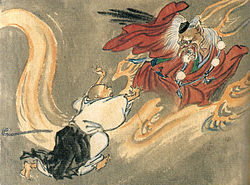
Tengu and a Buddhist monk - Kawanabe Ky sai, 19th century. The classic encounter: the Tengu as mirror of religious pride, the being that exposes what is false in the religious persona. Whether the monk survives the encounter with his spiritual pretensions intact depends entirely on his capacity for genuine humility.
In the *Konjaku Monogatarish * (Tales of Times Now Past, c. 1120 CE), one of the great medieval collections of Buddhist stories, Tengu appear repeatedly as the agents of disruption for the religiously arrogant. They lead astray the monk who is too proud of his learning, appearing to him in the form of a great teacher who feeds his pride until his spiritual path is entirely corrupted. They torment the priest who has accumulated institutional power without genuine practice. They abduct and disorient the practitioner who mistakes knowledge about enlightenment for the thing itself.
The teaching is precise: the mountain does not care about your reputation. The sacred high places that the Tengu inhabit are zones where ordinary social hierarchies - the prestige of temples, the ranking of monks, the weight of institutional authority - simply do not apply. What the Tengu responds to is the quality of the spirit, not the size of the reputation. And a large reputation built on a hollow spirit is precisely the kind of target the Tengu most enjoys deflating.
The Tengu Mask and Living Tradition
The Tengu is not merely a historical or literary figure. It remains a living presence in Japanese religious and folk culture, expressed through one of the most instantly recognizable icons in the visual tradition: the Tengu mask (tengu-men), with its extravagant nose, fierce eyes, and archaic expression.
Tengu masks appear in Noh theater (where the Tengu is a character type), in Kagura and Matsuri festival performances, at mountain shrines (particularly in the Shugendo tradition of mountain asceticism, which has always maintained an intimate relationship with the Tengu as the spirit of the sacred peaks), and in household decoration as a protective charm - for the Tengu's fierce, watchful energy, properly oriented, is understood as a force that drives away lesser malevolent spirits.

A Tengu mask representing the deity Sarutahiko at the Menkake Gy retsu festival. The Tengu and the ancient Shinto deity of crossroads share the long-nosed form: both figures preside over thresholds, both possess a fiercely watchful energy, both are associated with the sacred paths that cross between the human and the divine.
The Shugendo practitioners - yamabushi, literally "those who lie in the mountains" - are the religious figures most intimately associated with the Tengu. The yamabushi's traditional costume (the small black cap, the conch shell trumpet, the distinctive robes) overlaps significantly with the Daitengu's visual attributes, suggesting a historical symbiosis: the human practitioners of mountain asceticism were perceived as occupying the same spiritual space as the Tengu, and the Tengu were perceived as the spiritual masters of the mountains that the yamabushi sought to know.
In contemporary Japan, the Tengu remains extremely present in popular culture - in anime, manga, video games, and film, where it has undergone its latest transformation, often appearing as a figure of profound and dangerous power who serves as antagonist, mentor, or both simultaneously to human protagonists. The contemporary Tengu is almost invariably the most powerful being in any room it enters, and the most likely to behave in ways that confound ordinary moral categories.
The Esoteric Tengu: Pride as the Shadow of Spiritual Power
The Tengu's deepest theological significance is as the shadow of spiritual achievement: the being that appears when genuine power is acquired but is not accompanied by genuine humility. It is not accident that the Tengu's primary victims are not ordinary people - farmers, merchants, children - but religious practitioners. The danger is specifically concentrated at the intersection of real spiritual power and unexamined ego.
This is a profound insight that the Buddhist tradition articulates in multiple contexts: the stages of spiritual development that produce real power - the concentration of meditation, the insight of wisdom, the skillful means of compassionate action - are precisely the stages where the ego, finding itself capable of more and more, is most tempted to identify with its capacities rather than remaining in their service. The practitioner who achieves something real is more at risk, in this sense, than the one who has achieved nothing - because the one who has achieved nothing has nothing to be proud of.
The Tengu is the mythological figure of this risk: the long nose that grows longer with every pretension, the fierce wings that beat harder when they punish the proud, the master's knowledge that is offered to the genuine seeker and withheld - or weaponized - against the pretender. To pass through the Tengu's domain without harm, the tradition suggests, you must come with genuine purpose, genuine humility, and the willingness to be taught rather than the desire to be admired. The Tengu sees through the performance immediately. What it responds to is the thing underneath.
The mountains are still there. The sacred peaks of Japan still hold their shrines, still draw their pilgrims, still rise above the ordinary world into the realm where the air is cold and the distance from the village makes spiritual pretension obvious. And somewhere in the old trees near the summit, if you have come with genuine purpose rather than ego - you may encounter something that decides whether you deserve what you came for.
-
- Lux Esoterica*


Comentarios